Google Algorithm Updates: Latest News and Full History
Live rollout status and the complete, sourced history of Google core, spam and ranking updates.
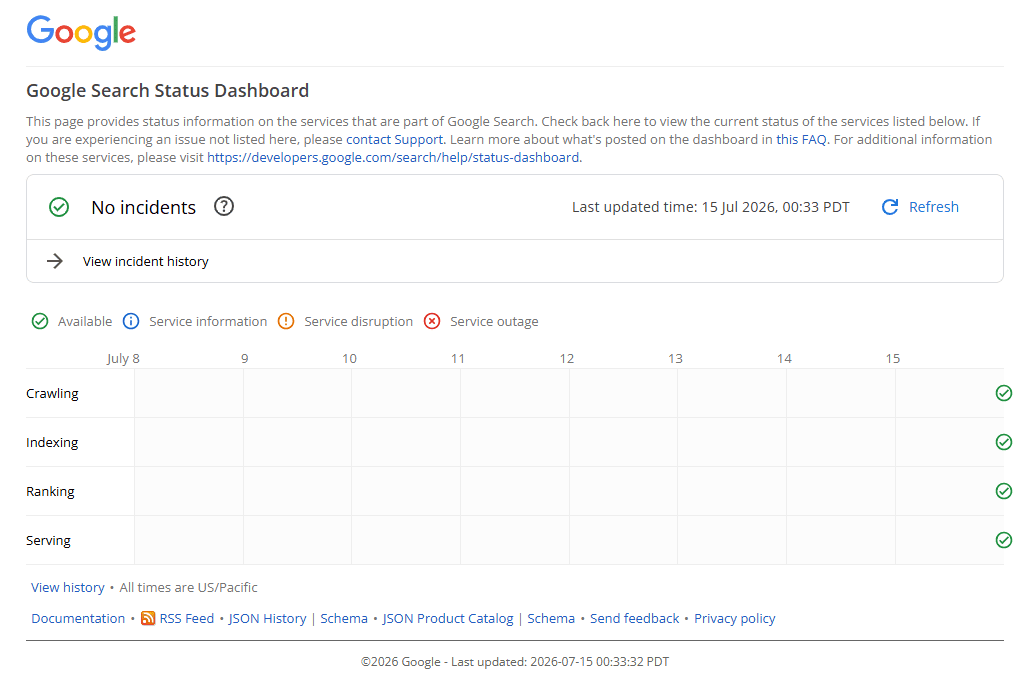
Last updated: Last checked: No confirmed Google update is rolling out right now
25Confirmed updates since 2023Search Status Dashboard era
5Confirmed updates in 2026Two core, two spam, one Discover
19.5 hrsFastest rollout on recordMarch 2026 spam update
45 daysLongest rollout on recordMarch 2024 core update
This page tracks every ranking update Google confirms, as it happens. The answer to "is Google updating right now?" is in the status chip above; the table below is the full dashboard-era history, and the section further down covers the named majors back to Panda in 2011. Every row links to a primary source. Google has said core updates happen "several times a year"; the observed cadence since 2023 is three to five confirmed updates a year, and 2026 has already had five entries in six months.
Google update history: the dashboard era (2023 to today)
Everything Google has confirmed on its Search Status Dashboard since January 2023, newest first. Durations are Google's own. For Panda, Penguin, Medic, BERT and the other pre-dashboard majors, see the earlier history below.
One dot per update over the last 10 years: the full dashboard era plus the named majors before it. Hollow dots are community-named updates Google never confirmed. Hover a dot for the name and date; the tables below have every detail.
June 2026 spam update finishes rolling out in about 2 days
Google released the June 2026 spam update on June 24 and marked it complete on June 26, a 2-day, 1-hour rollout that continues the much faster spam deployments Google has shipped since March. Google described it as "a normal spam update" applying globally and to all languages, and confirmed it does not specifically target link spam or the site reputation abuse policy. Sites that were demoted should expect recovery, if earned, to take months rather than days.
May 2026 core update completes after a volatile 12-day rollout
The May 2026 core update, which began May 21, completed on June 2 after 11 days and 21 hours. Search Engine Roundtable called it "a big one, causing a lot of search ranking volatility", with tracker spikes around May 23, May 30 and the final 24 hours of the rollout. It was a standard broad core update, the second of 2026, with Google pointing to its usual guidance on core updates rather than any specific target.
March 2026 core update completes; Mueller explains staged rollouts
The March 2026 core update began on March 27, three days after the March spam update completed, and finished on April 8 (12 days, 4 hours). During the rollout, Google's John Mueller addressed why volatility comes in waves: "We generally don't announce 'stages' of core updates... sometimes they have to work step-by-step, rather than all at one time", adding that there is no single "core update machine" being switched on.
March 2026 spam update completes in a record 19.5 hours
Google's March 2026 spam update completed in 19 hours and 30 minutes, the fastest rollout of any update documented on the Search Status Dashboard since it launched. For comparison, the August 2025 spam update took over 26 days. The speed was widely read as evidence that Google's spam systems can now deploy globally in a single push rather than the multi-week rollouts of 2024 and 2025.
First-ever Discover core update completes (US English only)
Google completed the February 2026 Discover core update on February 27 after roughly three weeks. It is the first core update scoped to Discover rather than Search: per Google, it was "released... for English language users in the US (will look to expand it to all countries and languages in the future)" and "is designed to improve the quality of Discover overall." As of early July 2026 Google has not announced an expansion beyond US English.
The December 2025 core update rolled out from December 11 to December 29 (18 days, 2 hours), closing a year with three core updates (March, June, December) and one spam update (August). Google flagged at release that the rollout "may take up to 3 weeks", and it nearly did.
What is a Google core update?
A core update is a broad change to Google's main ranking systems, released "several times a year" and announced on the Search Status Dashboard. Unlike spam updates, core updates do not target specific sites or violations. Google describes them as a reassessment of how its systems weigh content overall, which is why pages can gain or lose visibility without having changed anything themselves.
Rollouts typically take one to three weeks. The extremes so far: the March 2024 core update ran 45 days, while spam updates have become dramatically faster (the March 2026 spam update finished in under 20 hours). Volatility usually comes in waves during the rollout rather than on day one, and Google has confirmed that core updates can deploy "step-by-step, rather than all at one time".
Core vs spam vs the other update types
Core updates are broad quality reassessments; there is nothing specific to "fix" and Google's advice is to keep improving content helpfulness overall. Spam updates improve SpamBrain and related automated detection; sites demoted by one have a concrete policy violation to address, and Google says recovery "can take many months". Helpful content updates existed as standalone releases from August 2022 to September 2023, after which the system merged into core ranking with the March 2024 core update. Reviews updates were announced through November 2023; since then the reviews system changes continuously without announcements. And since February 2026 there is a new species, the Discover core update, scoped to the Discover feed rather than Search results.
Update history before the dashboard era (2011 to 2022)
Before the Search Status Dashboard, updates were announced (or discovered and named by the community) less formally. These are the majors every SEO should know. Community-named updates that Google never officially confirmed are marked.
Community-named local ranking shakeup filtering same-area listings
RankBrain (confirmed)
Machine-learning system for interpreting queries, confirmed as a top ranking signal
Mobile-friendly update ("Mobilegeddon")
Mobile-friendliness became a ranking signal on mobile searches
HTTPS ranking boost
HTTPS became a lightweight positive ranking signal
Pigeon (community name)
Local results tied more closely to traditional web ranking signals
Hummingbird
Rewrite of the core ranking engine for conversational and semantic queries
Penguin
Crackdown on link schemes and webspam; recovery required cleaning link profiles
Freshness update
Expanded query-deserves-freshness ranking; Google said it noticeably affected ~35% of searches
Panda
Content-quality classifier against thin, low-value content; later absorbed into core
Recovering from a Google core update
Google's own guidance is deliberately unexciting: a drop after a core update usually does not mean something is "broken" to fix. Its systems reassessed content overall, and other pages are now judged more helpful for those queries. The realistic playbook:
Confirm the update actually caused it. Compare your traffic dates against the rollout dates in the history table. A drop that started outside a rollout window has a different cause.
Assess the pages that lost, not the site in the abstract. Google's published self-assessment questions (originality, first-hand expertise, completeness, presentation, people-first intent) are the actual rubric to audit against.
Expect recovery on core-update timescales. Meaningful recoveries tend to appear at subsequent core updates rather than gradually; partial improvement between updates is possible but modest. For spam updates, Google said in June 2026 that recovery "can take many months".
Do not chase the update. Removing content wholesale or rewriting everything in a panic routinely makes things worse. Improve or consolidate the weakest content, demonstrate real experience, and wait for the next reassessment.
YMYL, E-E-A-T and the quality rater guidelines
YMYL ("Your Money or Your Life") is Google's label for topics that can significantly affect a person's health, finances, safety or wellbeing. YMYL pages are held to the highest quality bar, which is why health and finance sites feel core updates (Medic in 2018 being the canonical example) more sharply than most.
E-E-A-T stands for Experience, Expertise, Authoritativeness and Trustworthiness, the framework Google's human quality raters use to evaluate results. The extra "E" for first-hand experience was added in December 2022. Important nuance: raters and the quality rater guidelines do not directly change any page's rankings. Rater judgments are used to evaluate and train the ranking systems; E-E-A-T is a description of what those systems are tuned to reward, not a score your site carries.
Frequently asked questions
Did Google update today?
The live status at the top of this page says whether a confirmed update is rolling out right now, and the history table shows the most recent completed one. Google confirms updates only on its Search Status Dashboard; ranking volatility without a dashboard entry is unconfirmed, however loud the chatter.
How often does Google release core updates?
Google says "several times a year". Observed: four core updates in 2023, four in 2024, three in 2025, and two in the first half of 2026 (March and May), alongside spam and other updates.
How long does a Google update take to roll out?
Core updates typically take one to three weeks. The recorded extremes are 45 days (March 2024 core) and 19.5 hours (March 2026 spam, the fastest ever). Google announces both the start and completion on the dashboard.
What was the Google Medic update?
Medic is the community name for the August 1, 2018 broad core update, which hit health, medical and other YMYL sites unusually hard. Google never adopted the name; it was an ordinary (if large) core update by its account, and it is why E-E-A-T discussion took off in the SEO industry.
How do I recover from a core update?
Audit the pages that lost visibility against Google's published self-assessment questions, improve genuine helpfulness and first-hand experience, and expect measurable recovery around subsequent core updates rather than immediately. See the recovery section above for the full playbook.
What is the difference between a core update and a spam update?
A core update is a broad reassessment of how content is ranked; nothing specific is targeted and there may be nothing to "fix". A spam update improves Google's automated spam detection (SpamBrain); being hit by one indicates a policy violation to identify and address, and recovery takes months.
Spotted a change we have not covered? Ranking volatility, a new SERP test, a platform change: email us a tip and we will credit you if we cover it.
Cite this page:Keywords Everywhere, "Google Algorithm Updates: Latest News and Full History", last updated 7th Jul 2026, https://keywordseverywhere.com/news/google-algorithm-updates/
Our website employs cookies and other tracking technologies to enhance your browsing experience by
enabling essential website functionalities, improving your overall experience, gauging your interest
in our products and services, personalizing marketing interactions, and delivering advertisements
that are more pertinent to you.
Cookie Preferences Center
We Value Your Privacy
Cookies are small text files placed on your computer when you access a website. We
utilize cookies for multiple purposes to enhance your online experience on our site,
such as remembering your account login information.
You have the option to adjust your preferences and refuse specific types of cookies
from being stored on your computer while navigating our website. Additionally, you
can delete any cookies already present on your device, but note that removing
cookies might restrict your ability to use certain features of our website.
Essential Cookies
These essential cookies are required to deliver the services offered on our website
and to allow you to utilize specific features.
Without these cookies, we are unable to offer you certain services on our
website.
Permanently Enabled
Functionality Cookies
These cookies are utilized to offer a more personalized experience on our site and to
recall the preferences you set during your visits.
For instance, we may employ functionality cookies to save your preferences
or retain your login information.
Disabled
Tracking Cookies
These cookies gather information to analyze website traffic and understand how
visitors interact with our site.
For example, these cookies may monitor the duration of your visits and the pages you
view, aiding us in enhancing our website for your benefit.
The data collected via these tracking and performance cookies does not identify
individual visitors.
Disabled
Targeting and Advertising Cookies
These cookies are utilized to display advertisements that are likely to interest you
based on your browsing behavior.
These cookies, provided by our content and/or advertising partners, may merge
information gathered from our website with other data they've independently
collected about your web browser's activities across their network of websites.
If you opt to remove or disable these targeting or advertising cookies, you will
continue to see advertisements, but they may not be tailored to your interests.
Disabled
More Information
For any questions regarding our cookie policy and your choices, please contact
us.