

See the Search Volume Behind Google Trends
Does Google Trends show search volume?
Not on its own. Google Trends shows relative interest: a score from 0 to 100, where 100 is the point in time when a keyword was most popular.
It tells you the shape of demand, but never the actual number of searches. So a term sitting at "50" could be a few hundred searches a month or a few hundred thousand, and there is no way to tell which.
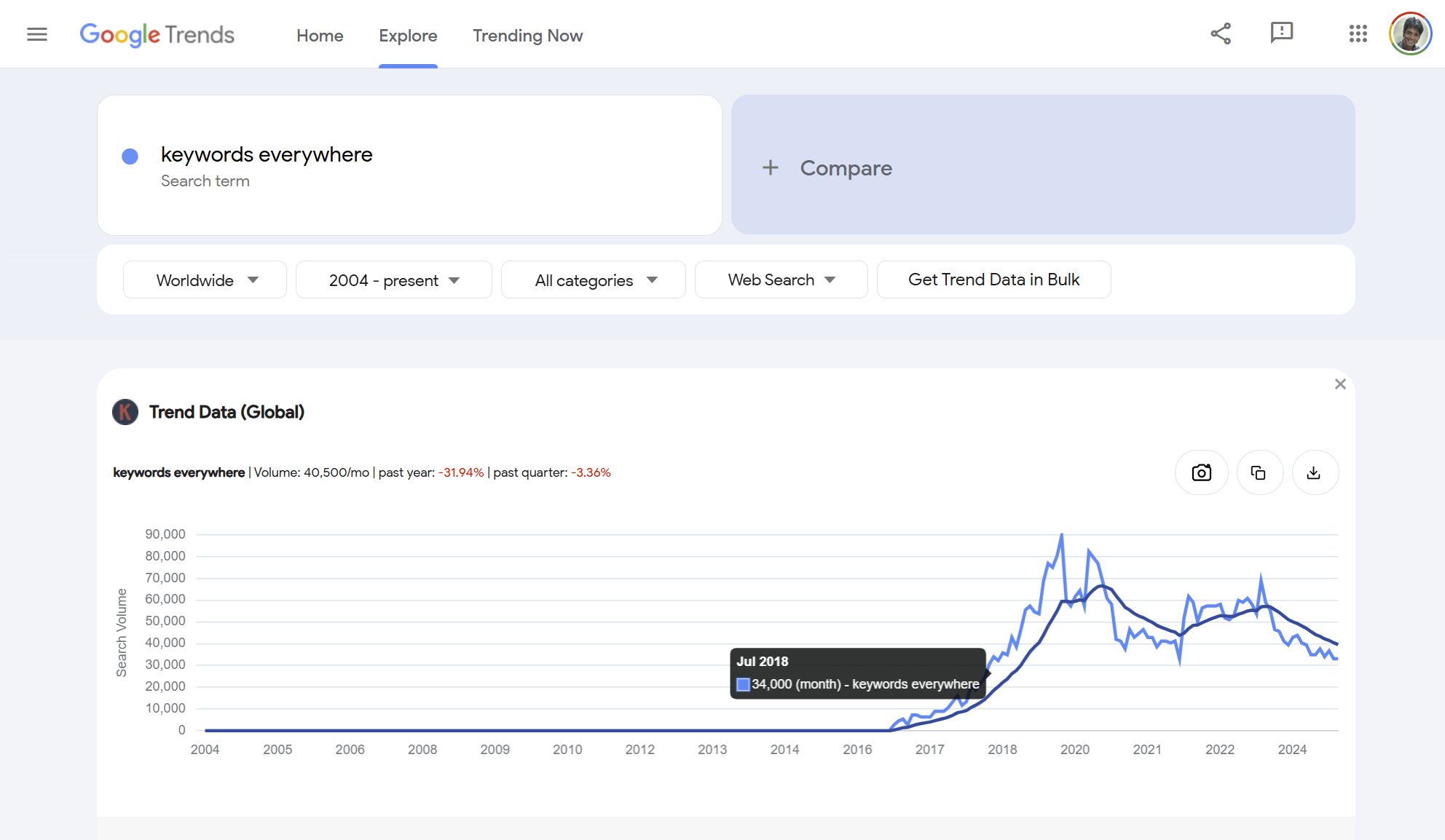
Keywords Everywhere fixes that. It overlays the estimated monthly search volume onto the Google Trends chart, so the 0 to 100 index becomes search-volume numbers you can compare.
The estimate is built from Google's own Keyword Planner data, the same source Google gives advertisers, scaled across the trend line.
That means you can read the estimated volume behind the trend line, compare the search volume of several keywords at once, and see the numbers for every related query Google Trends lists. Here is what changes once the extension is installed.
Google Trends interest vs actual search volume
| On its own, Google Trends shows | With Keywords Everywhere you also see |
|---|---|
| Interest over time as a 0 to 100 score, where 100 is the keyword's peak. | The estimated monthly search volume behind every point on the line. |
| A comparison of up to 5 terms as relative lines, all measured against the single highest point. | The monthly volume for each term, so you compare scale, not just the shape. |
| Related queries as a plain list of top and rising searches. | Search volume, CPC and competition for all 25 related queries. |
Three features added to Google Trends
Historical Search Volume Trend
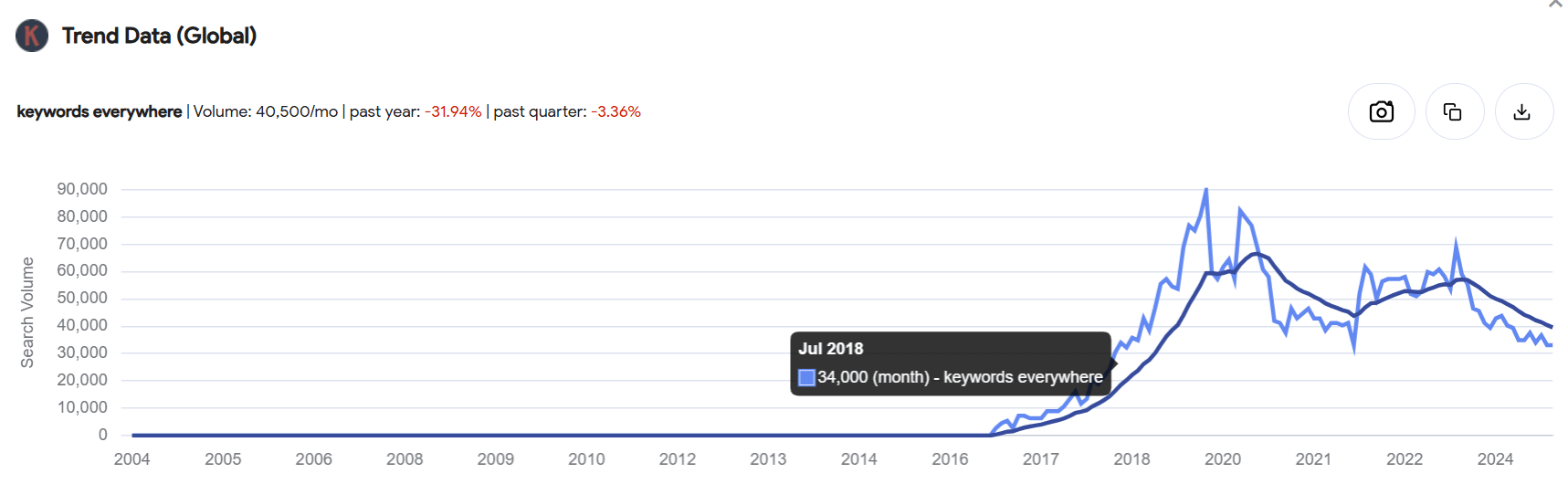
Keywords Everywhere overlays the estimated monthly search volume onto the Google Trends chart, so you can read the numbers behind the trend line, all the way back to 2004.
Compare Volumes Across Multiple Searches
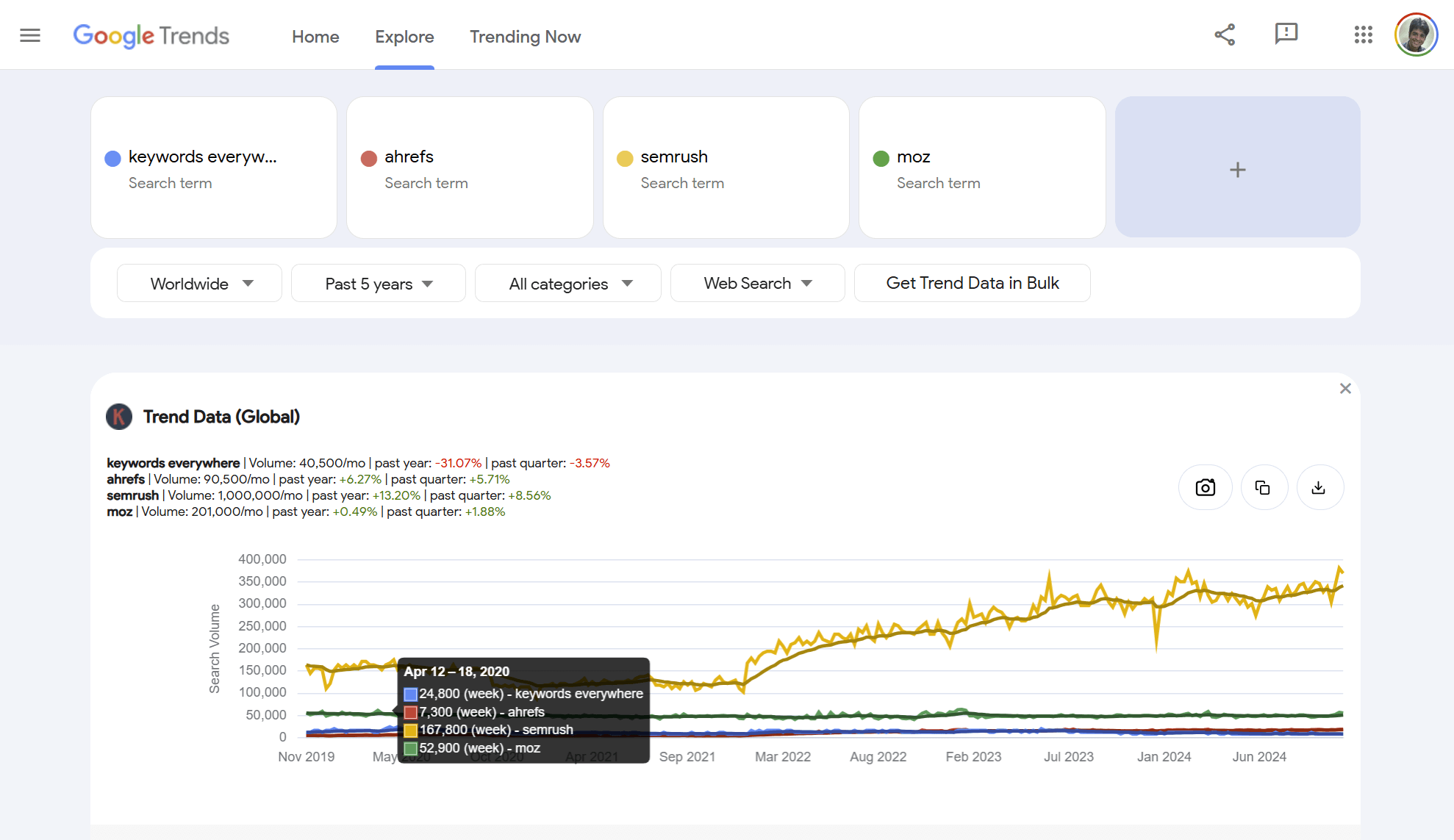
Compare several search queries together and you see the historical search volume trend for each one.
Having a volume estimate for each one is far more useful than comparing relative interest alone, where a flat-looking line could still be thousands of searches a month.
Volume, CPC & Trend Data for Related Queries
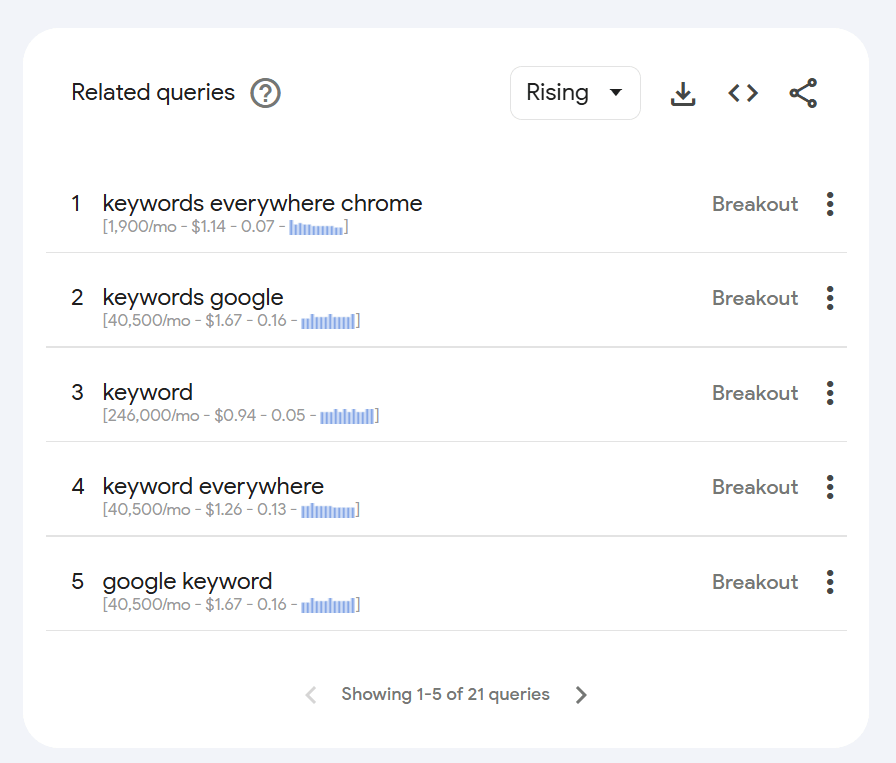
See the search volume, CPC, competition and trend data for all 25 related search queries that Google Trends lists at the bottom of the page.
Questions you may have
Does Google Trends show search volume?
Google Trends does not show actual search volume on its own. It shows relative interest, a score from 0 to 100 where 100 is the moment a keyword was most popular in the period and region you picked. Keywords Everywhere adds an estimated monthly search volume to the Google Trends chart, so you see the likely number of searches behind the line, not just its shape.
What does the number on Google Trends mean?
The 0 to 100 number is a relative popularity score, not a count of searches. 100 marks the keyword's peak for the time range and location you selected, 50 means it was half as popular as that peak, and 0 means there was not enough data. Because it is relative, the same keyword can show a different curve if you change the date range or country. To turn that score into concrete numbers, Keywords Everywhere shows an estimated monthly search volume alongside it.
How do I see the actual search volume on Google Trends?
Install the Keywords Everywhere extension for Chrome, Firefox or Edge, then open Google Trends as usual. An estimated monthly search volume appears on the trend chart, and the related queries show their Google Keyword Planner volume, so the 0 to 100 index is replaced with figures you can use. The data comes from Google Keyword Planner, the same source Google gives advertisers.
Can I compare the search volume of two keywords?
Yes. Google Trends lets you compare up to 5 terms, but it only draws them as relative lines measured against the single highest point, so a term that looks flat at the bottom could still be thousands of searches a month. Keywords Everywhere shows a monthly volume for each term, so you can compare their scale, not just their shape. You can also paste a whole list of keywords into the extension and get the volume for every one at once.
How do I find trending keywords?
Keywords Everywhere shows a Trending Keywords widget on the Google search results page. It lists keywords related to your search that are climbing right now and adds a Trending % column showing how much each one has grown over the last 30 days, using Google Trends data. It is a quick way to catch rising topics before they peak.
Is the Google Trends search volume data free?
Google Trends itself is free, and the Keywords Everywhere extension is free to install. The search volume numbers are a paid feature: you buy credits, and one credit returns the data for one keyword. Credits start at a low annual price and there are no monthly plans. You can also look up the monthly volume for a small batch of keywords for free with our Search Volume Checker tool.



Already installed? Sign up for an API key here
I love this tool. How can I help?
It would be awesome if you could write a review & share us through your favorite social network. We would love any help to get the word out.