
What are organic keywords?
Organic keywords are the search terms a page or website ranks for in Google's free results, the listings below the ads. Every keyword a site ranks for sends it some traffic, month after month, without paying for clicks.
Knowing which organic keywords a site ranks for, and how much traffic each one brings, tells you what is really driving its visitors. It is the fastest way to size up a competitor or spot the keywords worth targeting yourself.
Keywords Everywhere shows you the organic keywords for any URL or website, right on the Google results page, with an estimate of the traffic behind each one.
Want a quick look without installing anything? Our free Organic Ranking Checker and Website Traffic Checker do the same for any domain in your browser.
That shows where a site ranks today. To watch those positions change over time, see our free keyword rank tracker.
See organic keywords and traffic on the Google SERP
You can view the estimated Google traffic for every URL and website, and the top 10,000 keywords they rank for, directly on the search results page.
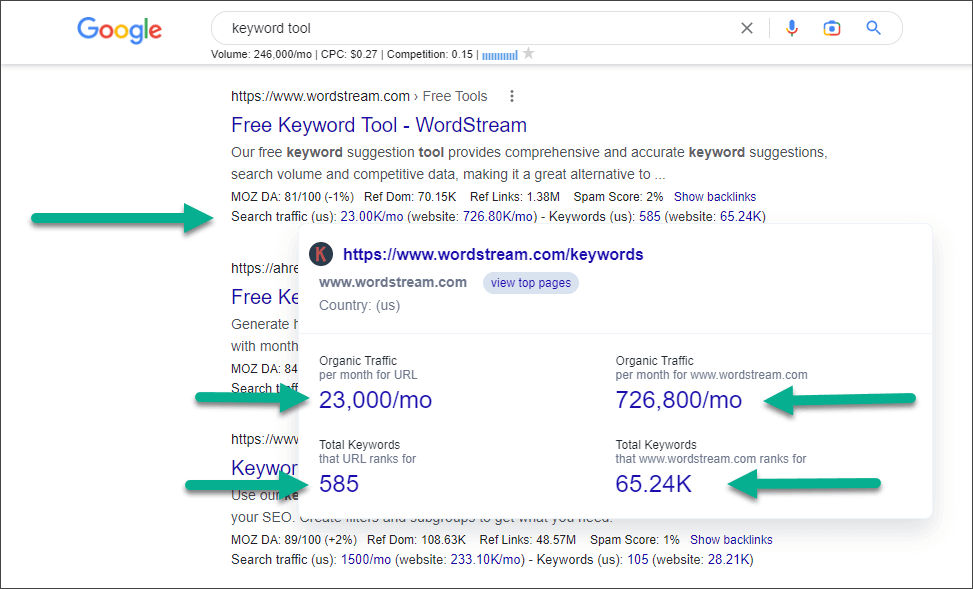
As the screenshot shows, each URL and website gets four metrics. The first two are the total monthly traffic the URL and the website get (from the US in this example), and the next two are the number of keywords the URL and the website rank for.
Hover over any metric for a popup with the full details.
Click any metric and a new page opens with the top 10,000 keywords that URL or website ranks for.
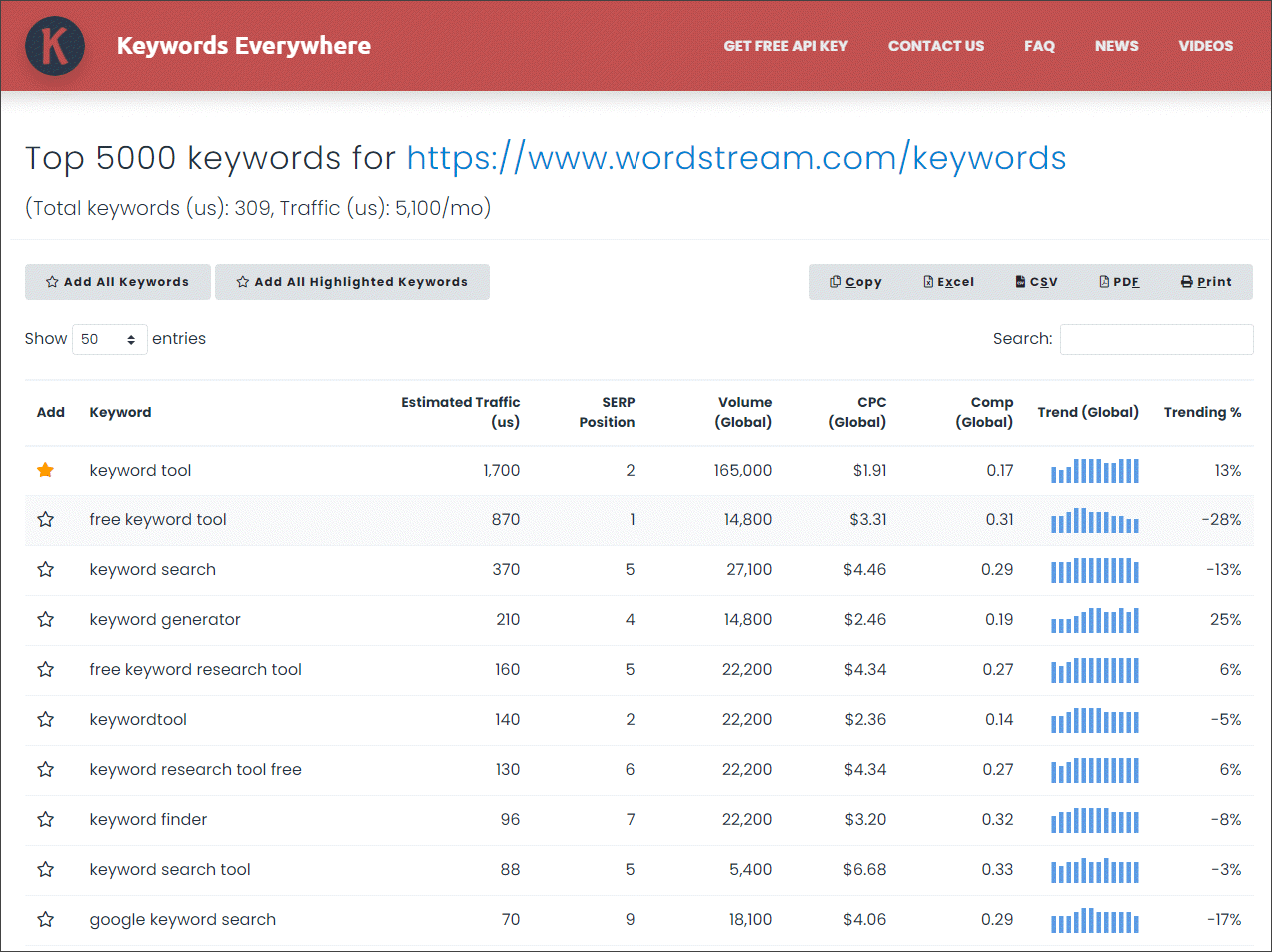
The keywords are sorted by the traffic they bring in, highest first. Next to each one you see the estimated organic traffic the URL or website gets from that keyword, plus the usual Keywords Everywhere search volume, CPC and competition metrics.
Get organic keywords for any website or URL
Keywords Everywhere adds two items to the extension menu, shown below.
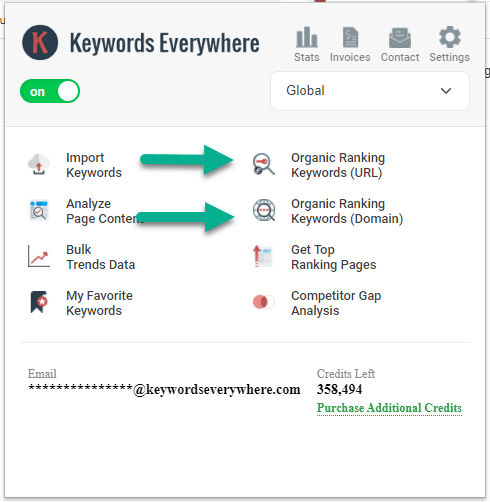
Visit any URL you want the data for and click "Organic Ranking Keywords (URL)". A new tab opens with the traffic metrics and the top 10,000 keywords that URL ranks for.
To get the data for the whole site instead, click "Organic Ranking Keywords (Domain)".
How are credits used?
Viewing the traffic and the total keyword count for each URL or website on the Google results page is free and uses no credits.
Opening the full keyword list costs one credit per keyword shown. So if you view the first 50 of the top 10,000 keywords, 50 credits are used, and you get the estimated traffic, volume, CPC, competition and trend data for those 50 keywords.
How is this data calculated?
Here are the steps behind the numbers.
1. We scrape Google for the top 230 million keywords by volume and store every URL that Google shows for them.
2. We estimate the traffic for each URL from its position in the results, using a simple click-through-rate curve and the keyword's monthly search volume.
For example, if a keyword has 10,000 searches a month, the first result earns roughly 38% of the clicks (about 3,800 visits), the second around 12% (about 1,200 visits), and so on down the page.
3. We add it all up across all 230 million results, for every URL and every website. The totals appear on the Google SERP, and the per-keyword figures appear in the keyword list.
One thing to keep in mind: this is estimated data. Every SERP is different, so real click-through rates vary with the keyword and the searcher's intent. A branded keyword in the first position might take 90% of the clicks.
It will never match a site's own Google Search Console exactly. What it is great for is comparing how different websites are doing, which makes it essential for competitor research.