Sep 28 2019
How credits will work in the new Keywords Everywhere
A few days back, we announced that Keywords Everywhere would be going paid on 1st Oct 2019. Since then we've received hundreds of emails asking for details on how the credits will work. Here we hope to answer all of your questions.
How can I buy credits?
When you click the "K" icon at the top right of your browser, in the menu at the bottom, you will see a link called "Purchase Credits". Clicking this will take you to a page where you can purchase credits.
What modes of payment do you currently accept?
Our payments are managed by FastSpring. You can pay using your credit/debit card or with PayPal.
How do credits work?
Every time the extension gets volume data for a single keyword, one credit will be used up. A credit will be used up irrespective of whether the keyword has any search volume.
- On websites such as YouTube, Amazon etc where you enter only a single keyword, and see the volume under the search bar, only one credit will be used.
- On google.com, where you see the Related, People also search for, & Long-tail keyword widgets, one credit will be used for the main search query, and one credit for every keyword shown in these widgets. As an example, when you do a search and you see 8 keywords in the Related widget, 20 keywords in the PASF widget & 25 keywords in the Long-tail
- For websites like Google Search Console, it depends on how many keywords are shown on the page. If you see 500 keywords on the page, then 500 credits will be used
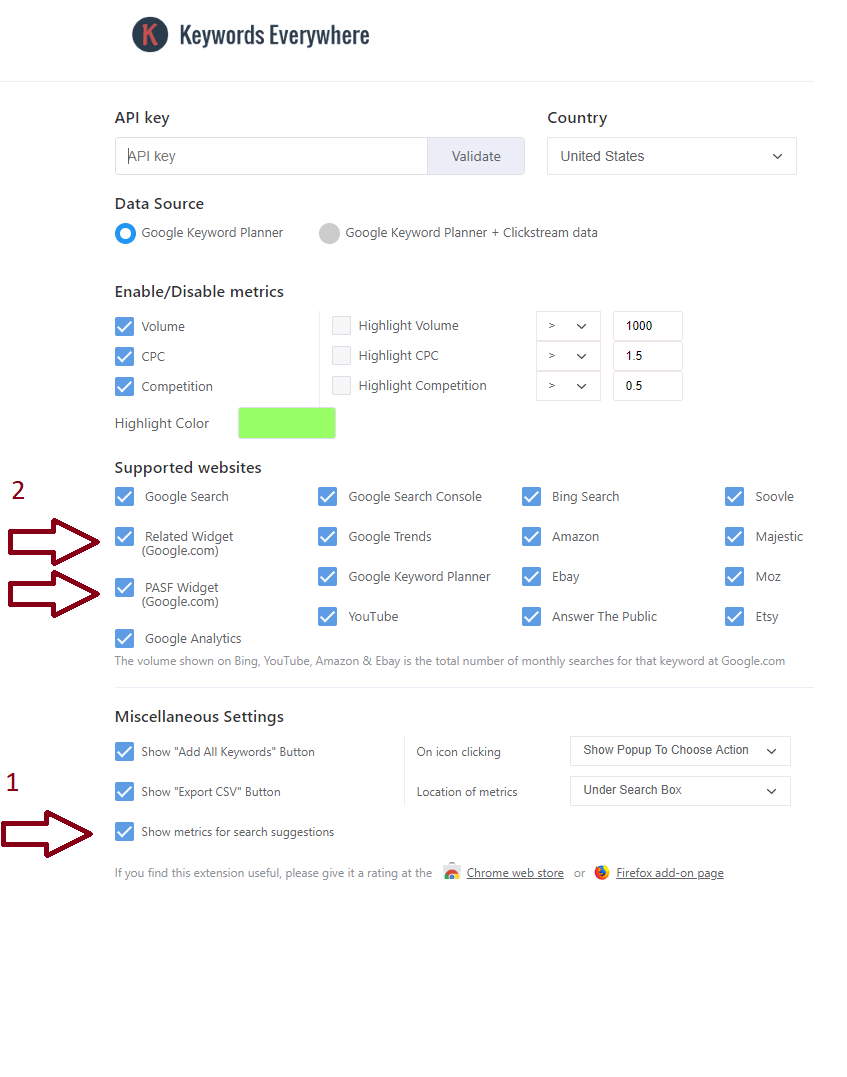
- When volume data is shown in search suggestions, e.g. Google AutoComplete, as many credits will be used up as the number of keywords shown in the suggestion dropdown. This can be disabled in the settings page by disabling the "Show Metrics in Autocomplete Suggestion Drop Downs" (earlier called "Show metrics for suggestions") checkbox.
- The credits used by Import Keywords feature is simple - you use up only as many credits as the number of keywords you've entered
- The Analyze Page Content feature will use as many credits as the total number of keywords found on the page. Note that depending on the content you are analyzing this can use up a Lot of credits very quickly.
- Every time you see the keywords in your "My Favorite Keywords" page, the software gets the latest volume data. In this case, we charge only 1/5th of the total number of keywords shown on the page. For e.g. if you see 20 keywords on the page, then we only deduct 4 credits from your account. This is done so as to stop potential abuse of the "My Keywords" section, since the latest data is always fetched.
How can I save credits when I am not doing keyword research?
Please check this article on conserving credits
I have more questions. What do I do?
If you have any questions we have not answered here, then please email us directly at help@keywordseverywhere.com.
Sep 25 2019
Keywords Everywhere will be a paid browser extension from Oct 1st 2019.
The Keywords Everywhere Chrome extension & Firefox add-on are going paid starting Oct 1, 2019 after being free for four years.
In late 2015, we created Keywords Everywhere with the idea of providing value to thousands of users by being a browser extension that gives you keywords data exactly where you need it the most.
Over the last 4 years, Keywords Everywhere has been completely free software used by more than a million users.
Unfortunately, a year ago, we started noticing bot activity where automated scripts were querying our API to get data for keywords. The number of calls made by bots soon far surpassed the number of calls made by real users, and for a year have been forcing us to constantly upgrade hardware in order to keep the software functional for our real users.
We have had to disable certain functionality like the Import Keywords & Analyze Page features. We have tried everything to mitigate bot activity such as blocking accounts, blocking IP addresses and IP ranges among other approaches. For a small set of users we tested implementing Google Recaptcha (and other recaptcha solutions), but this did not work well at all.
We spend a lot of time managing servers and issues because of the bot activity. The bots are always a few steps ahead and end up creating thousands of API keys and there is no way for us to control API usage. By making Keywords Everywhere a paid tool, all bot activity will cease immediately.
The only other option would have been to shut it down.
We are doing this to avoid having to shut down the extension completely. We hope you will continue to support us during this transition time.
We are keeping the price point as low as possible. There will be no monthly recurring plans. Keywords Everywhere will only have pay as you go plans. The credit based payment plan will cost just $1 for 10,000 keywords data. For most users the cost per month would be less than $2
With the funds we will also be able to add support for other countries, and build additional features. We have also recently brought back features that we had to previously block such as import keywords & analyze pages, all which we blocked because they were used extensively by bots.
On 1st Oct 2019, the Keywords Everywhere Chrome extension and Firefox add-on will stop automatically retrieving volume, CPC and competition data for all keywords. It will continue showing you the "related" keywords, and the "people also ask for" keywords in the widgets on the right hand side of google. To see the metrics, you will need to purchase credits for your account.
If you have any questions, please email us directly at help@keywordseverywhere.com.
Thank you!
Team Keywords Everywhere
July 7 2018
Ungrouping Google Adwords "Close-Variant" Keywords & Data for masked keywords

Around August 2016, Google Keyword Planner (GKP) started grouping together close variants. What this means is that if Google considers two keyword phrases to mean the same thing, it would start showing the same amount of search volume for both the keywords irrespective of whether one of them was searched more than the other.
Additionally, it started grouping mis-spellings. As an example, if you search for the keywords "seo" and "search engine optimization" in GKP, you will see the same search volume for both of them. If you spelled incorrectly and entered "search engine optimisation", you would still see the same search volume.
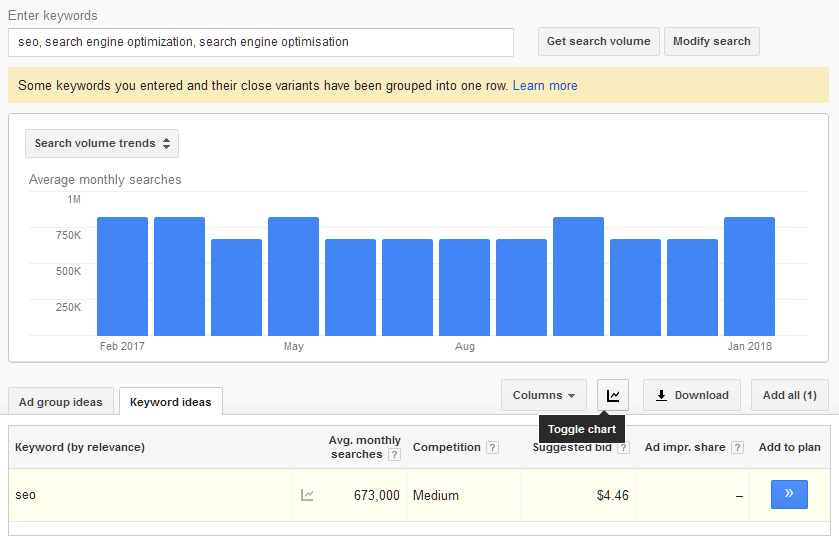
This obviously was a very bad idea. You had to be careful when mis-spelling keywords and there was no way to know which of the two variants "seo" and "search engine optimization" had the higher volume. Keywords Everywhere users started seeing the misleading high volume for such keywords.
Then sometime around April/May 2018, Adwords started showing masking the search volume for a wide range of keywords in the supplement, firearms and other niches (all the keywords show zero search volume). This might have been targeted at stopping advertisers from bidding on certain keywords. However, a few keywords like "api" seem to also have been inexplicable targeted.
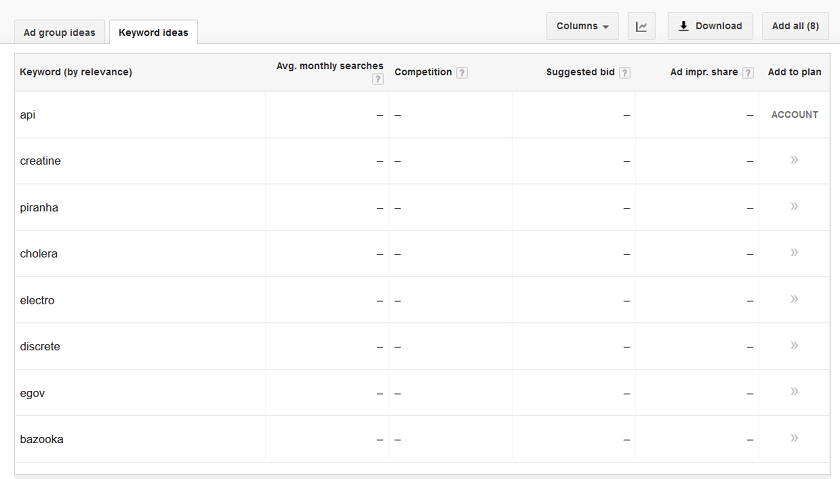
We've today made changes to Keywords Everywhere, to show data for close-variant and masked keywords. You will now start seeing the correct data for mis-spelled keywords as well as keywords which are close variants but are not searched for as often as the main keyword. You will also see correct data for the masked keywords.
If you have any questions, please feel free to email me at help@keywordseverywhere.com.

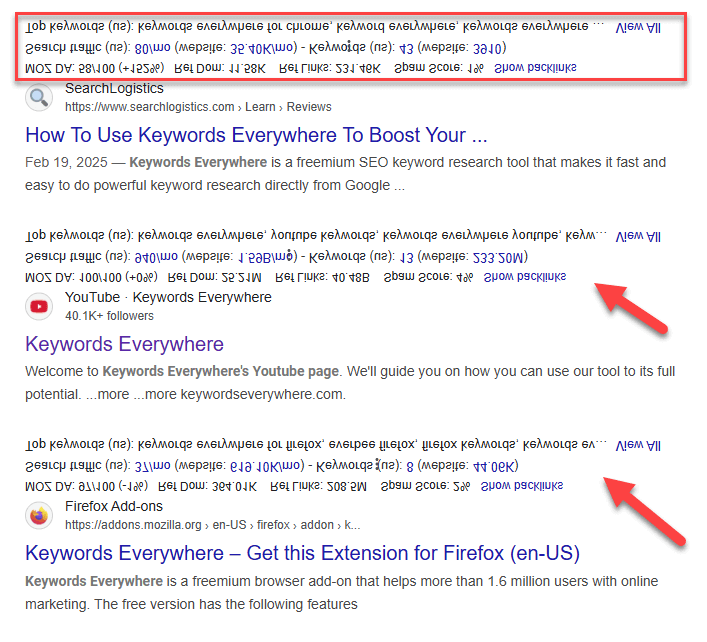 Update (10th Jun): This has been fixed in v11.38.
 Update (15th Feb): This issue has been fixed in v11.14 of the extension.