
See Search Volume in Google Search Console
Use Google Search Console for keyword research
Google Search Console is the one keyword tool that shows the exact searches people already use to find your site. These are real queries, straight from Google, not guesses.
Open the Performance report and you see each query with its clicks, impressions, click-through rate and average position. It is the best starting point for keyword research you have, because you are looking at terms you already rank for.
There is one gap. Search Console tells you that people searched a term, but not how many search it in total each month, or what it is worth. You can rank ninth for a query and still have no idea whether 200 or 20,000 people search it.
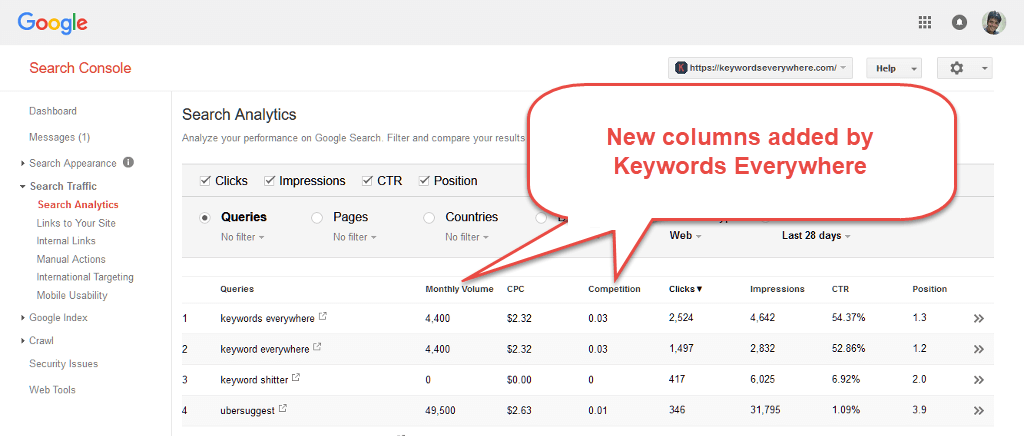
That is exactly what Keywords Everywhere adds. It puts the monthly search volume, CPC and competition right next to every query, so you can tell the high-demand keywords apart from the rest and decide which pages are worth pushing.
Want to check the volume for a list of your Search Console queries without installing anything? Our free Search Volume Checker looks up the Google search volume, CPC and competition right in your browser.
Where to find the data, and what it means
First install the Keywords Everywhere extension for Chrome, Firefox or Edge, then sign up for an API key and add credits, since the volume data is a paid feature.
In Search Console, open Performance > Search results, then scroll to the Queries table below the chart. With the extension on, Keywords Everywhere adds three new columns next to the usual Clicks, Impressions, CTR and Position, as shown in the screenshot above.
Monthly Volume: the average number of Google searches that query gets each month, taken from Google Keyword Planner.
CPC: the average cost per click advertisers pay for the keyword in Google Ads, a quick read on how commercially valuable it is.
Competition: a score from 0 to 1 for how many advertisers bid on the keyword in Google Ads.
One honest note on competition: it measures advertiser competition, not how hard a keyword is to rank for in organic search. A high-competition keyword can still be easy to rank for, and a low one can be tough, so read it as a commercial signal, not a difficulty score.
Search Console also powers the Queries report inside Google Analytics, and Keywords Everywhere adds the same columns there too.
Visualize your Search Console data
The Queries table answers "which keywords?", but it is a long, flat list. It is hard to see at a glance which topics are actually driving your traffic.
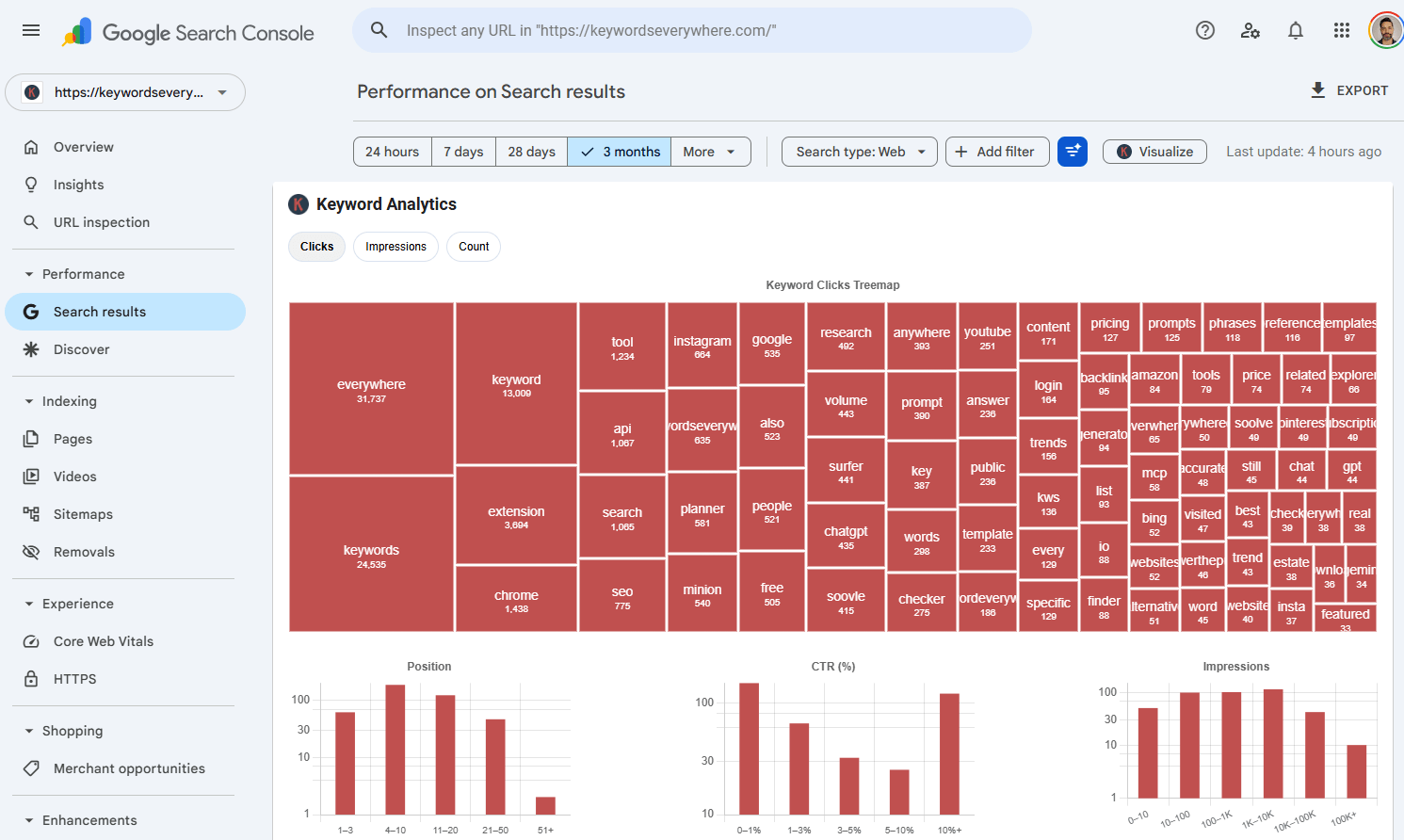
That is what the Visualize feature is for. With the extension on, a Visualize button appears at the top of your Performance report. Click it and Keywords Everywhere groups your top queries into a set of charts right below the line graph.
Keyword clicks treemap: your queries bucketed by their common modifiers, so you can see which words and topics pull the most clicks, the most impressions, and how many keywords sit under each one. For an essential-oils site, for instance, you might see "essential" driving the clicks across 492 keywords and "diffuser" across 318.
Position, CTR and impression bars: three quick bar charts showing how your queries spread across ranking positions, click-through rates and impression bands, so you can tell in a second whether most of your queries sit in the top ten or languish past position 50.
Search Console shows where you rank today. To track how those positions move over time, see our free keyword rank tracker, which records them daily from your Search Console data.
A drill-down modifier table: the same buckets as a clickable list. Click a modifier to drill into the queries beneath it, right down to the exact phrase, with the monthly volume, CPC, competition and 12-month trend on every row.
Everything that comes from Search Console, the clicks, impressions, CTR and position, shows on the free plan. The four Keywords Everywhere columns, volume, CPC, competition and trend, need a paid plan.
The payoff is a clear read on where to invest: double down on the topics that already perform, and spot the ones worth a fresh content push.
Looking for the Content Keywords report?
A lot of people land here searching for the "Content Keywords" report. It used to live in the old Search Console, and in Google Webmaster Tools before that, and it listed the words Google saw most often when it crawled your site.
Google retired it when the current Search Console launched, and it has not come back.
The good news is that the report it left behind is more useful. The Performance report's Queries view shows the actual searches that bring people to your site, not just the words on your pages, which is what you want for keyword research.
That is the view Keywords Everywhere works on, adding the search volume and CPC next to every query so the list becomes a ranked set of opportunities.
Questions you may have
How do I use Google Search Console for keyword research?
Google Search Console shows the exact searches that already bring people to your site. Open the Performance report, choose Search results, and look at the Queries table: every row is a real query, with its clicks, impressions, click-through rate and average position. The one thing it does not show is how much total demand each query has. Keywords Everywhere fills that gap by adding a Monthly Volume, CPC and Competition column next to every query, so you can find the terms you already rank for that also have real search demand and prioritise them.Where is the Content Keywords report in Search Console?
It is gone. The Content Keywords report was part of the old Search Console, and Google Webmaster Tools before it, and it listed the words Google saw most often when it crawled your site. Google retired it when the current Search Console launched and has not brought it back. The replacement is the Performance report's Queries view, which shows the actual searches people used to find you rather than the words on your pages. That is more useful for keyword research, and it is where Keywords Everywhere adds the search volume and CPC.What does the Competition metric mean?
Competition is a score from 0 to 1 that measures how many advertisers are bidding on a keyword in Google Ads. A value near 1 means many advertisers compete for it; near 0 means few do. It is an advertising metric, not a measure of how hard the keyword is to rank for in organic search, so a high-competition keyword can still be easy to rank for, and a low-competition one can be hard. Keywords Everywhere shows the same competition value everywhere it works, including next to your Search Console queries.How do I check the CPC for my keywords?
Keywords Everywhere shows the cost per click next to every keyword, drawn from Google Keyword Planner. In Search Console it appears as a CPC column in the Performance report's Queries table, alongside the monthly volume and competition. CPC is the average amount advertisers pay for a click on that keyword in Google Ads, so it is a quick read on how commercially valuable a term is, even for an organic page.How many keywords does Google Search Console show?
The Performance report shows up to 1,000 rows per view in the interface. To see more, filter by query, page, country or date to break the list into smaller segments, or use the export and the Search Console API. Keywords Everywhere adds its volume, CPC and competition to whatever rows are on screen, and it only uses a credit for the keywords you actually view, so paging through your queries does not spend credits on rows you never see.Do I need an API key, and is it free?
The Keywords Everywhere extension is free to install. To see the volume, CPC and competition data you sign up for an API key, which is free, and then add credits, since the metrics are a paid feature: one credit returns the data for one keyword. The same API key works across all of your devices, and credits start at a low annual price with no monthly plans.Can I check search volume for my keywords in bulk?
Yes. As well as adding columns inside Search Console, Keywords Everywhere has a Bulk Upload feature: paste a list of keywords or upload a file, and it returns the monthly volume, CPC and competition for all of them at once. It is the fastest way to process the queries you have exported from Search Console, and the same rate applies, one credit per keyword.Already installed? Sign up for an API key here
I love this tool. How can I help?
It would be awesome if you could write a review & share us through your favorite social network. We would love any help to get the word out.