

Topic clusters were not born from some random SEO trend. It came from a real shift in search. Way way back, the internet was getting crowded with disconnected pages chasing isolated keywords.
Then came Google’s Hummingbird update, which pushed search beyond exact-match keywords and closer to understanding meaning, context, and intent. So marketers had to rethink their content strategy.
Instead of continuing to publish scattered posts around isolated keywords, some companies started experimenting to keep pace with Google’s shift. HubSpot later helped popularize the hub-and-spoke approachIdentify and Fill Content Gaps: one pillar page for the main topic, with supporting pages linked around it. They found that stronger interlinking between related pages could improve SERP placement and increase impressions.
By 2017, this approach became known as topic clusters. Fast-forward to today, and the concept is still highly relevant because search engines now rely even more on context, intent, and topical depth.
This article will break down the strategy behind topic clusters and how to use them to build stronger topical authority over time.
What is a Topic Cluster Strategy in SEO?
A topic cluster strategy is an SEO content model where you build multiple related pages around one central topic. Instead of creating random articles, you organize your content into a structured network.
The main page is called the pillar page. It covers the broad topic and links out to more detailed cluster pages covering specific angles or questions. For example, a “content marketing” pillar page might connect to posts about blog strategy, keyword research, content calendars, and SEO writing.
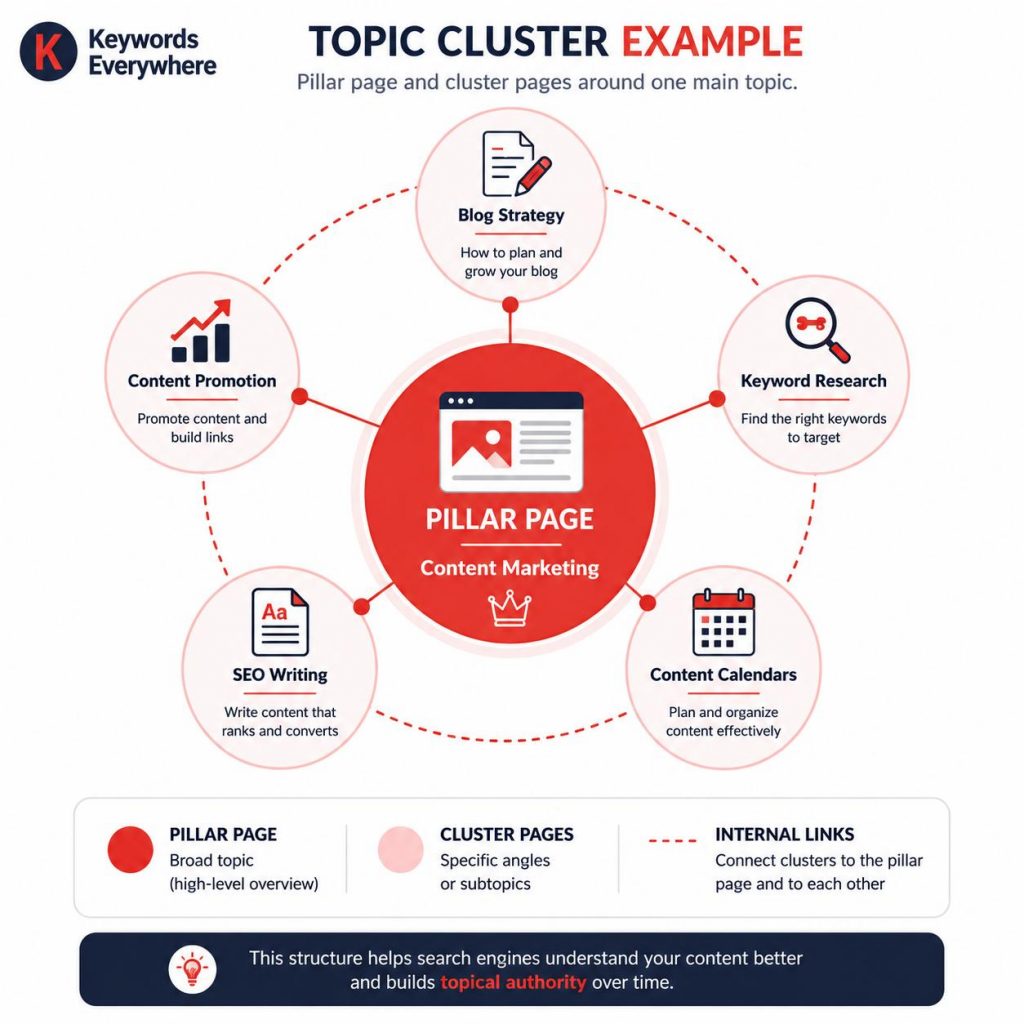


The “pillar page” is the main, in-depth content hub on a specific subject. This page is linked to several other articles covering more specific topics related to the main subject. These cluster pages are also called “supporting pages”.
The key is that each supporting page strengthens the authority of the main pillar page. You can do that by connecting your pillar page to your supporting pages via internal linking. You can’t really have a topic cluster without internal links. Every supporting page in the cluster should link back to the pillar page, which serves as the main hub for the topic.
Your pillar page should also link to your supporting pages. This ensures that Google recognises the content on these pages as related.
Other Topic Cluster Examples:
- Pillar Page: Email Marketing
- Clusters Pages:
- Email Subject Lines
- Email Automation
- Newsletter Design
- Email Segmentation
- Email Deliverability
- Pillar Page: Local SEO
- Clusters Pages:
- Google Business Profile
- Local Citations
- Review Management
- Local Keyword Research
- Map Pack Rankings
- Pillar Page: Fitness Apps
- Clusters Pages:
- Workout Tracking
- Calorie Counting
- Fitness App Reviews
- Beginner Workout Plans
- Home Workout Apps
- Pillar Page: Project Management Software
- Clusters Pages:
- Asana vs Trello
- Kanban Boards
- Team Collaboration Tools
- Time Tracking Features
- Project Management for Agencies
Topic clusters help Google understand how your pages are connected while showing that your site has real depth and expertise around a subject. Over time, your well-built clusters can effortlessly push more of your pages into the SERPs.
Importance of Topic Cluster
Besides helping individual pages rank higher, topic clusters make your whole site stronger. Instead of treating every article like its own little island, you connect related pages so Google can understand what your site is about and users can move through your content more easily.
Here are some of the main ways topic clusters improve your overall SEO strategy:
1. Builds topical authority
When you consistently cover a topic in depth, Google starts to connect your site with that subject. Instead of publishing random standalone posts, you create content that supports each other-– covering broad topics, niche angles, and related searches users are likely to explore next. That deeper coverage can make your site feel more complete both to Google and to readers.
2. Improves internal linking
A lot of sites treat internal linking like an afterthought, but topic clusters make internal links feel planned instead of random. Your pillar page connects to related subtopics, while supporting pages link back to the main hub, helping search engines understand the relationship between each piece of content.
Because everything is intentionally linked together, it becomes much easier to avoid orphan pages and keep important content discoverable.
3. Expands SERP coverage
Topic clusters help you occupy more space in the SERPs by giving you multiple entry points into the same topic. The pillar page targets the main keyword, while supporting articles help you capture smaller but highly relevant queries that users are searching for every day.
4. Strengthens E-E-A-T signals
When your content consistently answers related questions around one topic, it helps build stronger E-E-A-T signals over time. Each connected page adds more context, making your site look more complete, trustworthy, and authoritative in that subject area.
5. Improves user experience
Clusters make it easier for readers to find what they need next. Instead of landing on one article and hitting a dead end, they can click into related guides, deeper explanations, and follow-up topics that match where they are in the search journey.
This creates a smoother path through your site. Readers do not have to search around manually or go back to Google for the next answer. They can keep learning from your content, which can increase engagement, reduce bounce rate, and build even more trust over time.
6. Reduces content overlap
Without a cluster strategy, it’s easy to end up with several blog posts covering almost the same thing. A cluster structure helps prevent your content from competing against itself. Your pillar page targets the bigger topic, while cluster pages focus on narrower angles and related searches, reducing the chances of keyword cannibalization.
Overall, topic clusters help turn a bunch of separate blog posts into a stronger content system. Instead of creating one-off articles and hoping they rank, you build connected pages that support each other, guide readers forward, and show Google what your site is really about.
Creating an Effective Topic Cluster
Creating a topic cluster is not just about choosing keywords and writing more articles. Here’s how to effectively plan your strategy before you start creating content:
1. Start With a Strong Pillar Topic
To create a topic cluster that actually works, your content needs to be planned as a connected system. The best place to start is your pillar topic. This is the broad subject your cluster will be built around, so it should be relevant to your business, useful to your audience, and large enough to support several related articles.
A good pillar topic should not be too narrow, or you will quickly run out of supporting pages. But it also shouldn’t be too broad, or the cluster can become messy and difficult to organize. A simple test is this: can you map at least five to ten useful subtopics under it? If yes, it may be strong enough to anchor a cluster.
Before choosing your pillar topic, ask:
- Which topics are important to your brand?
- Which topics has your site already performed well for?
- What content do you already have?
- What does your audience care about?
- What topics do your competitors cover often?
The goal is to choose a topic that gives you room to build depth. The stronger the topic foundation, the better and more useful the rest of your cluster will be.
If you want to find topic opportunities before they become too crowded, Keywords Everywhere’s Free Trends Finder can also help. It surfaces fast-growing topics across different categories, so you can spot emerging pillar ideas early and build clusters around them while they still have room to grow.
Tools like AI Idea Generator and Content Idea Generator can also help you move faster here. They can suggest content ideas based on your topic, audience, and focus keyword, so you have more directions to explore.
2. Build Around Business Value, Not Just Traffic
Search volume matters, but it should not be the only reason you choose a topic. A keyword with high volume can look tempting, but if it doesn’t connect to your products, services, or audience needs, there’s not much point in chasing the keyword.
Strong topic clusters are built around actual business value. That could mean attracting leads, educating potential customers, supporting conversions, or building long-term authority in your niche.
In many cases, smaller keywords can even bring better opportunities. If the intent is clearer and more relevant to your business, that traffic can be a stronger fit for your actual business goals.
3. Do Keyword Research for Supporting Topics
Once you have your main pillar topic, use thorough keyword research to find the supporting pages that should sit under it. These are the more specific questions, subtopics, and long-tail searches people use when they want to learn more.
Look at metrics like:
- Search intent
- Search volume
- Keyword difficulty
- Relevance to your business
- Evergreen potential
- Google Trends data
For example, if your pillar topic is “home office furniture,” your supporting topics might include “best ergonomic chairs,” “standing desk setup ideas,” “small home office layout,” and “how to choose a desk for your workspace.” Each one supports the larger topic while targeting a more specific need.
Also Read: Keyword Research for Beginners: Step-by-Step Guide
4. Map Search Intent Before Writing
Before creating each page, make sure you understand the intent behind the keyword. Not every search needs the same type of content.
Some users want a basic explanation. Others want a comparison, a checklist, a product recommendation, or a step-by-step guide. If the content does not match what the searcher expects, even a well-written article can struggle to rank.
Mapping intent early helps you decide what each page should cover, how detailed it should be, and what kind of angle will be most useful.
5. Plan Your Pillar and Cluster Pages
Once your keywords and subtopics are ready, organize them into a simple pillar-and-cluster layout. The pillar page introduces the main subject, then links readers to supporting pages that go deeper into each subtopic.
For example, if your pillar topic is “home workout,” your cluster pages might cover:
- beginner home workouts
- bodyweight exercises
- small-space workout routines
- home workout equipment
- workout recovery tips.
This prevents your pillar page from turning into one oversized guide and gives each subtopic enough space to be covered properly.
6. Use Strategic Internal Linking
Internal linking is what holds the cluster together. Your pillar page should link to the supporting pages, and each supporting page should link back to the pillar page. Where it makes sense, cluster pages can also link to each other.
This helps readers move through your content naturally. It also helps search engines understand which pages are related, which page is the main hub, and how your content is organized.
Also, make sure to use clear, natural anchor text. The link text should tell readers and search engines what the linked page is about without sounding forced or repetitive.
7. Create High-Quality, Helpful Content
After mapping the cluster, focus hard on content quality. Each page should answer the search intent, use keywords naturally, and provide enough detail to be genuinely useful.
Avoid creating thin pages just to fill the cluster. Every supporting article should add something meaningful to the topic. The stronger each individual page is, the stronger the whole cluster becomes.
8. Identify and Fill Content Gaps
A topic cluster should not be treated as a one-time project. As your content grows, you may find missing subtopics, outdated pages, or areas where competitors are covering the topic better than you.
That is where content gap analysis comes in. Look for questions you have not answered yet, keywords you’re not targeting, and pages that need updating. Filling these gaps helps strengthen the cluster over time.
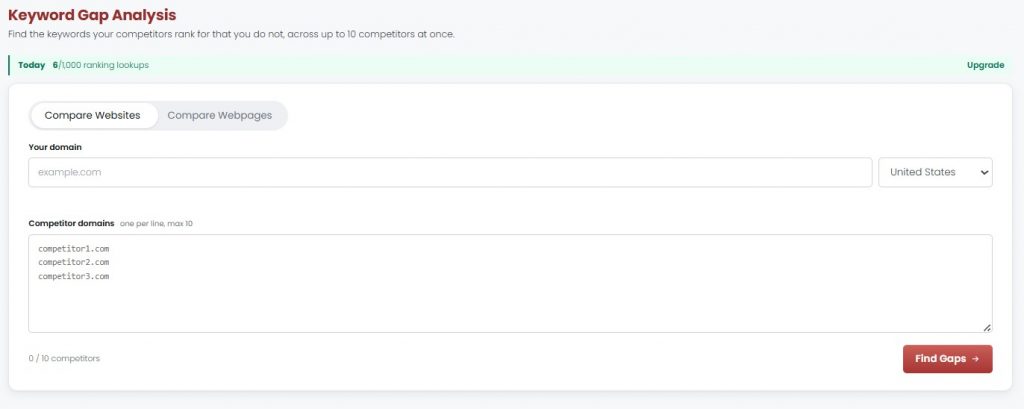
You can also check competitor pages with Top Pages Finder to see what’s getting traction and where your own content cluster could go deeper. For a clearer keyword-level view, our Keyword Gap Analysis tool can help you compare your site against up to 10 competitors and find the keywords they rank for that you don’t.
And for larger clusters, tools like AI Text Generator can help speed up the first draft for missing subtopics, FAQs, or supporting sections. The key is to use it strategically: fill real gaps, avoid generic filler, and make sure every new section strengthens the cluster.
9. Track and Improve Performance
Once your topic cluster is live, track how it performs. Look at rankings, organic SEO traffic, clicks, impressions, engagement, and conversions. SEO takes time, so don’t expect results overnight.
If a cluster is performing well, you can expand it with more supporting content. If some pages are underperforming, look at whether the content needs better intent alignment, stronger internal links, more depth, or clearer keyword targeting.
You can also run underperforming pages through our Free SEO Content Checker to audit them against a target keyword. It helps flag issues with keyword usage, content quality, page structure, and SERP snippets, giving you a clearer idea of what to improve next.
In general, a strong topic cluster is a living system. The more you review, improve, and expand it, the more value it can bring to your site over time. If you’re auditing overall cluster performance, tools like SEO Analyzer and SEO Optimizer can help surface page-level issues and optimization opportunities that might otherwise be easy to miss.
Common Mistakes in Building Topic Clusters
Even a good topic cluster idea can fall apart if the pages are not planned properly. Here are some common topic cluster mistakes to watch out for:
1. Choosing Pillar Topics That Are Too Niche
A pillar topic needs enough room to support several related pages. If the topic is too specific, you may only be able to write one or two useful articles around it before running out of ideas.
For example, “best running shoes for rainy weather” is likely too narrow for a pillar page. A stronger pillar topic would be “running gear,” since it can expand into shoes, clothing, recovery tools, beginner gear guides, and more.
2. Choosing Pillar Topics That Are Too Broad
On the other hand, a pillar topic can also be too big. If the topic is too broad, the cluster becomes hard to organize and may lose focus.
A topic like “marketing” is probably too wide for one cluster because it can include SEO, email marketing, social media, branding, paid ads, analytics, and dozens of other areas. Instead, it’s better to narrow it into a more manageable pillar, such as “content marketing for small businesses” or “SEO strategy for ecommerce.”
The goal is to choose a topic that’is broad enough to build around, but specific enough to feel like one topic.
3. Creating Pillars That Overlap Too Much
Another common mistake is creating multiple pillar pages that are basically trying to own the same topic. Even if the keywords are slightly different, the search intent may be almost identical.
When pillar topics overlap too much, your content can start competing with itself. It also makes internal linking less efficient because you may not know which pillar page a supporting article should link to. As a result, link equity gets divided across overlapping pages instead of strengthening one main resource.
Thus, before creating a new pillar, ask whether it truly deserves its own cluster or if it should simply be part of an existing one. If two pillar topics answer the same user need, it’s usually better to combine them or make one a supporting page.
4. Letting Pillars Compete With Product or Service Pages
Your pillar topics should be close enough to your business to support your goals, but not so close that they compete with your main product or service pages.
For example, if you sell project management software, a pillar page about “project management” may be helpful. But a pillar page targeting “project management software” could compete with your actual product page. That can confuse search engines about which page should rank for the commercial keyword.
To avoid this, keep pillar pages more educational and use product or service pages for bottom-of-funnel terms. Your cluster can still support conversions, but optimally, your product pages should still own the sale.
5. Skipping a Content Audit Before Building Clusters
Before building new clusters, look at what you already have. Many sites already have useful articles that can be updated, merged, redirected, or added into a cluster.
Skipping this step can lead to duplicate pages, missed internal linking opportunities, and unnecessary new content. A quick content audit helps you see which pages are worth keeping, which ones need improvement, and which ones may be holding the site back.
This gives your topic cluster a cleaner foundation instead of piling new content on top of an already messy structure.
A strong topic cluster is more than just a collection of articles. Every page should have a clear role within the bigger content strategy. The better the planning is upfront, the stronger the entire cluster becomes.
FAQs
How many cluster/supporting pages should a topic cluster have?
There is no fixed number, but most topic clusters work best with at least 5 to 10 supporting pages. The right size depends on how broad the main topic is and how many meaningful subtopics, related questions, and search intents you can realistically cover.
How many topic clusters should I create to rank well?
There is no ideal number. It depends on your industry, goals, and content capacity. Most websites build multiple clusters over time around their core services, products, or expertise areas. Quality, relevance, and structure matter much more than simply publishing more clusters.
How long does it take for topic clusters to improve rankings?
Topic clusters usually take several weeks or months to show noticeable SEO impact. Search engines need time to crawl, index, and understand the relationships between your pages. Results also depend on competition, content quality, internal linking, and your site’s overall authority.
Can older content be added into a topic cluster?
Yes. Existing articles can often be updated and reorganized into a topic cluster structure. This may involve improving content quality, refining keyword targeting, adding internal links, and connecting older pages to a relevant pillar page and supporting cluster content.
Are topic clusters only useful for blogs?
No. Topic clusters can work for blogs, ecommerce websites, SaaS companies, service businesses, educational sites, and many other website types. Any site publishing content around related subjects can use clusters to improve organization, internal linking, and search visibility.
How often should topic clusters be updated?
Topic clusters should be reviewed regularly, especially when information changes, rankings drop, or new search trends emerge. Many websites revisit important clusters every few months to refresh outdated content, improve internal links, fill content gaps, and expand supporting topics over time.
Conclusion
A topic cluster strategy should definitely be a part of your overall content strategy– and your SEO strategy in general.
It’s not just a matter of dominating keywords. It’s about gaining authority over entire topics, which is what modern SEO is really moving toward. If you want to build real topical authority, topic clusters are definitely one of the best places to start.