

Back in the day, you could easily game rankings by just cramming in a few target keywords and calling it a win. That era is long gone. Search has evolved, algorithms are smarter, and honestly, the web is better for it.
Today, with AI-driven results, deeper intent analysis, and changing user behavior, rankings depend on far more than keyword placement alone. Context, usefulness, and real answers matter more than ever. So it’s only fair to ask: do keywords still matter, or have they lost their edge? Let’s take a closer look.
Are Keywords Still Important for SEO in 2026?
Yes, keywords still matter, but not the way they once did. Search engines now evaluate pages based on how well they answer a query, not how closely they match it word for word.
That shift didn’t happen overnight. Early versions of Google treated searches as strings of words, not ideas. If a page repeated the same terms often enough, it could rank, even if the content itself wasn’t helpful. That approach led to a wave of spammy tactics and low-value content, which eventually forced Google to change course.
How Search Evolved Beyond Keywords
Google’s algorithm updates over the years didn’t eliminate keywords. They redefined how relevance is measured.
- 2012: Penguin targeted spammy SEO tactics, including keyword stuffing and manipulative link schemes.
- 2013: Hummingbird introduced semantic search, allowing Google to focus more on meaning and natural language instead of individual words.
- 2015: RankBrain added machine learning, helping Google interpret unfamiliar queries and weigh factors like intent, location, and behavior alongside keywords.
- 2019: BERT dramatically improved Google’s ability to understand context and nuance, especially in longer or conversational searches.
- 2022: Helpful Content Update reinforced the idea that content should be written for people first, not search engines.
- 2024: March Core Update further emphasized genuine usefulness as a key differentiator in search results, reducing the visibility of content created primarily to attract clicks rather than inform or help users.
Each of these changes moved Google away from mechanical keyword matching and toward language understanding. Today, keywords help search engines understand what a page is about, but they’re only one part of a much larger system. Language, structure, intent alignment, and user satisfaction now do the heavy lifting.
Why Keywords Are Becoming Less and Less Important
Keywords used to be the backbone of SEO. They helped search engines figure out what a page was about and decide which results to show for specific queries. However, search engines no longer rely on simple word matching to determine relevance.
Here are the main reasons keywords have become less central to SEO:
• Searches Are Becoming More Conversational
Search behavior has changed significantly over the years. Instead of short, fragmented phrases, users now search using full questions and natural language.
Advances in natural language processing enabled search engines to recognize that many differently worded queries can point to the same intent. A hundred users might ask the same question in a hundred different ways and still expect the same result. Because of this, optimizing content around every possible keyword variation is no longer necessary.
• Intent Matters More Than Exact Keywords
Modern SEO focuses less on what words are used and more on why someone is searching. Algorithms now prioritize intent over phrasing, evaluating whether a page truly solves the underlying problem behind a query.
That means usefulness, clarity, and completeness matter more than perfect keyword matches. Besides, when intent is satisfied clearly and thoroughly, keyword coverage tends to follow naturally.
• Semantic Understanding Reduced Keyword Dependence
Search engines have also become much better at understanding context and relationships between topics. With semantic search, relevance is determined by how concepts connect, not just by the presence of individual words. This has dramatically reduced reliance on rigid keyword optimization.
• Keyword Tracking Is Less Reliable Than It Used to Be
Another reason keywords matter less is that they are harder to measure accurately. Zero-click searches now account for a large share of search activity, with users getting answers directly on the results page through featured snippets and AI-generated summaries. Even when your content is visible or cited, that exposure may not result in a measurable click.
At the same time, Google Search Console provides less query-level transparency, often grouping long-tail searches under “other” or hiding low-volume queries entirely. Search has also expanded beyond traditional browsers to include voice assistants, smart devices, and visual search tools—many of which do not pass keyword or referral data.
So while keywords and tracking haven’t disappeared, they’ve lost their starring role. Search engines now evaluate context, intent, and overall usefulness far more than exact phrasing. Pages that genuinely solve problems and deliver clear value consistently outperform those built around rigid keyword tactics.
What’s No Longer Relevant
Some keyword practices that once worked are now either ineffective or actively harmful. The strategies below no longer signal relevance. If anything, they can drag performance down or even trigger penalties that are hard to recover from.
1. Exact Keyword Matching
Optimizing pages solely to match an exact query word-for-word is no longer effective. Search engines now understand variations, synonyms, and related concepts, making rigid matching unnecessary and often limiting.
2. Keyword Density Formulas
There is no ideal keyword percentage. Attempting to hit a specific density target usually results in awkward phrasing and reduced readability. Modern algorithms do not reward pages for repeating a term a certain number of times.
Rather than chasing percentages, you can use tools like our free Keyword Density Checker to see how your content compares to the top-performing SERP results and identify missing topics or terms.
3. Keyword Stuffing and Forced Phrasing
Deliberately inserting keywords where they don’t belong, especially in visible content, is still considered a spam signal. These practices are more likely to hurt rankings than help them.
4. Meta Keywords
Meta keywords have been ignored by Google since 2009 and offer no SEO value today. Including them does not improve rankings and has no impact on visibility.
5. Over-Optimized Anchor Text
Forcing exact-match keywords into every internal or external link used to be common. Now it looks manipulative. Over-optimized anchors can trigger link spam signals and dilute trust. Use natural, descriptive anchors instead of stuffing keywords into every link.
In short, these older techniques are built around manipulating keywords rather than serving users. That approach no longer aligns with how modern search engines evaluate content.
What Are Still Relevant
While keywords have lost their role as a primary ranking lever, they remain important when used correctly. The difference is how they’re applied.
1. Title Tags
Title tags remain one of the most important on-page SEO elements. They appear as the clickable headline in search results and help establish relevance at a glance.
A well-optimized title tag should:
- Include the primary keyword naturally, ideally near the beginning
- Stay under ~60 characters to avoid truncation. Consider using a Character Counter.
- Use clear, compelling language that encourages clicks
For faster title optimization, try our free Title Tag Generator and Headline Generator. It can generate multiple title variations and help you find a stronger angle for the SERPs.
2. Meta Descriptions
Meta descriptions are not a direct ranking factor, but they strongly influence click-through rates. A good meta description:
- Accurately summarizes the page
- Uses the target keyword naturally
- Stays within 150–160 characters
- Includes a clear reason to click
A strong meta description can take a few tries to get right. Our free Meta Description Generator helps by generating fresh options, showing competing descriptions, and letting you regenerate until you find the best fit.
3. Header Tags (H1, H2, H3)
Header tags create structure and clarity for both users and search engines.
- The H1 should clearly state the page’s main topic and usually include the primary keyword
- H2s and H3s should organize content logically, using relevant terms where they make sense
This hierarchy helps search engines understand what the page covers and how information is organized and prioritized.
You can also use our Free H1 Checker to review how top-performing pages structure their headings before building your own. It helps you study their H1s, H2s, and H3s, then create a clearer, better-organized version that’s easier for users and search engines to follow.

4. Keyword Placement (Without Obsession)
Keywords still matter in key locations, but repetition is no longer required. Primary and secondary keywords should appear where they naturally belong—titles, headers, and early context—without disrupting readability. You can also use tools like SEO Content Checker to review keyword placement, keyword usage, content quality, and page structure, so you can catch weak spots without overthinking every single keyword mention.
Bottom line, gone are the days of obsessively repeating the same phrase. Clear language and thorough topical coverage carry far more weight in modern SERPs.
5. URL Optimization
URL optimization still matters because URLs provide immediate context. A clean, descriptive URL with the primary keyword tells search engines what the page is about before any content is parsed.
It also helps users assess relevance at a glance in search results and shared links. This strategy has endured every algorithm update because structure remains fundamental to how search works.
6. Semantic Keywords
Related terms, synonyms, and conceptually connected phrases (LSI Keywords) help reinforce topical relevance. These don’t need to be forced; they often appear naturally when content thoroughly covers a subject.
7. Image Alt Text
Alt text improves accessibility and provides context for images. When relevant, it can also help pages appear in image search results. Alt text should describe the image clearly, not serve as a place for keyword stuffing. For bigger pages with several images, our free Alt Text Generator helps keep alt text clear, consistent, and easier to manage.
8. Structured Data (Schema Markup)
Schema markup helps search engines interpret content more precisely and can enable rich results such as FAQs, reviews, and product snippets. While not a ranking guarantee, it can significantly improve click-through rates and overall visibility.
For a quicker setup, our free Schema Markup Generator can generate valid structured data for popular schema types, helping you move from idea to implementation in just a few clicks. After that, you can use our Schema Markup Validator to confirm the markup is complete before publishing.
9. Authoritative Backlinks
Backlinks from reputable sources still signal trust and authority. While not a keyword factor directly, they reinforce the credibility of content built around a topic.
10. High-Quality Content That Satisfies Intent
Ultimately, content is king and everything else is just complementary. Pages that clearly answer user questions, demonstrate expertise, and provide real value consistently outperform those built around keyword tactics alone.
If your goal is to reach the top of the search results, focusing on keywords alone won’t get you there. Strong SEO rankings come from building pages that deliver as much real value as possible.
That means earning quality links, creating a network of well-connected pages, keeping visitors engaged with useful content, and yes—using keywords thoughtfully and in context. When all of these SEO strategies work together, search engines have far more signals to justify ranking your page ahead of the rest.
How Does Google Engage with Keywords
At a high level, Google engages with keywords across three main stages: crawling, indexing, and serving (ranking).
1. Crawling
Google continuously sends automated programs, often referred to as crawlers or spiders, across the web. Their job is to discover new pages, revisit existing ones, and follow links between pages.
During crawling, Google analyzes page content, internal links, external links, headings, images, and metadata. This is where keywords are first encountered, not as ranking triggers, but as signals that help describe what a page covers.
A strong internal linking structure matters here. When pages are well connected, crawlers can discover content more easily and understand how topics relate to one another. That’s why sites with a clear content hierarchy and logical internal links tend to perform better over time.
At this stage, Google is not judging whether a page deserves to rank. It’s simply gathering information.
2. Indexing
Once a page is crawled, Google attempts to understand it and decides how it should be stored in its index. This is where keywords help define topical relevance, but not in the old, one-keyword-per-page sense.
Here, Google analyzes:
- The main topic of the page
- Key terms and phrases used naturally throughout the content
- Related concepts and semantic signals
- Page structure, headings, and context
Rather than assigning a single keyword, Google associates a page with a set of topics and meanings. This allows the page to surface for a wide range of related searches, even when the exact phrasing doesn’t appear on the page.
Indexing is also dynamic. Pages can strengthen their index signals when:
- Content is updated or expanded
- New internal or external links are added
- Users consistently engage with the page
On the flip side, pages that remain outdated, thin, or unused can lose relevance over time.
3. Serving (Ranking)
When a user searches, Google interprets the query to determine intent and context. It then pulls relevant pages from the index that best match that intent.
Keywords help identify which pages are eligible to appear, but they don’t decide rankings on their own. Google’s ranking systems consider a wide range of factors, including:
- Content relevance and depth
- Authority and trust signals
- User engagement and satisfaction
- Freshness and page experience
This is why keyword-optimized pages don’t automatically rank well, and why pages with fewer exact matches can still outperform others if they better address the search intent.
Keywords help Google understand and categorize content, but they’re just one piece of the puzzle. They ensure a page can be found and considered, while relevance, quality, and usefulness determine how prominently it appears. In short, keywords can still support discovery, but it ultimately boils down to the overall value the page delivers to the searcher.
Keyword Research Is Here to Stay
While keywords don’t carry the same weight they used to, keyword research is still a foundational part of SEO. It’s still one of the most accessible ways to understand what people are searching for and how often those searches happen.
In today’s search landscape, keywords operate within a much larger system that includes machine learning, user behavior, content quality, and AI-powered search features. They don’t drive rankings on their own, but a well-developed keyword strategy can still help search engines interpret relevance and decide which pages should be considered for a query.
Keyword research helps prioritize what to target. By checking search volume alongside competition, keyword research highlights topics where a site can realistically perform well, rather than competing for highly saturated terms.
Strategic keyword research also enables the development of robust topic clusters, which remain one of the most reliable ways to scale organic growth.
Despite keywords still being useful, algorithm updates can make keyword-based SEO feel more complicated. But just keep in mind that those changes are ultimately designed to improve the search experience. Google isn’t adjusting its systems to make optimization harder. It’s trying to deliver more useful results. As search improves, you get all the benefits too. The traffic that reaches your site becomes more intentional and better aligned with what you offer.
Keyword Strategy: Dos and Don’ts
Again, keywords are no longer the magic trick they used to be, but they’re definitely not useless either. In terms of keyword strategy, here’s a quick breakdown of what works today and what doesn’t.
Keyword Strategy (2026): The Dos
Search has evolved, but the core principles are still straightforward. These are the practices that still move the needle.
1. Integrate the keywords naturally
Keywords should flow naturally within your content, reinforcing relevance without disrupting readability. If a sentence feels forced, it probably is.
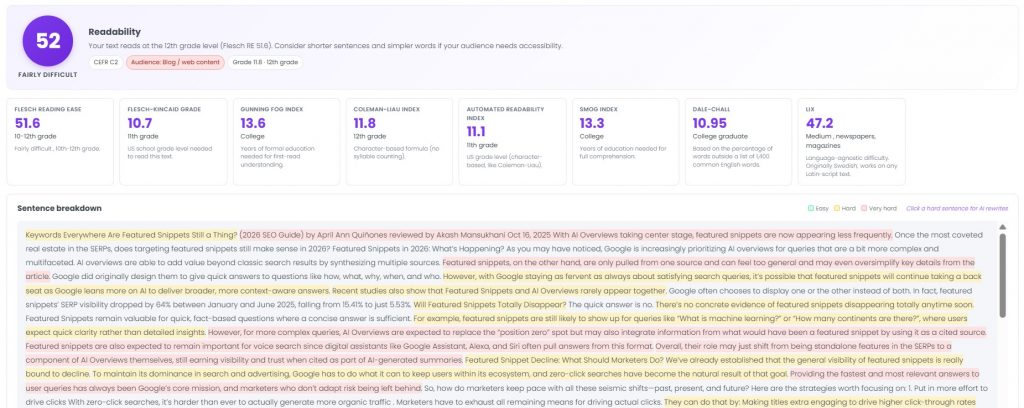
Our free Readability Checker can help you spot awkward or hard-to-follow sentences, so you can clean up keyword placement without making the content sound stuffed.


2. Continue paying attention to keyword placement
Placement still matters. Your focus keyword should appear in the title, URL, headers, meta description, and image alt text. This isn’t about manipulation. It’s about making the page’s purpose obvious to both users and search engines.
3. Focus on long-tail keywords
Instead of fighting high-authority sites for broad terms, long-tail keywords give you realistic ranking opportunities and traffic that actually converts. They also align better with modern search behavior. People now search in full questions and conversational phrases, especially with voice search and AI-driven results.
4. Prioritize semantic keywords
Semantic keywords are related terms that provide more context around a subject. For example, a page about baking bread might naturally include terms like flour, yeast, oven temperature, kneading, and proofing. The more specific and detailed the terms and concepts are, the deeper Google and AI interpret the page’s topical depth.
Bottom line, semantic keywords encourage better writing. They push you to explain topics more fully and naturally, resulting in content that’s easier to read, easier to trust, and stronger from an authority standpoint.
5. Focus on keywords with business potential
The thing is, traffic alone doesn’t pay the bills. Focus on keywords tied to actions—whether that’s purchasing, subscribing, comparing, or solving a problem tied to your product or service. Rankings only matter if they support real business outcomes.
6. Think in topics, not isolated terms
Stop optimizing for individual keywords and start answering complete questions. It’s all about identifying real pain points and striving to be as helpful as possible. When you treat content like an act of service instead of a keyword exercise, the SEO pieces fall into place. Besides, when you cover a topic well, the keywords come naturally– not to mention AI Overview citations, GEO advantages, and wider reach across search and AI.
7. Match the search intent
Keywords might get your content indexed, but intent determines if it ranks. If your page doesn’t align with what the searcher is actually trying to do, Google sees it as a poor result, even if the content itself is high quality. In fact, Google watches how people interact with results. When a page consistently earns clicks, longer visits, and fewer returns to the search results, Google further rewards it with better rankings.
Thus, to create content that actually performs, always check what’s ranking and align your format, depth, and angle with the dominant intent behind the query.
8. Mind the Keyword Difficulty
High-KD terms are usually dominated by big brands with deep backlink profiles and years of authority. Competing there can drain time and budget with little payoff. Mid- or lower-KD keywords, on the other hand, give you quicker wins, steadier organic SEO traffic, and conversions sooner. Stack enough of those, and you naturally build the authority needed to compete for tougher terms later.
To sanity-check your targetting process, you can use a Keyword Difficulty Checker to see how competitive the current SERP really looks. It uses the Domain Authority of the top-ranking pages to estimate difficulty, so you can focus on terms that match your site’s current authority.
9. Consider voice search
Voice search changes how people phrase queries. Instead of short, choppy keywords, users speak in full questions like they’re talking to a person. That means your content should sound natural, conversational, and direct.
Clear answers, simple language, and structured sections help you show up in voice results. If you ignore voice, you risk missing a growing share of high-intent searches that are usually further down the funnel and closer to taking action.
10. Push for AI Mentions
Think beyond traffic alone. A growing share of searches now end directly on AI-generated summaries, with users getting answers without ever clicking through. That means fewer immediate visits but far more passive visibility.
If you’re not referenced, you’re essentially invisible. If you are, your brand shows up at scale, right where decisions happen. Those AI mentions credibly position you as the authority and often translate into later branded searches, higher-intent traffic, and real conversions.
11. Build topic clusters
Publishing more pages isn’t the goal. Publishing connected, in-depth pages is. A strong pillar page anchors the subject, while supporting articles dive into specifics and link back to each other. This structure improves navigation, reinforces topical depth, and gives crawlers clear signals about what you truly specialize in.
Over time, those internal links compound. One strong page lifts the rest, helping you rank across an entire topic instead of fighting for visibility article by article.
12. Use a good keyword tool
While SEO intuition is good, at the end of the day, it should be backed by real numbers. A solid Google keyword tool or Keyword Finder helps validate demand, uncover related terms, assess competition, and avoid guesswork.
13. Aim for topical authority
Ranking for a few keywords is nice. Being trusted for an entire topic is better. Topical authority comes from going deep, not wide. When you consistently publish thoughtful, experience-backed content around one subject, search engines begin to see you as a reliable source. That trust translates into stronger rankings, links, and even AI citations over time.
14. Adjust keyword strategy KPIs
Keyword rankings used to be everything. Now they’re just part of the picture. Between AI citations, zero-click searches, and longer buying journeys, value shows up in different ways.
Instead of obsessing over clicks and positions, start tracking what actually moves the needle: conversions, branded demand, qualified leads, and citation visibility. Because realistically, if it doesn’t tie back to business growth, it’s probably just a vanity metric.
Keyword Strategy (2026): The Don’ts
Lots of old-school keyword tactics simply don’t work anymore. These are the habits worth leaving behind.
1. Don’t stuff keywords or force phrasing
Repeating the same term over and over doesn’t make a page more relevant. It just makes it harder to read. If the copy sounds robotic or awkward, both users and search engines will notice.
2. Don’t optimize for exact-match keywords only
Again, modern search understands synonyms and context. Writing separate pages for every tiny variation (“best crm tool,” “top crm tool,” “crm best tool”) creates thin, competing content instead of stronger coverage.
It only leads to keyword cannibalization and diluted signals. The best approach is to consolidate similar topics, build depth, and let one authoritative page carry the weight.
3. Don’t chase high-volume keywords blindly
Big search volume looks tempting, but broad terms are usually dominated by established brands. Without realistic authority, you’ll burn time and budget with little return.
4. Don’t write for algorithms instead of people
If you’re constantly thinking about inserting keywords instead of answering the question clearly, the content will feel unnatural. Google’s systems measure usefulness. Real readers do too.
5. Don’t rely on outdated SEO tricks
Meta keywords, density formulas, hidden text, and over-optimized anchors don’t help anymore. At best they do nothing. At worst, they send spam signals.
6. Don’t publish content just to hit a quota
More pages don’t equal more rankings. Low-value “filler” content dilutes trust signals. Fewer, better pages consistently outperform mass publishing.
7. Don’t ignore what’s already ranking
Skipping SERP analysis is like guessing in the dark. If you don’t study the top results, you risk creating the wrong format, depth, or angle from the start.
Before writing, check what Google is already showing. Are the top results listicles, how-to guides, service pages, videos, product pages, or local listings? That tells you what kind of page you actually need to create.
Our Free SERP Checker helps you review the ranking pages, local packs, People Also Ask questions, and other SERP features for your keyword, with location filters for country, state, or city. The key is just to study what ranks, then build something sharper, fuller, and more useful.
8. Don’t ignore engagement signals
Ranking isn’t just about matching words. If users bounce quickly, don’t scroll, or don’t click through, Google reads that as a weak result. Poor interaction tells search engines your content didn’t satisfy the query.
9. Don’t treat keywords as one-and-done research
Search behavior is always shifting. New terms, AI queries, and trends pop up constantly. If you never refresh your research, you slowly drift out of relevance. You can use tools like our free Trend Finder to find new opportunities as they emerge, making it easier to refresh old content and expand into relevant topics.
10. Don’t neglect updates after publishing
Content that goes stale loses rankings eventually. If stats, screenshots, or processes change, refresh the page. Thoughtful and regular updates help protect and recover rankings.
11. Don’t separate SEO from content quality
Great optimization can’t save thin or generic content. Keywords might get you indexed, but depth, clarity, and usefulness are what keep you ranking.
The Future of Keywords
Keywords have been a core part of search engine optimization for decades. They’ve helped structure content, guide discovery, and connect users with relevant information. The question now isn’t whether keywords still matter—it’s how their role will continue to change.
In all likelihood, SEO as it’s traditionally understood will keep evolving, and some familiar tactics may eventually fade. Google has consistently shown little tolerance for search manipulation, and each major algorithm update moves further away from mechanical optimization and closer to true semantic understanding.
As semantic search, machine learning, and AI-driven systems become more advanced, it’s possible that keyword sensitivity will matter less than ever. Search engines may reach a point where relevance can be determined almost entirely through context, authority, user behavior, and content usefulness, regardless of whether specific keywords are deliberately targeted.
That doesn’t mean keywords will disappear overnight. But their influence is likely to continue shrinking as search engines get better at interpreting meaning rather than matching words. Keywords then may become more of a supporting signal than an optimization focus.
For marketers who have relied heavily on keyword-driven strategies, this shift is a signal to adapt. Improving SEO in the future will require deeper attention to content quality, topical authority, internal linking, brand signals, engagement, and credibility. These are the elements search engines increasingly reward, and they’re far harder to game.
In that future, keywords won’t vanish, but they’ll matter less on their own. SEO success will depend less on how well content is optimized and more on how useful, trustworthy, and relevant it proves to be over time.
FAQs
Where to put keywords for best results?
Put keywords where they naturally help explain what the page is about. That usually means the title tag, H1, a few subheadings, and early in the content. Sprinkle them in where they make sense, not everywhere. If it reads well to a human, you’re probably doing it right.
Should you target zero volume keywords?
Zero-volume doesn’t always mean zero interest. Many long-tail, niche, or emerging queries fall below Google’s reporting thresholds and never show up in keyword tools. If people are discussing it on social media, forums, Reddit, or Q&A sites—but publishers aren’t—that’s often low-hanging fruit and a quick win. As long as the intent is clear and relevant to your audience, these keywords can still be worth targeting.
Can you rank without targeting a specific keyword?
You can. Pages often rank for hundreds of queries without explicitly targeting each one. When content thoroughly answers a topic, Google associates it with related searches automatically. That said, keyword research still helps guide topic selection and avoid creating content no one is searching for.
Should you still track keyword rankings?
Track them, but don’t obsess. Rankings are now just one signal among many. Zero-click searches, AI citations, branded demand, and conversions matter just as much. Use rankings to spot trends and issues, not as the sole measure of SEO success.
Is keyword research still worth doing in 2026?
Absolutely, but its role has shifted. Keyword research is less about finding exact phrases to repeat and more about understanding demand, intent, and competition. It helps prioritize topics, uncover gaps, and avoid wasting time on queries that are too competitive or misaligned with your audience.
Conclusion
Keywords still matter but only when they’re used in service of better content. They help define topics and guide discovery, but rankings are ultimately earned through relevance, depth, and trust. In modern SEO, content quality does the real work.