

Keywords don’t need to be forced anymore, but they still need to be placed with intent. When the right term appears in the right place, it helps search engines connect the dots faster and helps users instantly recognize relevance.
What no longer works is keyword stuffing or rigid exact-match placement. Those tactics are outdated and won’t fool modern search systems.
Today, keyword placement still influences click-through rates and user experience, but Google’s ranking signals are far more nuanced. Placement is no longer a shortcut. It’s one supporting piece of a much bigger puzzle.
So which keyword placements actually matter in modern SEO? Let’s break them down.
Keyword Placement in SEO: Best Practices
There’s no magic formula for keyword placement anymore. What still matters is contextual relevance. Keywords placed thoughtfully in high-signal areas help confirm topic focus without forcing repetition or degrading readability.
A few placements still act as strong signals. These are the ones worth paying attention to:
1. Title Tag
If there’s one place keyword placement still clearly matters, it’s the title tag. It’s the first thing Google reads and the first thing people see in search results, so it pulls double duty for both rankings and clicks.
Putting your main keyword at the beginning (front-loading) helps search engines and users understand your topic immediately.
Best Keyword Placement Practices for Title Tags
- Front-load your primary keyword (first 3–5 words)
- Keep titles under ~60 characters (avoid truncation)
- Make it benefit-driven (Guide, Checklist, Tips, Examples, etc)
- Avoid stuffing multiple variations
CTR Boosters
- Add numbers (7 Tips, 10 Examples, Step-by-Step?)
- Use outcome words (Rank Higher, Boost Traffic, Save Time)
- Create light curiosity (What most people miss? What actually works?)
- Match search intent exactly (Guide vs Tips vs Tutorial vs Checklist)
- Use separators for readability (— | : )
- Keep wording simple and skimmable (no jargon)
- Promise clarity or ease (Beginner-Friendly, Simple, Explained)
- Avoid vague titles (be specific, clear, action-oriented)
- Test emotional hooks carefully (Fast, Easy, Proven, Free)
- Make it feel like the obvious next click
Think of your title tag less like metadata and more like a headline. If it’s clear, relevant, and genuinely useful, people click, and those clicks often reinforce your rankings.
Good Keyword Placement Examples in the Title Tag
Let’s assume you’re targeting the term “Transactional Keywords”. The intent is most likely informational, but the coverage for this keyword can be a bit broader than other long-tail variations like “how to find transactional keywords”. If you want to rank for the term “transactional keywords”, here are some good examples of ideas, angles, and title formats you can consider.
- Transactional Keywords: Examples + SEO Strategy
- Transactional Keywords (Step-by-Step Targeting Guide)
- Transactional Keywords: Definition, Tips & Examples
- Transactional Keywords 101 (Everything You Need to Know)
- Transactional Keywords Explained (Beginner-Friendly Guide)
A common best practice in title optimization is to frontload the primary keyword, meaning it appears at the beginning of the title, often before a colon. This helps search engines and users quickly understand the topic. And since most users tend to just skim search results, frontloading helps the title catch the eye and communicate relevance at a glance, which can improve click-through rates.
If you’re not sure what angle to pick, your best bet is to check the existing SERP landscape. You can do so manually, or if you have a Keywords Everywhere account, you can confirm intent and ideate your SEO title automatically in seconds using the “Run SEO Report” widget.
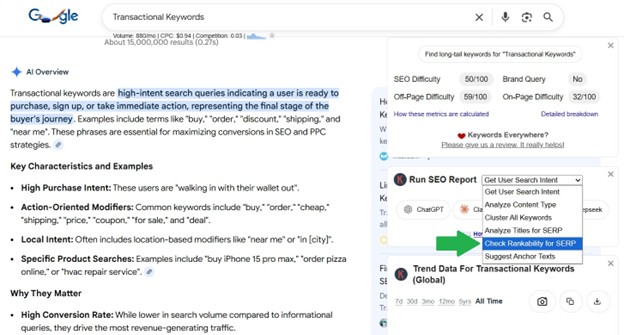


Click “Check Rankability for SERP” from the dropdown, and then select the LLM of your choice, be it ChatGPT, Claude, Gemini, or Deepseek. Wait for the LLM to run the report, and use the insights to guide your next steps.
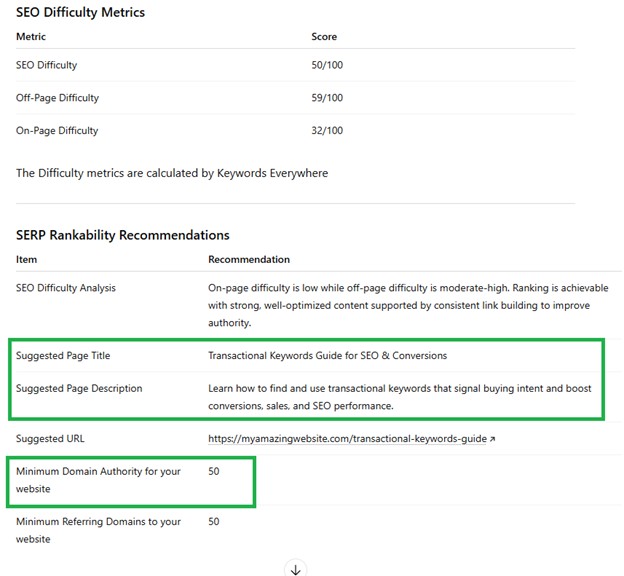
From there, you can see a suggested page title that instantly captures the angle and search intent based on the SERPs. You’re also given a suggested meta description and the DA score you need to compete.
You can interact with the AI model further to refine the title and make it more engaging and click-worthy, but the tool at least allows you to work from a clear starting point instead of figuring it out from scratch.
You can also preview how your title and meta description will appear in the SERPs using SEO Minion’s SERP Preview, helping you catch truncation, formatting issues, or weak phrasing before publishing.
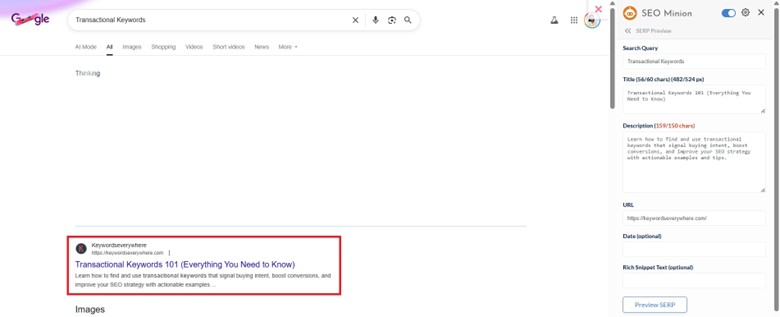
Getting this right is crucial for CTR, as users make split-second decisions based almost entirely on how your result looks in the SERPs.
Also Read: How to Use SEO Minion
There’s another completely free SERP Preview Tool powered by Keywords Everywhere, serppreviewtool.com. And it does more than just simulate snippets.
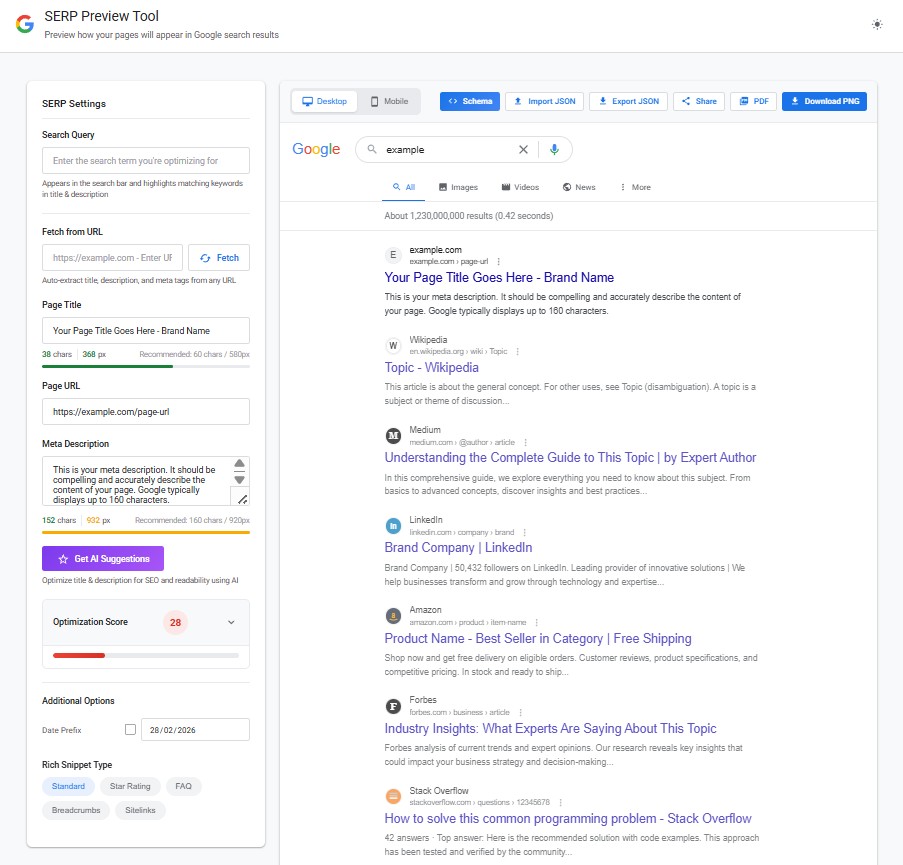
Paste a live URL and it automatically pulls your existing title and meta description, then highlights keyword placement so you can instantly see if you’ve front-loaded properly. It also gives you an optimization score, flags common issues (like length or weak CTAs), and even offers AI suggestions to improve your title.
You can preview rich snippets, test schema elements, and export or share the result with clients, all without creating an account.
Read More: Best Free Google SERP Preview Tool: Optimize Titles & Descriptions
2. Meta description
Meta descriptions were briefly used as a direct ranking factor in the early days of search, but Google stopped factoring them into rankings around 2009 due to widespread abuse and keyword stuffing.
Today, Google treats meta descriptions as a suggestion and may rewrite them up to 70% of the time. However, naturally incorporating the primary keyword increases the likelihood that your snippet is selected and displayed as intended.
Plus, when the search term appears in your description, Google bolds the text, which acts as a visual anchor that draws the eye and improves your Click-Through Rate (CTR).
Writing a clear, relevant description also reduces the risk of Google pulling awkward or out-of-context text from the page itself. While Google is excellent at understanding content, auto-generated snippets don’t always reflect the strongest or most click-worthy phrasing.
3. Header Tags (H1, H2, H3)
Header tags act as structural signals that help search engines interpret the hierarchy and meaning of your content. They’re not direct ranking factors on their own, but they strongly influence how Google parses and contextualizes a page.
Your primary keyword should appear once in the H1 to clearly establish the page’s main topic. Beyond that, it does not need to be repeated verbatim across multiple headers. Instead, use closely related terms, variations, or partial matches in H2s and H3s to support subtopics and expand topical coverage.
This approach reinforces relevance by showing alignment between your title, headers, and content without forcing repetition. In other words, strong header usage isn’t about stuffing the same keyword everywhere. It’s about creating clear thematic structure that search engines and users can both understand.
4. Introduction/ First 100-200 words
Google’s systems scan content from top to bottom, and strong early context makes it easier to understand what you’re covering from the start. That’s why many SEO best-practice guides suggest placing your primary keyword near the beginning of your introduction.
However, Google’s own documentation does not dictate a strict rule that a keyword must appear in the first 100-200 words to rank. The idea of a rigid first-100-words rule is also rather constraining. Google’s systems today are sophisticated enough to interpret topical relevance from context and semantic signals throughout the page, especially if the title tag, H1 heading, and structured content already convey the main topic clearly. If it fits naturally, use it. If not, don’t stress it. The best approach is simply to write a clear, helpful introduction that explains the topic upfront.
In fact, if you look at many top-ranking pages, you’ll notice the exact keyword isn’t always repeated word for word. Google connects the dots using related terms, intent, and topical depth. That’s why writing clearly and covering the topic well matters far more than hitting a specific word count or keyword placement target.
5. URL Slug
From a crawling perspective, the URL is one of the first pieces of metadata Googlebot encounters, so a descriptive slug like /keyword-placement-guide immediately communicates topic and intent, whereas parameter-heavy URLs like /page?id=8472&ref=blog offer little semantic value.
Including your primary keyword once in the slug reinforces consistency across your title tag, H1, and body content, which reduces ambiguity during indexing. Still, the impact is supportive rather than decisive. It helps clarify relevance but won’t compensate for weak content.
6. Body Content
Your body content does most of the heavy lifting. It’s where Google really figures out whether your page deserves to rank. A few natural mentions of your main keyword help establish context, but you don’t need to repeat it every other sentence or so.
Modern algorithms understand synonyms, related phrases, and overall meaning. So instead of obsessing over exact placement, focus on explaining the topic well. Cover the subject thoroughly and the keywords tend to fall into place on their own.
7. Image alt text
While alt text has SEO value, its primary purpose is accessibility. Screen readers rely on it to describe images to users, and Google uses it to understand visual content. So think description first, keywords second. If the image naturally relates to your topic, incorporating a keyword can help reinforce relevance. Otherwise, just describe the image accurately and leave the keyword out.
Image filenames work the same way. A clean, descriptive filename can add a bit more context, especially for image search, but it’s not a ranking booster by itself. If a keyword fits naturally and actually describes the image, great—use it. If not, forcing one in won’t help.
8. Image Internal Links and Anchor Text
Internal links help Google understand how your pages relate to each other and which ones are most important. Anchor text plays a supporting role here by giving context about the destination page, but it doesn’t need to be keyword-heavy to be effective.
The most reliable approach is to use anchor text that reads naturally and clearly describes what the linked page covers. Exact-match anchors can work occasionally, but repeating the same keyword-focused anchor across multiple pages often adds little value and can feel forced. This is especially true in link building, where repeating the same anchor text over and over may act as a spam signal rather than a boost.
Using a mix of phrasing—partial matches, related terms, and plain-language descriptions—helps reinforce topical relationships without over-optimizing. When internal linking is done well, it improves crawlability, strengthens topical authority, and makes your site easier to navigate for both users and search engines.
Keyword Placement in Content: Bonus Tips
Context is what makes keyword placement work. Search engines now evaluate pages based on how well ideas stay connected, not how often a term appears. Here are a few bonus tips to keep your keyword placement natural and effective.
1. Do keyword mapping
Keyword mapping is the process of planning where each keyword belongs before you start writing or updating content. Your primary keyword should define the main topic of the page, while secondary keywords support it by covering subtopics, variations, and related questions. Mapping this out upfront helps prevent overlap, repetition, and pages that feel scattered across too many angles.
2. Do keyword clustering
Instead of targeting one keyword at a time, group closely related terms together and address them within the same piece of content. Keyword clustering allows a single page to rank for multiple variations without forcing exact matches. It also helps search engines understand the depth and scope of your topic more clearly. You can use a keyword clustering tool to streamline this process.
3. Use lots of semantic keywords
Semantic keywords help search engines and AI systems understand not just what your page mentions, but what it actually covers. The deeper and more connected your language is, the easier it becomes for AI to place your content within its knowledge graph and topic models.
Related terms, synonyms, and supporting concepts (LSI keywords) signal topical depth, showing that your page addresses the subject as a whole rather than touching on it superficially. This kind of coverage increases the likelihood that your content is recognized as a reliable reference and surfaced in AI-driven results.
4. Avoid overoptimization
Overoptimization usually stems from trying to “do SEO” too aggressively. Repeating keywords, overloading headings, or forcing exact phrases into awkward positions can make content harder to read and less useful.
5. Avoid keyword placement that breaks flow
If a keyword disrupts readability, it is in the wrong spot. Keyword placement should feel invisible to readers. When a phrase stands out, sounds awkward, or pulls attention to itself, it is usually overdone. A good rule of thumb: if a human notices the keyword, it probably does not belong there.
6. Do not mix unrelated keywords on a single page
Each page should stay tightly focused on one topic. Mixing unrelated keywords in an attempt to rank for more queries often confuses both readers and search engines. When a page strays too far from its core subject, relevance weakens and performance usually follows.
7. Revisit Placement During Refreshes
Keyword placement is not permanent. As search intent shifts and SERPs evolve, where keywords appear may need to change as well. Content refreshes are a good time to move keywords into clearer sections, add supporting terms users now expect, and remove forced placements that no longer fit the page.
In modern SEO, search engines don’t reward keyword tricks anymore. They reward pages that stay coherent, useful, and on-topic. If your content flows logically, keyword placement usually takes care of itself.
FAQs
• Can proper keyword placement really improve ranking?
Keywords placed thoughtfully help search engines understand what a page is about. But rankings still depend on strong content, authority, and links. Placement supports good content—it doesn’t replace it, and adding more mentions won’t create results on its own.
• How many keywords should I include in a single blog post?
There’s no ideal number. Instead of counting keywords, focus on covering the topic naturally and thoroughly. One primary keyword with several related variations usually happens organically. Trying to hit a specific number often leads to awkward phrasing, which hurts readability and doesn’t improve rankings.
• Should I focus on targeting just one primary keyword per article?
Yes, generally. One clear primary keyword keeps your page focused and avoids mixed signals. You can still target related terms and variations, but having a single core topic helps Google understand intent and improves your chances of ranking for that specific search query.
• What is keyword density, and does it still matter for SEO?
Keyword density refers to how often a term appears compared to total word count. It used to matter more, but today it’s largely outdated. Google evaluates meaning and context, not percentages. Writing naturally and covering the topic well is far more effective than chasing density formulas.
• Should I add keywords in tags?
Generally speaking, it’s not worth it. Tags are meant for content organization, not keyword targeting. Using them as a place to stuff keywords often leads to overlap, index bloat, and diluted relevance rather than improved rankings.
• Does Google penalize websites for bad keyword placement?
Google doesn’t penalize minor placement issues, but obvious keyword stuffing or manipulative tactics can hurt rankings. Over-optimization makes content look spammy and degrades the user experience, which often causes the page to stop clearly answering the question it’s meant to solve. Clear, natural keyword placement consistently performs better than forced repetition.
• Should I prioritize writing for users or search engines?
You should always prioritize writing for users. Search engines are designed to reward content that genuinely helps people understand or solve something. When your content is clear, useful, and easy to follow, search engines can interpret and rank it more effectively.
• What’s the biggest mistake people make with keyword placement?
Over-optimizing. Stuffing keywords into every section, header, or sentence usually backfires. It hurts readability and adds no real benefit. Modern SEO rewards natural language and clarity, not mechanical placement rules.
• Do keywords in anchor text still matter?
Yes, but naturally. Descriptive anchor text helps search engines understand what the linked page is about and strengthens topical relationships between pages. It’s a useful context signal, especially for internal links. Just avoid over-optimized or repetitive exact matches. Clear, natural, and readable anchors work best.
• Is keyword density still relevant?
Not really. Keyword density used to be a popular metric, but modern search engines evaluate meaning and context instead of percentages. Chasing a specific density often hurts readability. It’s better to write naturally, cover the topic thoroughly, and let keywords appear where they make sense.
• Can you still rank even without thinking about keyword placement?
Yes, in some cases. Strong content that nails search intent can rank on its own. Just make sure to validate demand and difficulty with keyword research first, then reinforce the topic through clear titles, headers, and internal links. Focus on clarity and usefulness above all else. If your page answers the query better than what’s already ranking, keyword tricks aren’t that necessary.
Conclusion
At the end of the day, great SEO isn’t about squeezing keywords into every corner. It’s about smart placement that supports great content. Titles, headings, and early context still matter because they help search engines understand your page faster.
Still, don’t overthink it. Write for comprehension first and optimization second. As long as it’s genuinely helpful and relevant, it will outperform “perfect optimization” every time.