

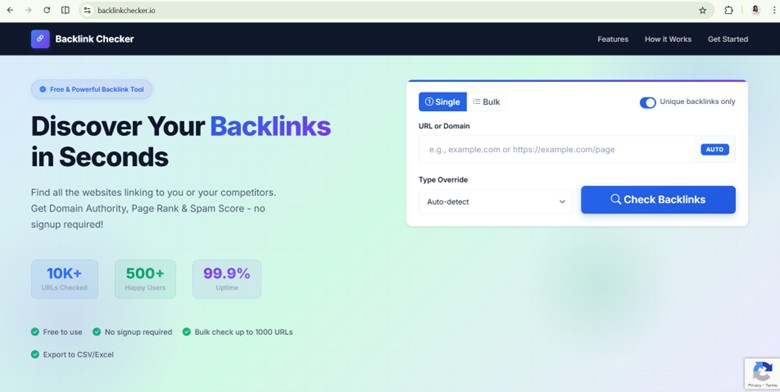
If you’ve ever wanted to see who’s linking to your website without paying for expensive SEO software, backlinkchecker.io is the answer.
It’s a completely free backlink checker that lets you uncover backlink data for any page or domain. There’s no sign-up wall, no trial countdown, and no feature restrictions. You don’t need to create an account or hand over your email just to run a report. Open the site, paste your URL, and start checking.
For quick audits, competitive checks, or client calls, that simplicity is honestly refreshing.
Why Use BacklinkChecker.io?
Besides the fact that it’s completely free with no login required, BacklinkChecker.io offers several practical advantages that make backlink research faster and more accessible. Here’s what sets it apart:
1. Instant Results with a Simple Interface
The interface is straightforward. Enter a page URL or root domain and the tool automatically detects what you’re trying to analyze.
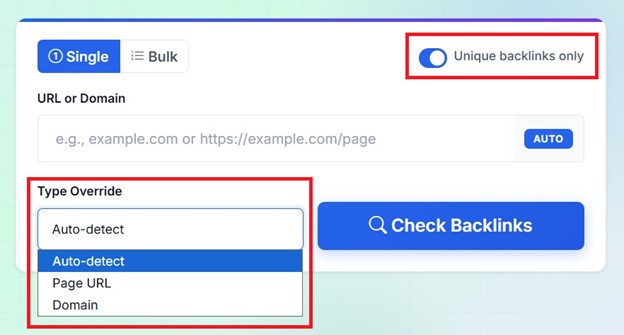


You can choose between page-level and domain-level analysis depending on what you want to examine. Select “Page URL” if you want to see backlinks pointing to a specific page, such as a blog post or landing page. Choose “Domain” if you need a broader view of all backlinks pointing to the entire website. Leave it on “Auto-detect” if you want it handled automatically.
You can also toggle the “Unique backlinks only” option to remove duplicate links, giving you a cleaner and more accurate backlink overview.
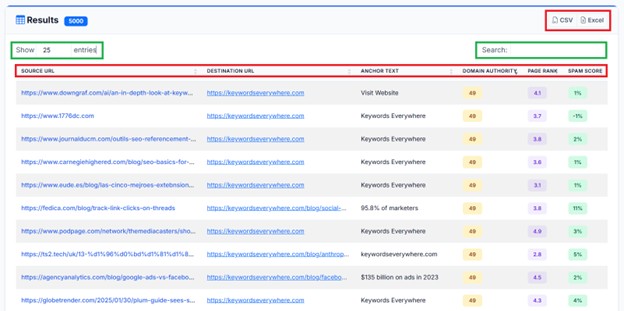
Once you enter your URL or domain and hit search, give it a few seconds, and you’ll have a complete overview of your backlinks ready to review. Everything is organized in a clean table format so you can scan results quickly without clicking through endless menus.
2. Key Metrics Included
The report cuts straight to the essentials, showing the linking source, destination URL, anchor text, authority metrics, and even spam score. You can easily adjust the number of entries displayed, search within the results, or download the data as CSV or Excel.
3. Bulk Checking Up to 1,000 URLs
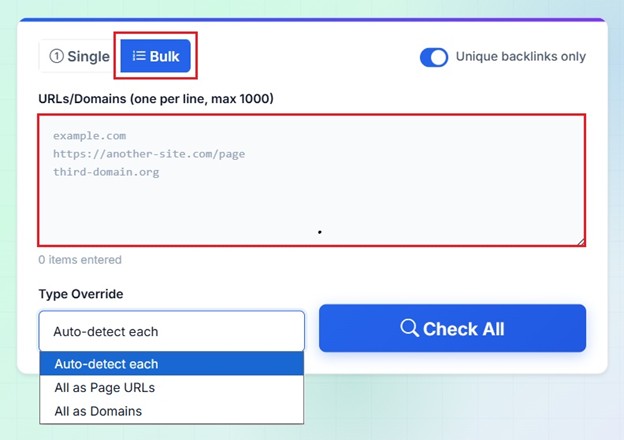
Besides single page checks, BacklinkChecker.io is built for scale. You can analyze up to 1,000 URLs or domains at once, making it a major time-saver for competitive analysis, content cluster audits, and large-scale research projects. Instead of running reports one at a time, simply upload your list and get consolidated backlink data in a single batch.
Most tools charge serious money for this level of scale. With backlinkchecker.io, you get it all for free.
4. CSV and Excel Export
After generating your backlink report, you can download the full dataset as a CSV or Excel file for deeper analysis. This allows you to segment backlinks by authority thresholds, flag potentially risky links based on spam score, or track link acquisition trends over time.
You can also plug the data directly into client reports, dashboards, or internal SEO documentation without extra formatting. The export mirrors exactly what appears in the table, so no data is lost in translation.
5. Powered by Keywords Everywhere API
One common concern with free tools is data quality. BacklinkChecker.io is powered by the Keywords Everywhere API. That means the backlink data comes from a structured source, not AI-generated guesses or scraped approximations.
You’re working with real backlink metrics, which makes the results far more reliable for decision-making.
When Should You Use BacklinkChecker.io?
BacklinkChecker.io can be helpful in several common SEO scenarios. Whether you’re checking your own site, sizing up a competitor, or reviewing recent link-building work, having quick backlink data on hand just makes things easier.
● When You Just Need a Quick Backlink Snapshot
If you’re preparing for a strategy discussion or reviewing a specific page, you don’t always need advanced link gap reports or historical charts. You simply need to see who’s linking, what anchor text they’re using, and how strong those referring pages are. BacklinkChecker.io gives you that overview immediately, without setup or configuration.
● Before Launching a Link-Building Campaign
Before allocating time or budget to link building, review your current backlink landscape. This helps you detect overused anchors, weak domains, and areas where authority is lacking. This gives your outreach efforts direction. So instead of blasting links everywhere, you’re reinforcing under-supported pages and giving them a fair shot at ranking.
● Competitor Page-Level Analysis
Sometimes the real insight isn’t at the domain level but at the page level. If a competitor’s pricing page or blog post is outranking you, running a quick backlink check can reveal whether that specific URL has strong external support. This helps you understand if rankings are driven by content quality, link authority, or both.
● Anchor Text Validation
Search engines assess not only the volume of backlinks, but also how anchor text is distributed. When distribution skews heavily toward exact-match keywords, it can raise red flags. When it lacks relevance, it weakens the SEO value of those backlinks. With BacklinkChecker.io, you can analyze anchor patterns at a glance and refine your link building strategy accordingly.
● Internal Linking Strategy Support
Not every page earns backlinks at the same rate. Some tend to accumulate more authority, and those high-authority pages can serve as internal power hubs. Once identified, they can be leveraged to support conversion pages, product categories, or cornerstone content.
For instance, if a research-driven blog post earns strong backlinks, it can pass value to a high-priority landing page through targeted internal links. Instead of letting link equity sit idle, you redistribute it intentionally.
● Spam Risk Screening
Backlink quality matters just as much as quantity. A quick scan of domain authority and spam score metrics can help you identify questionable links before they become a bigger issue. It’s not a full toxic link audit, but it’s a practical first filter for spotting obvious risks.
If certain links appear manipulative or irrelevant, you can investigate further and determine whether they should be removed or included in a disavow file.
● Content Strategy Guidance
Backlinks often reveal what types of content people consider worth referencing. If certain formats consistently attract links—such as comparison guides, data studies, or templates—that’s a strong directional cue for future content decisions. Instead of guessing what might earn links in the future, you can let backlink patterns guide your content roadmap.
● Bulk Competitive Research
If you’re comparing entire sections of competing sites, bulk checking makes the process efficient. Upload up to 1,000 URLs and quickly identify which pages have stronger external support, giving you a clear picture of competitive positioning in minutes rather than hours.
● Post-Campaign Validation
After running outreach or digital PR campaigns, you can use the tool to confirm whether links are live and where they’re placed. Instead of manually opening every referring page, you get a quick verification snapshot to ensure placements went through as expected.
For larger campaigns, this saves serious time. If you’ve pitched 50+ publishers or secured links across multiple landing pages, bulk checking lets you validate everything in one pass instead of spending hours clicking through sites one by one.
Takeaway
Not every backlink check requires enterprise software. Sometimes you just need fast, reliable data you can trust. With API-backed metrics and full export access, BacklinkChecker.io keeps things efficient and practical.