

After MozCon 2016, when the growing impact of featured snippets was highlighted, SEOs suddenly needed a way to surface question-based queries at scale. Answer the Public filled that gap beautifully by visualizing Google autocomplete data into clean, digestible question clusters.
From 2017 to 2020, it gained serious traction through viral content marketing. Influencers and SEO blogs recommended it as essential for capturing position zero. The visual “search cloud” format made it especially appealing to content teams. By the time it was acquired by NP Digital in 2022, it reportedly had around 1 million monthly users, already cemented as a staple in the SEO toolkit.
But SEO evolved. AI Overviews, zero-click SERPs, and tougher competition changed the game. As SERP features like featured snippets became just one piece of the puzzle, professionals started favoring workflows that connect ideation to execution.
For a single blog post, Answer the Public might be enough. But once you’re planning dozens of pages or building topical authority, you need deeper data, competitive insights, and SERP-level analysis. That’s when alternatives make more sense.
Best Answer the Public Alternatives
If you’re wondering what other options you have beyond Answer the Public, there are several solid tools worth exploring. Here are the best Answer the Public alternatives to consider:
1. Keywords Everywhere
Plans start at: $7 per month
Free Trial: Freemium model
Both Answer the Public and Keywords Everywhere are built to help you understand what people are searching for. But the main difference is in workflow integration. Because Keywords Everywhere is a browser extension, you don’t feel like you’re “using a tool” in the traditional sense.
Keywords Everywhere overlays data directly onto Google, YouTube, Amazon, and other platforms. You’re researching in real time, in the actual search environment, so you don’t have to copy and paste keywords into a separate interface to get metrics.
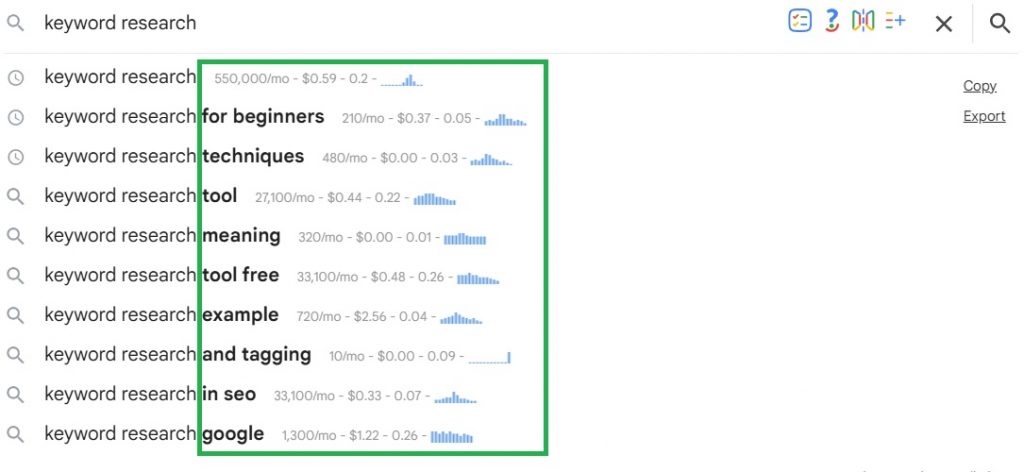
When you perform a search on Google (or other platforms), you can view keyword metrics directly under the search box and even within the autocomplete section:



You can also see related keywords, People Also Ask data, long-tail variations, trend patterns, and attached metrics such as search volume, CPC, and competition.
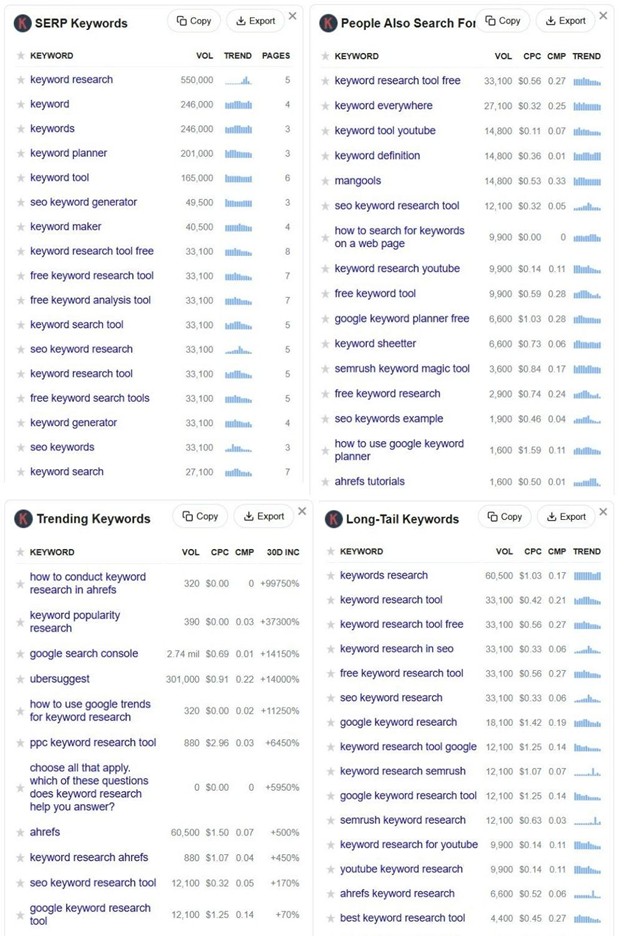
As you browse these widgets, you’ll notice the contextual grouping. Instead of dumping massive autocomplete lists, it surfaces tightly related variations and intent-aligned suggestions that translate directly into publishable content angles.
Answer the Public, on the other hand, is a typical standalone platform. You visit the site, enter a keyword, and explore the results in its visual question maps and search clouds. It’s easy to navigate and intuitive, but for users who do keyword research all day, being able to see metrics instantly inside the SERP can be more efficient.
Then there’s bulk analysis. Keywords Everywhere allows users to upload or paste large lists of keywords and retrieve metrics at scale.
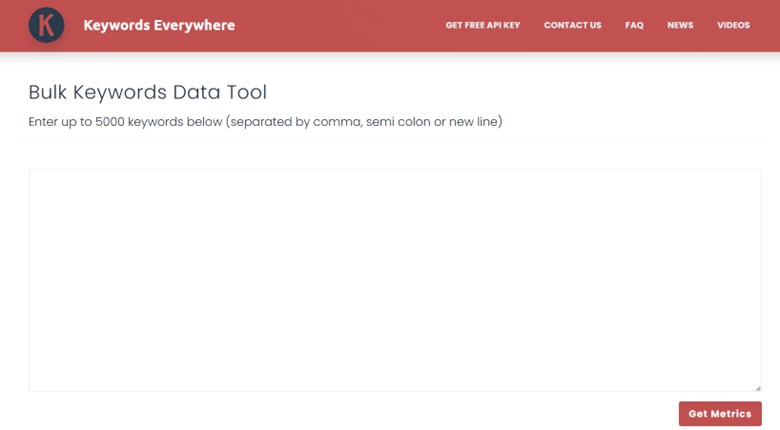
This is crucial for agencies, content teams, and advanced SEO practitioners. If you’re working with hundreds of keywords across multiple clusters, you need structured exports with volume, CPC, and competition.
Another key advantage is multi-platform research. Keywords Everywhere doesn’t just show Google data. It works across YouTube, Amazon, eBay, Etsy, and other search environments. That’s valuable for eCommerce sellers, affiliate marketers, and content creators who optimize across platforms.
Answer the Public did broaden its coverage, though. It now spans search engines, social media, shopping platforms, and AI models. At the end of the day, the right tool depends on your workflow, your goals, and how you prefer to approach research.
Keywords Everywhere vs Answer the Public: Verdict
If your priority is creative ideation and question-based exploration, Answer the Public still does that extremely well. It visualizes how people phrase their queries and makes it easy to uncover angles you may not have considered. For early-stage content brainstorming, that format can be super handy.
But if your focus is execution, validation, and scale, Keywords Everywhere can feel more aligned with modern SEO workflows. Because Keywords Everywhere integrates directly into Google and other platforms, it reduces friction. You’re not bouncing between tools or switching tabs nonstop to pull basic metrics. The data is right there — search volume, CPC, competition, related terms, and intent signals — while you browse. That tight integration makes research faster and more decision-driven.
In the end, the decision comes down to how you work. It ultimately depends on how you research, plan, and execute SEO.
2. AlsoAsked
Plans start at: $15/month ($12/month billed annually)
Free Trial: Limited Daily Credits (Free Plan)
AlsoAsked is a People Also Ask-focused research tool that turns Google PAA questions into a visual roadmap you can use for outlines, FAQs, and content clusters.
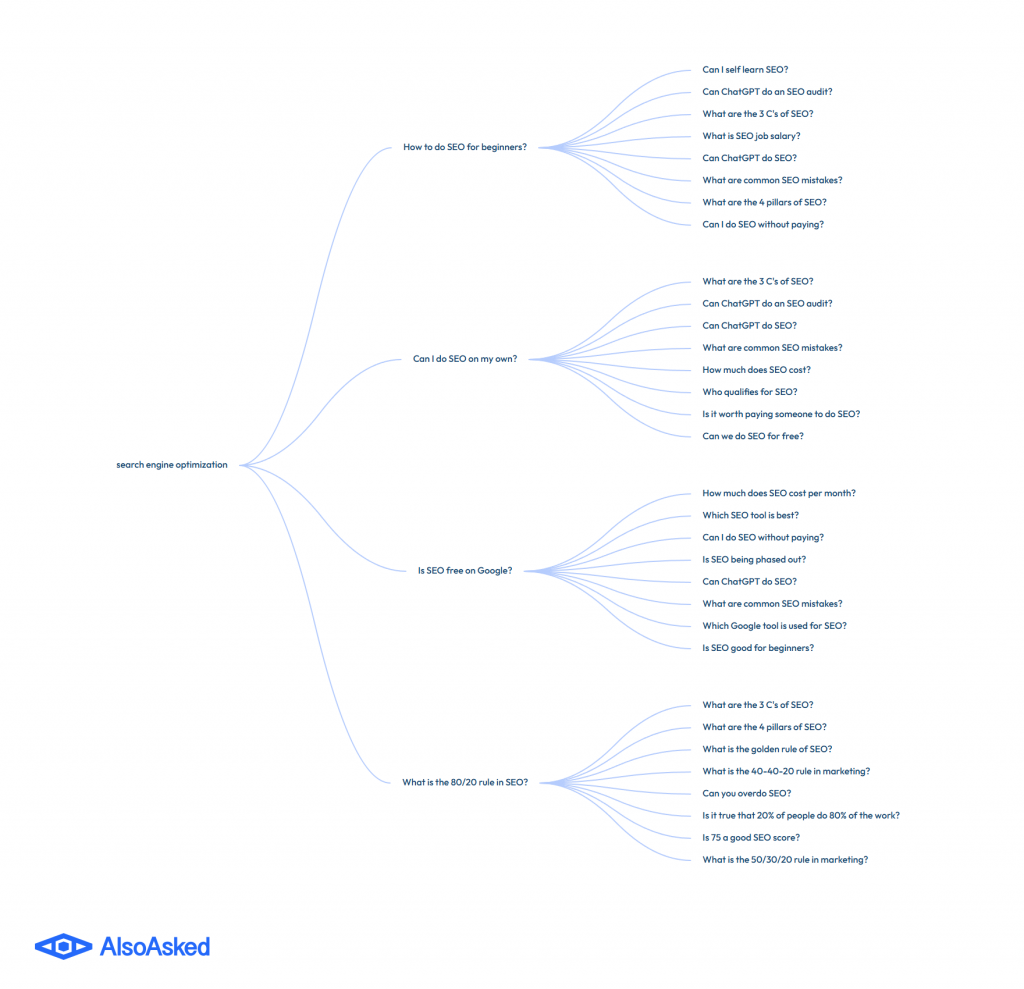
It stays relevant because PAA is the whole point of the product, and the team is clearly building around a specific niche. They are not just surfacing questions. They are making People Also Ask usable as a repeatable content planning workflow. With SERPs getting more crowded and clicks harder to win, PAA remains a practical way to capture follow-up intent and build pages that answer what users are actually asking next.
AnswerThePublic was originally known for autocomplete-based question ideas, but it also has added more PAA-style functionality recently. It now includes a dedicated People Also Ask section, and it can display those PAA questions in a tree view similar to what people typically associate with AlsoAsked.
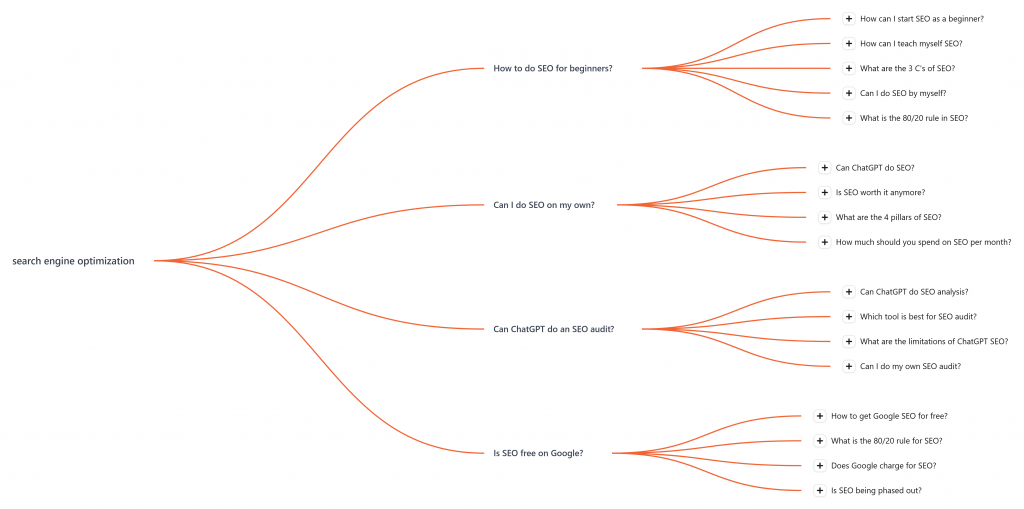
Where AlsoAsked still keeps a clear edge is depth and planning features that are built specifically around PAA at scale. It leans harder into clustering and roadmap creation with capabilities like bulk search uploads (up to 1,000 queries at a time), stronger export options (including spreadsheet-friendly exports), and higher-tier features like deep expansion and API access for teams who want to operationalize PAA research across many topics.
Plus, if you’re looking for free alternatives to answer the public, AlsoAsked lets you run a small number of searches for free (3 credits) without even creating an account, which is enough for quick PAA trees and basic cluster planning. Just note that “Deep Search” costs 4 credits, so you’ll need a paid plan for deeper expansion.
Answer the Public vs AlsoAsked: Verdict
AnswerThePublic now overlaps more with AlsoAsked thanks to its PAA tree view, so it can handle basic PAA discovery in the same platform you use for ideation. However, AlsoAsked stays relevant for teams and heavier workflows because it goes all-in on PAA planning features like deeper expansion, bulk runs, and export-first outputs.
If you are writing one-off posts as needed, ATP can do the job– not to mention it pulls question angles from multiple sources like search engines, socials, and even AI models. Once you are ready to turn those ideas into repeatable clusters, AlsoAsked is the smoother workflow.
3. SEMrush
Plans start at: $199/month ($165.17/month billed annually)
Free Trial: 7-day free trial
If you want to go beyond keyword expansion and actually build a full SEO strategy, SEMrush is a major step up.
Although both AnswerThePublic and Semrush help you generate content topics based on real queries, they are built for very different levels of work. AnswerThePublic is primarily an ideation and “question angle” engine. It pulls questions and phrases from multiple channels and presents them in visual maps and lists, which is great when you want to brainstorm content angles fast.
Semrush, on the other hand, is a full SEO suite. Instead of only generating ideas, it’s designed to help you validate, prioritize, and compete using data and competitive context.
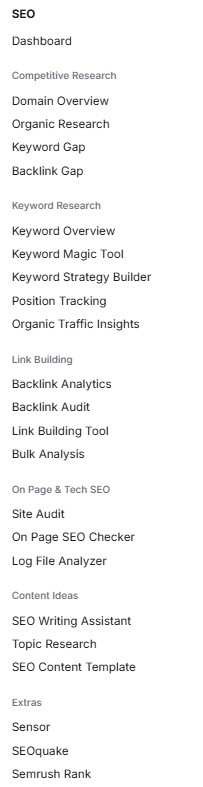
For keyword research alone, tools like Keyword Overview and Keyword Magic Tool provide metrics such as search volume, keyword difficulty, intent, and CPC, plus filtering and grouping so you can turn a seed term into a usable keyword set.
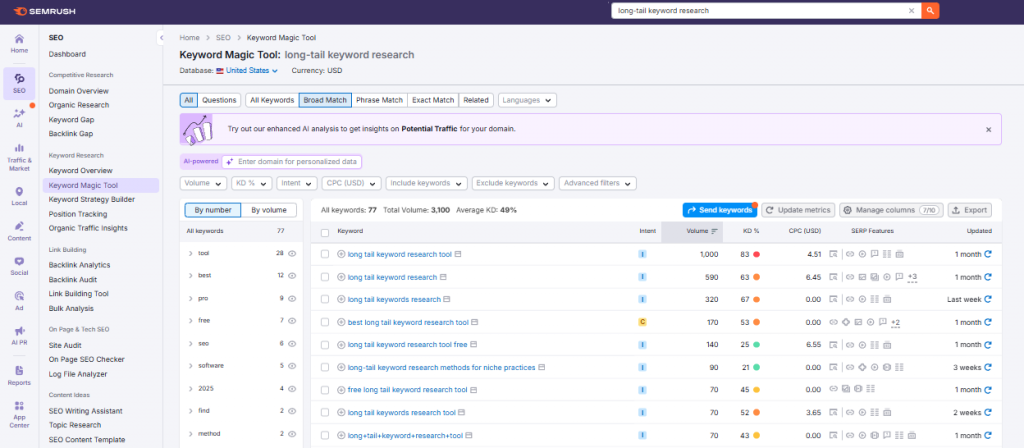
Where Semrush really separates itself is in end-to-end SEO execution. You can use it to size up competitors, uncover gaps, and support execution with workflows like site auditing, rank tracking, and content planning. If you’re planning a serious SEO campaign, Semrush reduces tool switching because research, validation, and next steps are all covered in one place.
In contrast, AnswerThePublic works like a search listening tool at its core. It pulls question-style language from real search behavior and turns it into organized clusters, which helps you spot how people talk about a topic and what they ask next. This is why it still performs well for ideation, FAQs, and early-stage topic discovery.
But it is no longer just that. Over the years, it has added more layers and sources, so it can support broader discovery workflows beyond classic autocomplete-style ideation. That is why it still performs well for ideation, FAQs, and early-stage topic discovery, while also helping teams pull angles from multiple discovery channels.
Answer the Public vs SEMrush: Verdict
If you mainly need ideas and phrasing, AnswerThePublic is usually enough. It is designed to surface question angles quickly, which makes it useful for blog ideation, outlines, and early topic expansion.
Semrush is more of a full workflow platform. Beyond keyword discovery, it helps you size up competitors, find gaps, and track performance over time with built-in SEO execution tools. Pick Semrush if you need competitive intelligence + end-to-end SEO execution tooling. It is the better fit when you want one platform to carry the work from research to validation to tracking, especially for ongoing campaigns.
4. Ahrefs
Plans start at: $129/month ($108//month billed annually)
Free Trial: No Free Trial
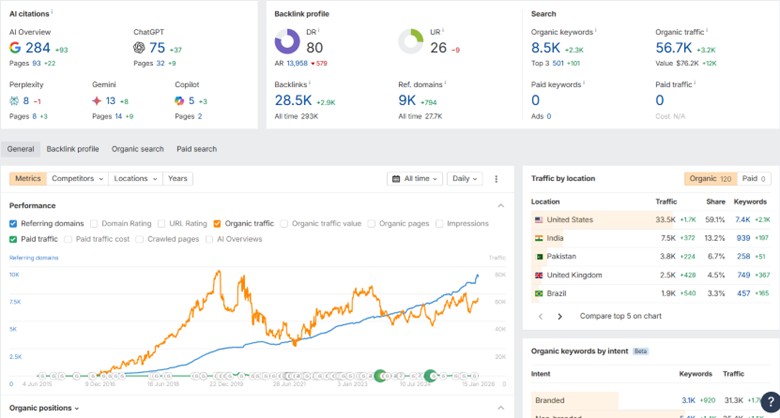
Ahrefs is another SEO platform that goes way beyond idea generation. It’s built for keyword research, competitor analysis, backlinks, and figuring out what it’ll actually take to rank.
For starters, Ahrefs’ Keywords Explorer doesn’t just hand you keyword ideas. It gives you the full context– search volume, ranking difficulty, SERP intent, and whether people are even clicking results or getting their answer without leaving Google.
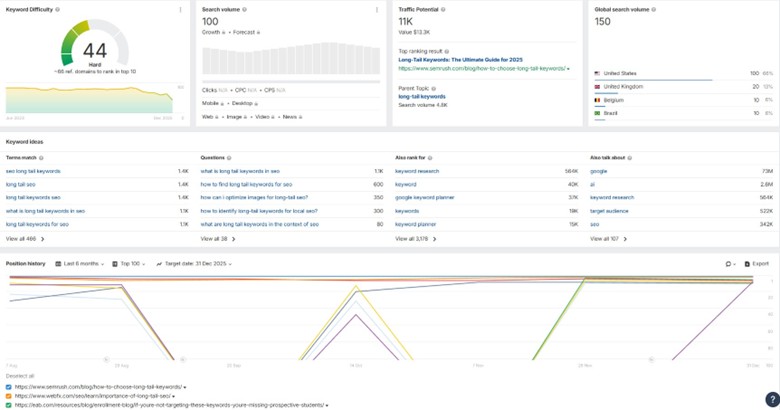
Then there’s Site Explorer where you can plug in a competing site and instantly see their top pages, the keywords driving traffic, and the “easy wins” they’re getting that you can realistically target too. You can also run Content Gap to find keywords competitors rank for that you don’t.
And to make sure your site can actually capitalize on all that content work, Ahrefs also includes Site Audit, which flags technical issues like broken links, crawl/indexing problems, slow pages, and other SEO blockers that could be holding your rankings back.
Finally, Ahrefs’ backlink tools are one of its biggest flexes. You can analyze referring domains, anchor text, link growth, and even find link opportunities by seeing who links to similar pages in your space.
Answer the Public vs Ahrefs: Verdict
Ahrefs is the stronger, more complete SEO platform, but it can also be overkill if you’re just trying to brainstorm content angles, build a quick FAQ, or plan a handful of posts without doing deep competitor research.
If your workflow is mostly brainstorm → outline → write, AnswerThePublic is usually the more practical choice because it stays focused on question-based discovery instead of pulling you into heavy analysis.
On the flip side, Ahrefs is the move when you’re auditing what already ranks, uncovering “easy win” keywords, and using link data to understand why competitors are beating you. Overall, the choice comes down to whether you need fast ideas or a full decision-making toolkit
5. Ubersuggest
Plans start at: $12/month (Lifetime Price: US$120)
Free Trial: 7-day free trial
Answer the Public and Ubersuggest are actually under the same umbrella. NP Digital (Neil Patel’s company) acquired AnswerThePublic in May 2022, and it’s positioned to complement Ubersuggest rather than compete with it. Ubersuggest came first as the core SEO suite, and AnswerThePublic was acquired later to strengthen the top-of-funnel “question discovery” side of the workflow.
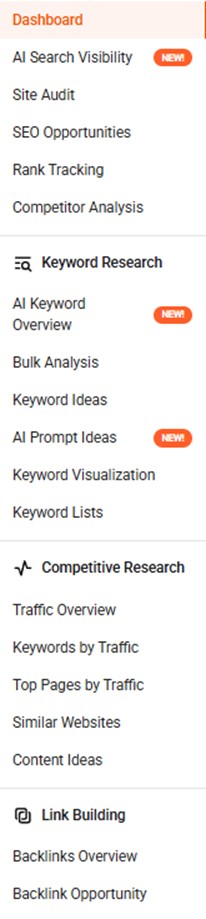
On the other hand, Ubersuggest gives you a more “all-in-one” coverage: keyword suggestions, search volume, keyword difficulty metrics, basic competitor research, backlink insights, rank tracking, and site audit features.
If you want a budget-friendly alternative that covers both ideation and execution, without jumping into a full enterprise SEO suite, Ubersuggest is one of the most practical picks.
Answer the Public vs Ubersuggest: Verdict
Ubersuggest is the bigger, more “do-it-all” tool, but it can be a lot if all you need is quick topic inspiration. If you’re mostly doing “brainstorm → outline → write”, AnswerThePublic is usually the better fit because it stays lightweight and just cranks out long-tail, question-based angles.
However, Ubersuggest makes more sense when you want those ideas to come with validation and follow-through—keyword metrics, competitor insights, backlink data, rank tracking, and site audits, so you can prioritize what’s worth publishing and improve what’s already live. It’s trying to keep the full SEO loop under one roof (even if it’s not on the same depth level as SEMrush/Ahrefs).
If you want something simpler than the big suites but more data-driven than ATP, Ubersuggest is a strong budget alternative.
Conclusion
Most users don’t switch tools randomly. They explore alternatives when their needs evolve. Maybe they want a broader SEO toolkit. Maybe they need more actionable SERP data. Maybe they’re managing multiple client campaigns at once.
Answer the Public may not cover the full spectrum of modern SEO needs, but it still delivers real value, especially for question-based research and content ideation. In the end, it comes down to your goals and choosing the tool that matches the level you’re operating at.