
Ahrefs is definitely a robust SEO tool, but not every SEO needs a full enterprise-level suite. Maybe you’re tired of high subscription costs, maybe your team doesn’t use most of the advanced features, or maybe you just want faster keyword data without the extra overhead. Whatever the reason, there are plenty of tools today that can match—or even outperform—Ahrefs in specific areas.
In this article, we’re listing the top Ahrefs competitors worth exploring, depending on your goals, budget, and workflow. But before we dive in, let’s set the context on why many SEO are considering Ahrefs alternatives.
Why Consider Ahrefs Alternatives?
Ahrefs originated as a backlink checker and remains the “king” in this area for many SEOs. It also boasts one of the largest and most up-to-date backlink databases, powered by the second most active web crawler next to Google. Over the years, it evolved into a full-blown SEO suite covering keyword research, content planning, site audit, rank tracking, and many more.
One of the main reasons they quickly built their “rabid fanbase” is their hands-on commitment to producing extensive and high-quality educational content. Their blog and YouTube channel teaches users how to get great results from SEO. Their blog traffic grew tenfold, and they basically bootstrapped their way to over $100 million in revenue just by hinging on organic growth and customer loyalty.
However, Ahrefs leans expensive, and those who do jump in despite the steeper pricing expect really strong results for their website or business. SEOs who are serious about backlinks are rarely disappointed, but for individuals and smaller teams, the cost can be hard to justify, given their simpler day-to-day needs.
Lots of users were also pretty put off when Ahrefs introduced their credit-based system, charging by credits with overage fees, which made costs less predictable. Many users found themselves hitting usage limits sooner than expected, especially when pulling multiple reports or working on larger sites. This led a lot of users to start looking for Ahrefs alternatives with more generous usage limits or transparent pricing models.
Whether you’re exploring ahrefs alternatives to find something cheaper or better, the tools below are strong contenders depending on your needs and budget.
Best Ahrefs Alternatives
Ahrefs set a high bar for what an SEO platform can do, but modern SEO workflows aren’t one-size-fits-all anymore. Some teams prioritize speed over depth, others need clearer pricing, and many just want to focus on specific tasks like content planning, rank tracking, or technical audits.
As the SEO tool landscape has matured, several platforms now excel in these narrower but highly practical areas, making them compelling alternatives depending on how you actually work day to day.
1. Keywords Everywhere
Plans start at: $7 per month
Free Trial: Freemium model
If you’ve only been using Ahrefs for keyword research, its price tag may be costing you way extra. For basic tasks like quickly validating keyword ideas, checking search volume, or brainstorming long-tail keywords, tools like Keywords Everywhere are often sufficient.
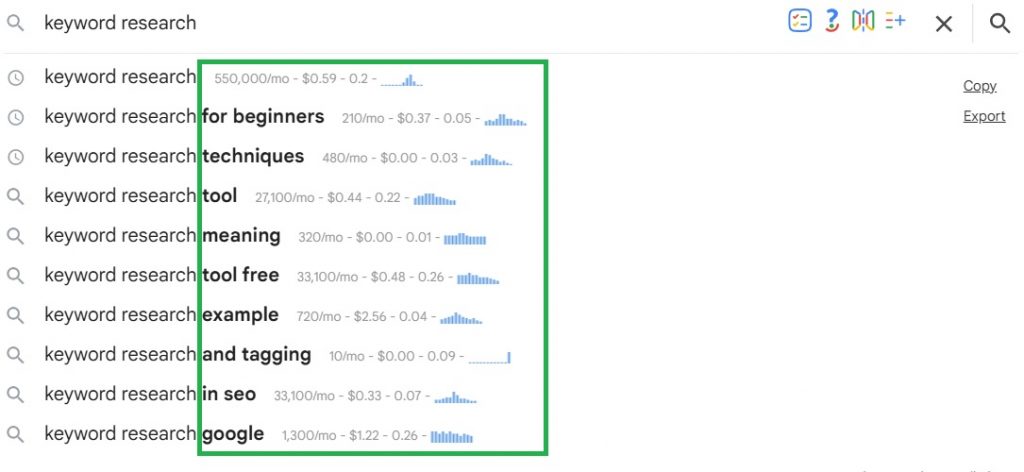
What’s unique and refreshingly convenient about Keywords Everywhere is how you can access keyword-level data without opening dashboards and managing a full SEO suite. As a browser extension, it brings keyword metrics directly into your search experience.



You can even readily find search volume and keyword metrics of the autosuggested keywords.
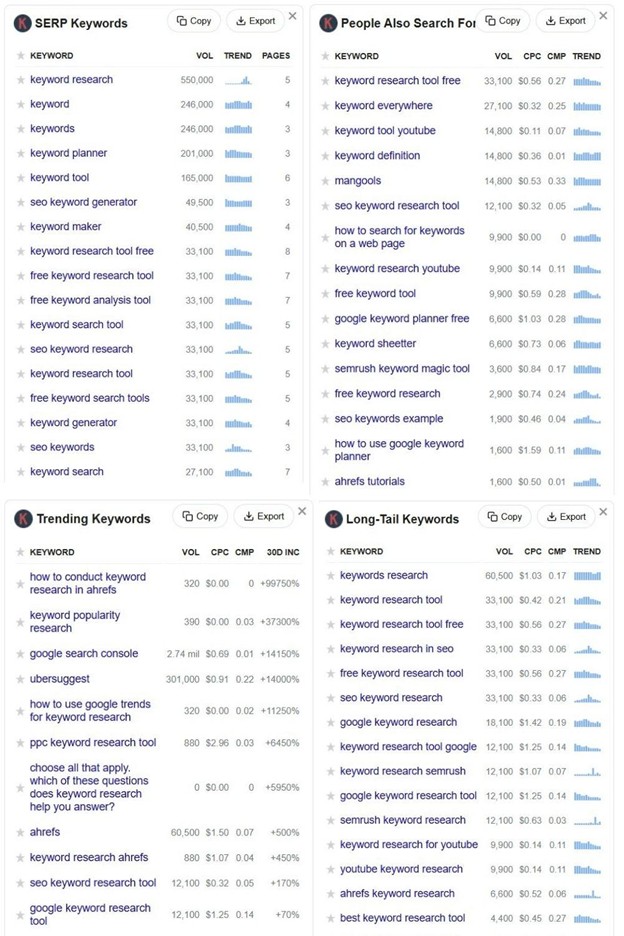
There are widgets for nicely curated keyword groupings as well, packed with relevant keyword ideas you can scan and validate on the spot.
You can access these features not only when browsing Google but also on YouTube, Amazon, Etsy, Ebay, Quora, and 20+ other major platforms. It’s now much easier to validate ideas as you go, without committing to a heavy SEO platform.
Plus, Keywords Everywhere is no longer just an in-browser tool or keyword research tool, either. It now has standalone tools covering many of the same core areas Ahrefs is known for, including:
- Backlinks Checker
- Website Ranking Checker
- Backlink Gap Analyzer
- Keyword Gap Analysis
- Organic Ranking Checker
- Website Traffic Checker
- Top Pages Finder
- Competitors Finder
- Keyword Difficulty Checker
- SERP Checker
- SEO Analyzer
That said, many people find Ahrefs’ learning curve to be rather steep because of how extensive its feature-set is. Keywords Everywhere, in contrast, is very user-friendly with virtually no learning curve, perfect for low-effort SEO work that still gets results.
Ahrefs vs Keywords Everywhere: Verdict
While Ahrefs is built for deep, enterprise-level SEO analysis, Keywords Everywhere earns its place as an alternative or a complementary tool by eliminating friction from the most common SEO tasks. It delivers search volume, CPC, competition, trends, and long-tail keyword ideas directly inside the SERPs, along with page-level metrics like traffic estimates, backlinks, and ranking keywords. For many workflows—content planning, keyword validation, competitor scanning—this is exactly the data people open Ahrefs for, just surfaced faster and without dashboard overhead.
If you’ve tried Ahrefs but only ended up using a fraction of its features, you can slash your SEO costs big time by switching to leaner yet perfectly workable tools like Keywords Everywhere.
2. SEMrush
Plans start at: $199/month ($165.17/month billed annually)
Free Trial: 7-day free trial
Semrush and Ahrefs are often treated like interchangeable tools. However, they shine in different areas, which becomes clear as projects scale.
The whole debate about Semrush vs Ahrefs practically centers on trade-offs: depth versus breadth, specialization versus consolidation, and simplicity versus all-in-one workflow.
Semrush is an all-in-one marketing solution with 55+ tools for SEO, PPC, social media, content marketing, local SEO, site audit tool, market research, and competitor research. Meanwhile, Ahrefs is repeatedly called out for having one of the most comprehensive and accurate backlink indexes and deeper link-related insights. How each tool handles research, tracking, and execution can feel very different in day-to-day use.
For instance, in terms of keyword coverage, Semrush consistently surfaces a broader range of keyword ideas, particularly long-tail and informational queries, which makes it stronger for discovery and early-stage research. Semrush also backs this up with its Personal Keyword Difficulty (PKD %), which measures difficulty based on your own site rather than a generic average.
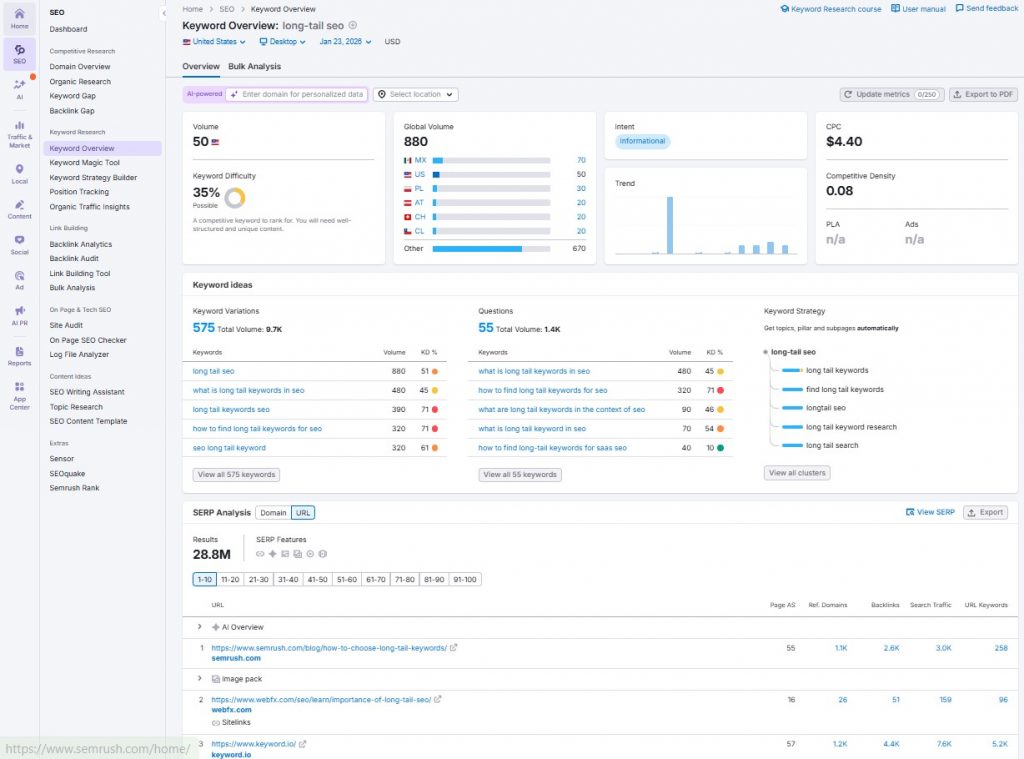
Another big difference shows up in backlink analysis. Ahrefs is widely regarded as having one of the most robust backlink indexes available, with faster link discovery and more granular link metrics. This makes it particularly valuable for link building, competitive link analysis, and technical SEO audits. Semrush also offers capable backlink tools, but they are more commonly used for high-level competitive insights rather than deep link investigations.
However, while Ahrefs has the strongest reputation for finding backlink opportunities, Semrush also supports link prospecting and takes the process further with an integrated outreach function.
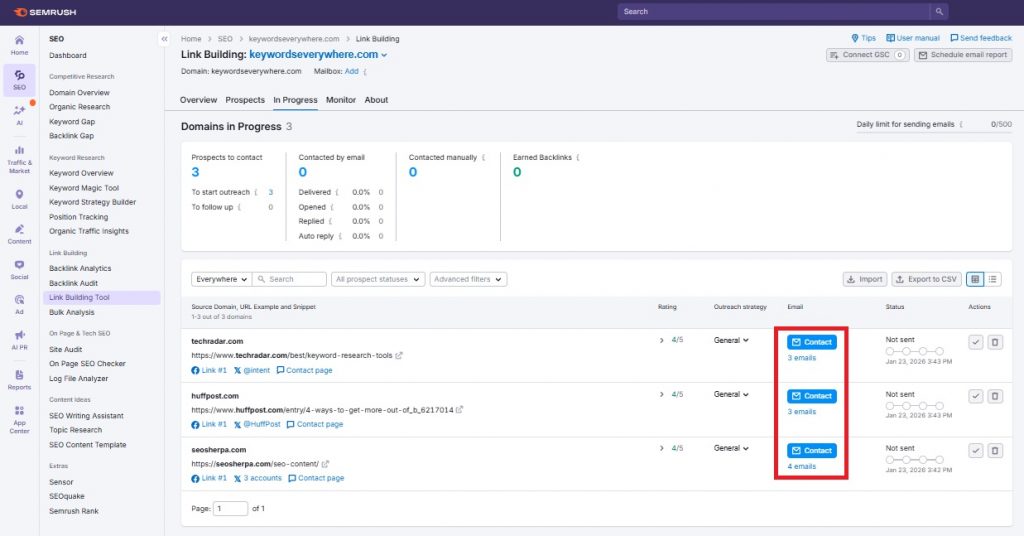
You can connect your email account directly to Semrush and send personalized outreach emails without leaving the dashboard, while CRM-style tracking helps manage and monitor the entire link-building workflow in one place.
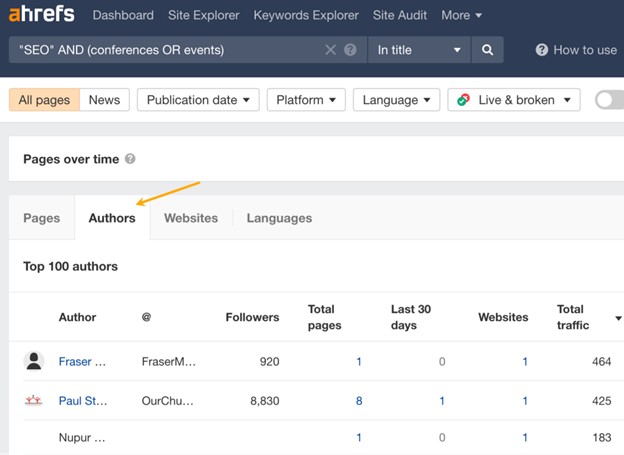
Ahrefs doesn’t handle email outreach, but it does a strong job of identifying prospects and assessing link quality. The Linking Authors tab in particular is a real time-saver, showing which authors are linking to a site and which pages they cite, making it much easier to move from link analysis to targeted outreach.
Search intent and SERP context also separate the two platforms. Semrush layers in intent classification, SERP features, paid and organic overlap, and competitive density, which helps users plan content strategically and understand how a keyword fits into a broader market. Ahrefs, by contrast, places more emphasis on traffic potential and click behavior, which is especially useful once a keyword has already been shortlisted. This difference in workflow extends beyond individual features.
At a strategic level, it ultimately comes down to scope. Semrush favors an all-in-one approach that supports SEO alongside adjacent marketing needs, while Ahrefs deliberately maintains a narrower, SEO-first focus. Both approaches are effective, but they serve different teams, workflows, and responsibilities.
Ahrefs vs Semrush: Verdict
Semrush and Ahrefs are two of the biggest names in SEO. If you’re not looking to downsize but to upgrade to more marketing capabilities, SEMrush is a strong all-in-one toolkit that extends beyond SEO into PPC insights, social media, and content planning.
And although both tools have always been quite expensive, Semrush often becomes a more cost-effective Ahrefs alternative if you use many of its tools regularly. It’s also more generous with daily reporting limits than Ahrefs, allowing you to pull more reports regardless of plan tier. But if you have more link-centric needs, Ahrefs definitely still has the edge. Overall, neither tool is universally better. It all depends on what you’re trying to get done.
3. SE Ranking
Plans start at: $65/month ($52/month billed annually)
Free Trial:14-day free trial (No credit card required)
Starting at $65, SE Ranking’s plans are significantly more budget-friendly than Ahrefs’ comparable tiers, making it a better choice for small businesses, freelancers, and growing agencies.
Here are a few areas where SE Ranking offers more value:
● Keyword tracking
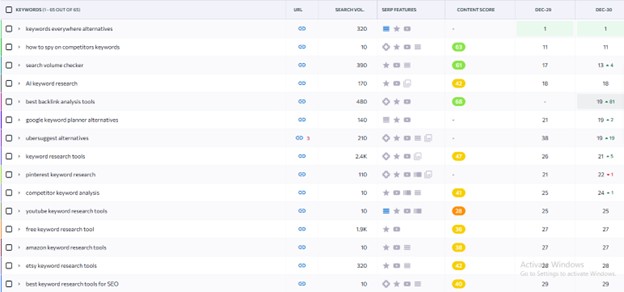
Ahrefs allows you to monitor keyword ranking positions across different search engines (including YouTube and Amazon, not just Google), devices, and locations. However, by default, its rank tracking updates are weekly, whereas SE Ranking provides daily updates in all plans (daily updates are an add-on cost in Ahrefs).
● On-page SEO audit
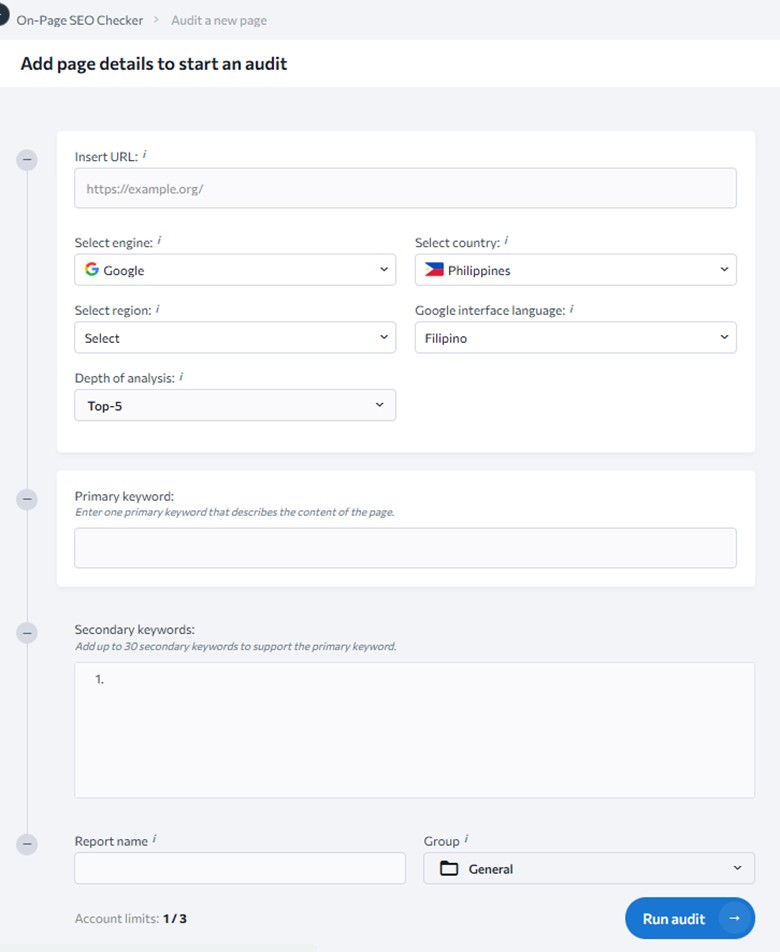
Ahrefs includes on-page analysis as part of its Site Audit, which performs over 170 checks. However, it does not offer a dedicated, standalone on-page SEO checker with page-level optimization guidance like SE Ranking. Also, performance metrics such as Core Web Vitals are surfaced via integrations with Google PageSpeed Insights or CrUX data, whereas SE Ranking displays these insights directly within its own dashboard.
● Integrated Content Marketing Suite
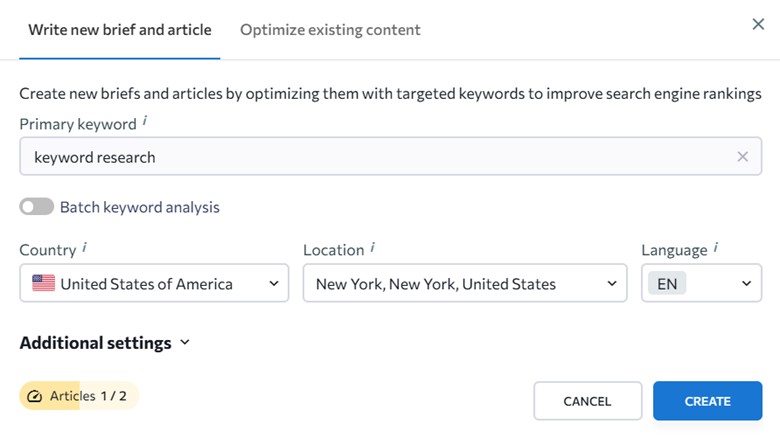
SE Ranking has a more developed content marketing suite with AI writing/editing assistance built-in, which Ahrefs only offers as more basic content idea generation or in higher-tier future releases.
Ahrefs vs SE Ranking: Verdict
There’s no denying Ahrefs is powerful, especially when it comes to backlinks, but its pricing, credit limits, and weekly rank tracking can be a turnoff unless you’re ready to pay more. SE Ranking feels more forgiving by comparison, with clearer limits and better day-to-day usability. For most core SEO tasks, it delivers great value, though its data depth may fall short for large-scale or ultra-competitive campaigns. Bottom line, if you don’t rely heavily on massive backlink and keyword datasets, SE Ranking covers 80–90% of SEO needs at a fraction of the cost.
4. Mangools
Plans start at: $30.50/month ($18.85/month billed annually)
Free Trial: 10-day free trial (No credit card required)
Instead of trying to do everything, Mangools sticks to five focused tools that cover the SEO basics most users care about: KWFinder for keyword discovery, SERPChecker for SERP competitiveness, SERPWatcher for rank tracking, LinkMiner for backlink analysis, and SiteProfiler for domain metrics. This already covers the core SEO workflows most people actually use, without advanced features (log file analysis, massive exports, complex filters) that many small teams never touch in Ahrefs.
However, Ahrefs’ biggest strength is its enormous backlink database, which is valuable for large brands and link-heavy strategies. Mangools’ LinkMiner only focuses on essential backlink insights (referring domains, link strength, follow/nofollow) that are usually enough for small sites, bloggers, and local businesses but may fall short if you need in-depth competitive research or large-scale SEO.
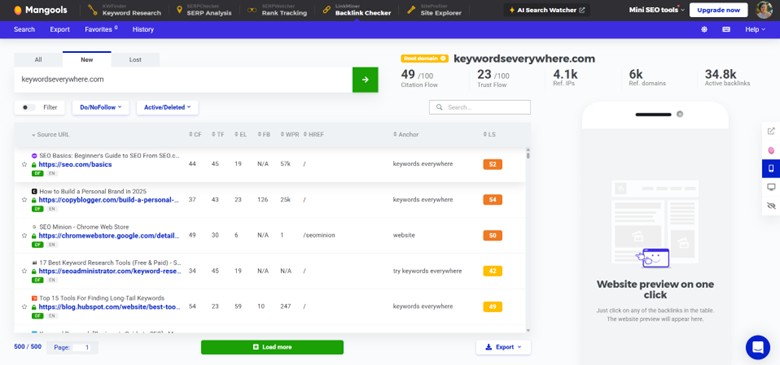
However, Mangools does strategically supplement its own data by licensing third-party metrics like Majestic’s proprietary link Trust Flow and Citation Flow inside LinkMiner. These well-recognized link quality and trust signals help spot strong vs weak links more quickly without requiring a separate Majestic subscription. But in terms of backlink index size and crawling depth, Ahrefs still leads the market.
Just take note that Ahrefs uses a credit-based system where many actions consume credits. Mangools uses clear, fixed limits tied to your plan, which makes it easier to budget and avoids surprise restrictions. For instance, Mangools includes daily keyword rank updates by default while Ahrefs typically updates rankings weekly unless you upgrade or use additional credits for more frequent checks.
Ahrefs vs Mangools: Verdict
At $30.50/month, Mangools covers what many users consider 80–90% of everyday SEO needs. Ahrefs, while far more powerful, is also significantly pricier and makes the most sense for teams that depend on large-scale backlink analysis and deeper competitive intelligence.
Overall, Mangools stands out as a clean, affordable, and lightweight toolkit– well suited for solo bloggers, small sites, and SEO newcomers who prefer fewer knobs, simpler workflows, and minimal setup.
5. Ubersuggest
Plans start at: $12/month (Lifetime Price: US$120)
Free Trial: 7-day free trial
Hobbyists and small site owners are drawn to Ubersuggest because it’s super budget-friendly, starting at only $12 per month. Their basic tier already offers the core SEO features you need like keyword research, site audit, competitor analysis, backlink tracking, rank tracking, and content idea generation. Ahrefs, on the other hand, can be powerful but also quite complex, especially for beginners. If you want workflow simplicity, Ubersuggest definitely feels more approachable.
For instance, with Ubersuggest, you get a detailed keyword overview that brings keyword data, keyword ideas, and content ideas together in a single, unified view. The tool recently released the AI Keyword Overview feature merging keyword-level data and content ideation features powered by AI.
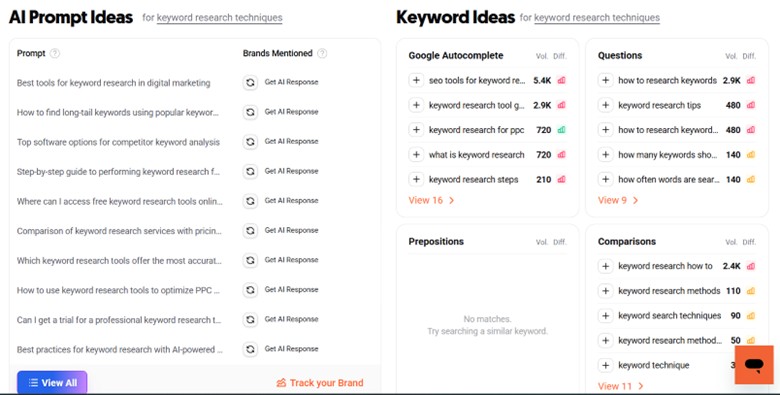
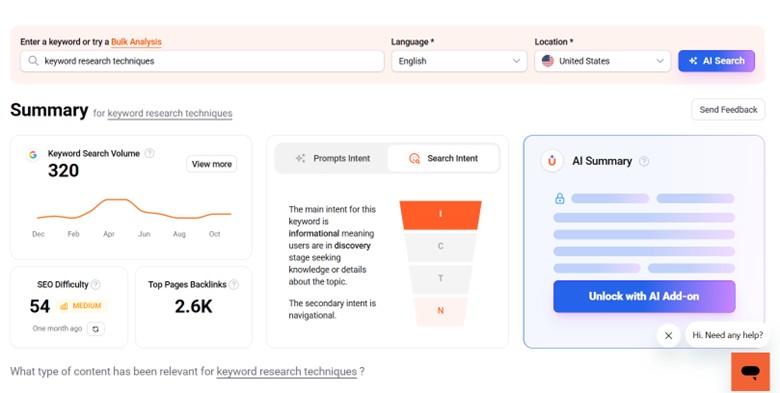
Ubersuggest also relies heavily on charts and graphs to visualize its data, making it really easy for users to understand trends and opportunities at a glance. However, if your SEO work depends on deep backlink intelligence, large-scale competitive analysis, and highly granular data, Ubersuggest’s lighter datasets and feature set may feel a bit limiting.
In the end, Ubersuggest is ideal if you want to research, decide, and publish quickly, while Ahrefs is perfect for those who need to analyze, validate, and really break into competitive SERPs.
Ahrefs vs Ubersuggest: Verdict
If you’re a beginner who just needs the SEO basics and don’t want to invest in expensive subscriptions, Ubersuggest can be a strong Ahrefs alternative. If you’re an advanced SEO downsizing to a smaller project or side website and no longer need deeper data as much, Ubersuggest can still offer faster workflows, simpler execution, plus lower overhead. With its one-time payment option for lifetime access, it’s definitely a major draw for small businesses and freelancers on a budget.
6. Moz
Plans start at: $49/month ($39/month billed annually)
Free Trial: 7-Day Free Trial
The overall industry narrative generally favors Ahrefs for depth, but there are specific use cases where Moz makes sense as a replacement or complement. For example:
- Budget-conscious teams– You want a full SEO tool without the higher cost tier that comes with Ahrefs. Especially if advanced backlink intelligence or large-scale content gap mining aren’t mission-critical, Moz delivers the core SEO workflow at a more accessible price point.
- Local SEO tracking– If you need to track keywords tied to specific cities or regions, Moz tends to deliver more actionable local insights. Its true geo-based tracking helps you monitor rankings at the city or regional level, so you’re seeing how pages perform in actual local SERPs, not blended national averages. This is a strong fit for many service-based businesses. Just take note Moz Local is a separate subscription from Moz Pro and is not included in the standard Moz Pro plans. You need to pay for it independently if you want local listing and reputation management tools.
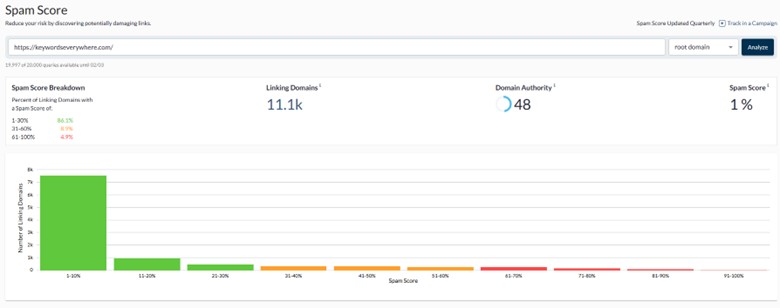
- Spam evaluation– Moz’s Spam Score is still fairly unique. Instead of just assessing link quality, it flags domains with spam-like patterns outright, which is helpful for audits and outreach decisions.
- Opinionated, decision-forward UX
Moz is intentionally more prescriptive in how it presents data, often guiding users toward a clear answer to “Is this worth targeting?” rather than leaving interpretation entirely up to the user. Ahrefs, by contrast, is more exploratory—“Here’s all the data, now figure it out.” This makes Moz easier to operationalize for teams, junior SEOs, and client-facing workflows.
- MozBar as an SEO staple
MozBar is an old-school SEO favorite that still does its job well– quick authority checks, link context, and spam signals without any setup. Ahrefs provides SERP overlays as well, but MozBar stays popular because it’s simple, familiar, and instantly actionable.
- Authority metrics people recognize
Moz’s DA and PA remain common reference points in SEO reporting. Ahrefs’ DR and UR work well too, but Moz’s metrics tend to be more recognizable to clients and decision-makers.
- Metric-driven on-page optimization (page-level)
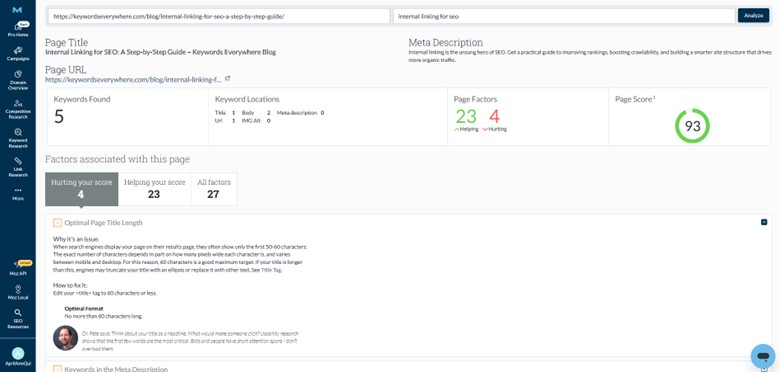
Moz includes a dedicated On-Page Grader that scores individual pages and provides concrete, keyword-specific recommendations. Ahrefs also offers content analysis and SERP insights, but there’s no built-in on-page tool like Moz’s that grades pages and tells you exactly what to fix.
Moz vs Ahrefs: Verdict
Moz Pro is business-friendly enough as an SEO toolkit. If your SEO work needs to balance cost, usability, and practical execution, Moz is a solid option either as a replacement for Ahrefs or as a complementary tool alongside it. However, if you live and breathe link building, competitor teardown, and large-scale data analysis, Ahrefs is likely the better tool for you.
Final Thoughts
There’s no question that Ahrefs is incredibly powerful, especially for teams that rely heavily on backlink data and competitive insights. However, with AI search reducing the need for brute-force keyword and link analysis, SEO workflows are changing. If your strategy is more content-led or experimental, lighter and leaner Ahrefs alternatives may be the better option.

