
Moz began as a tight-knit blog and online community in 2004, where SEO experts and enthusiasts actively shared ideas and research. The blog took off, evolved into a small consulting firm, and eventually made the leap into SaaS in 2008 after noticing how underserved the SEO software space was. That move led to their first tool releases, including Linkscape, Rank Tracker, and the iconic MozBar.
Moz definitely helped shape the early SEO landscape, offering guidance and tools at a time when the industry had very few. But as search became more competitive and data-driven, many users feel Moz’s toolkit hasn’t really grown at the same pace.
If you’re feeling the same way, here are some Moz alternatives to consider:
Best Moz Alternatives for SEOs
The best Moz alternative isn’t the same for everyone. Ultimately, it comes down to what your SEO stack really requires. So, your chosen Moz Pro alternative should depend on your goals and budget. Here are some Moz competitors that can step in for different use cases.
1. Keywords Everywhere
Plans start at: $7 per month
Free Trial: None (But with Free limited version)
If you’ve been using Moz mainly for quick keyword checks and feel like you “don’t use it enough” to justify the subscription cost, then Keywords Everywhere is a solid Moz alternative at only $7 per month.
If you just want a simple, no-frills keyword research tool, Keywords Everywhere is a strong option because it lets you discover and validate keywords without having to log in to any dashboard or SaaS account. As a browser extension, you can uncover keyword ideas as you browse right inside the SERPs.
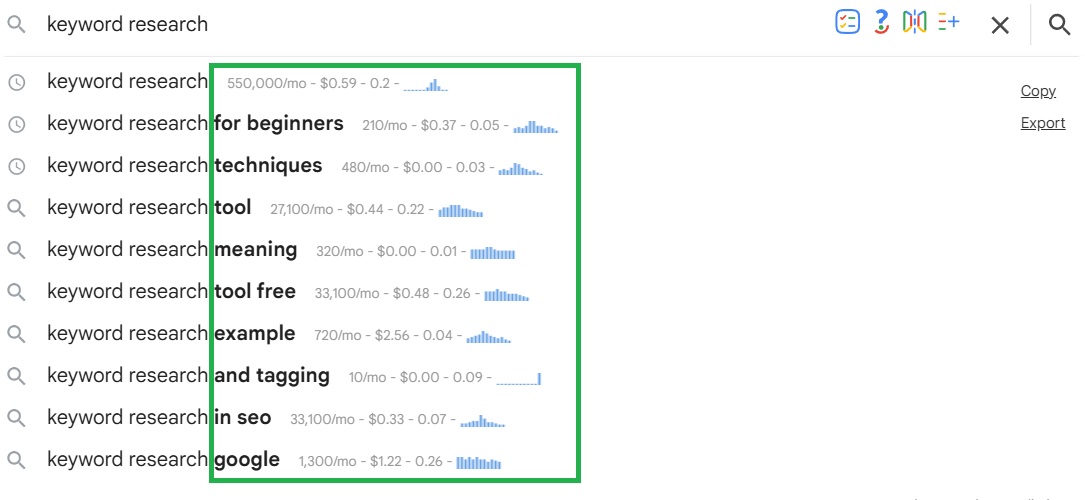
You can see keyword search volume and metrics directly in the autocomplete section:


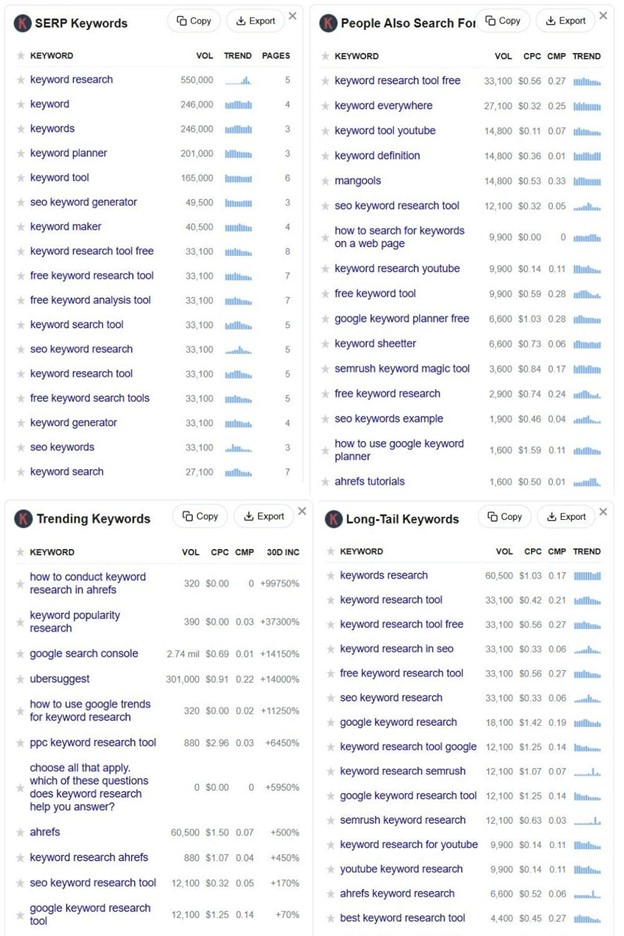
You can also view different widgets organized neatly into different categories:
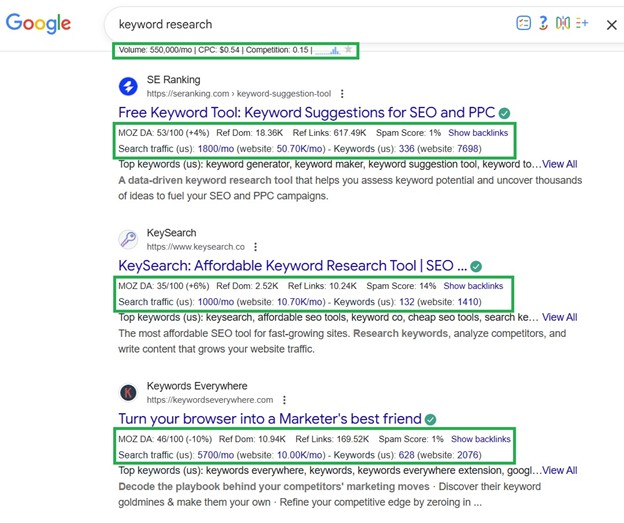
And if you love the widely popular MozBar, it’s also one of the built-in features of our tool. On top of what you typically see in a MozBar, we also layer over other key insights like how much traffic the page is getting as well as the entire domain. If you click these metrics, you can even see the list of keywords those pages and websites are ranking for.
This browser-based convenience can be enjoyed directly on Google, YouTube, Amazon, and 17+ other major platforms. If you just want a functional, ultra-affordable tool for quick idea generation, Keywords Everywhere is one of those tools you end up using non-stop.
Many content writers, solo creators, bloggers, and small businesses love how frictionless and lightweight it is— no learning curve, no dashboards to manage, and no heavy monthly fees.
Keywords Everywhere also bundles value-packed add-on tools that simplify your on-page, technical, and other SEO workflows:
- Keyword Planner– A powerful long-tail keyword generator that taps into the autosuggest APIs of Google, YouTube, Amazon, eBay, and Etsy to instantly feed you long-tail, question-based, comparison-based, and preposition-based keywords organized neatly by modifier.
- SEO Checker– SEO requires a lot of manual reviewing—titles, meta tags, URLs, speed issues, security flags, and more. SEO Checker handles these tasks for you by running a full automated audit of your site.
- SE Minion– You can analyze pages, check links, find errors, preview SERPs, review structured data, and validate international tags, all without switching between different tools.
Keywords Everywhere then goes well beyond basic keyword research. It’s a lightweight SEO tool built for everyday use without the overhead of a full software suite.
2. Ahrefs
Plans start at: $129/month ($108//month billed annually)
Free Trial: No Free Trial
If you’re looking for Moz alternatives mainly because of backlink data limitations, Ahrefs can be a good choice. Over the years, marketers felt like Moz’s link index updates more slowly, and it’s also way smaller compared to Ahrefs and Semrush. Nowadays, Ahrefs is gaining the most traction in terms of having the largest, freshest, and most frequently updated backlink indexes.
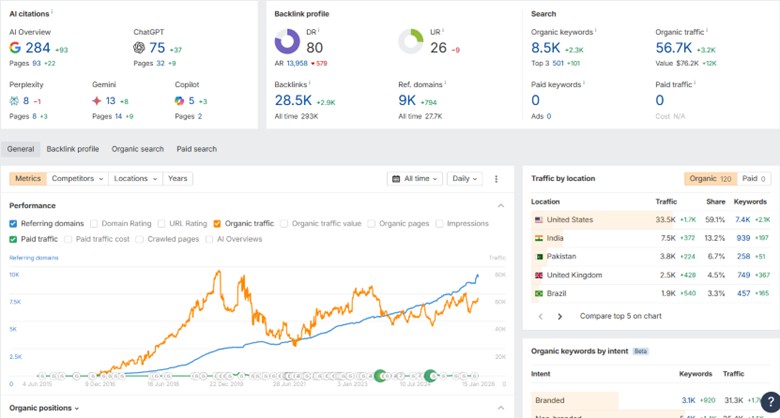
Ahrefs is a great Moz alternative if your main focus is organic SEO and backlink/competitive intelligence. Just take note that it costs over three times higher than Moz with the Lite Plan starting at $129 per month, but you’re also getting more robust site-audit, content gap analysis, and keyword coverage.
Ahrefs’ Keywords Explorer also gets frequent positive mentions as a top-tier keyword research tool. It provides robust metrics such as keyword difficulty, search volume, and even Traffic Potential, which estimates how much traffic a page could capture by ranking #1 across all related keywords.
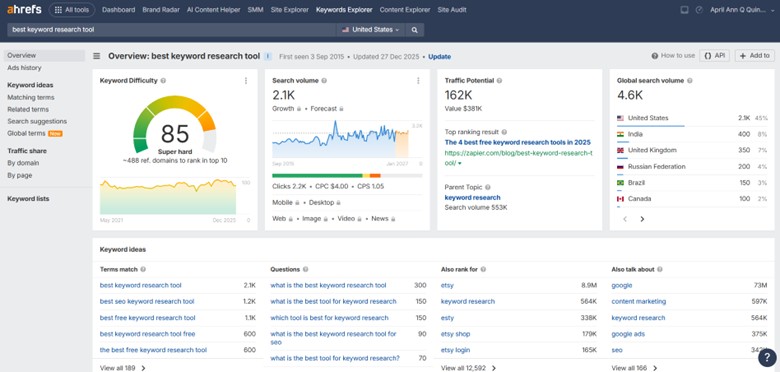
Ahrefs’ Parent Topic feature is also especially handy, helping you avoid over-publishing near-duplicate pages by showing when multiple keywords can realistically be covered with a single piece of content.
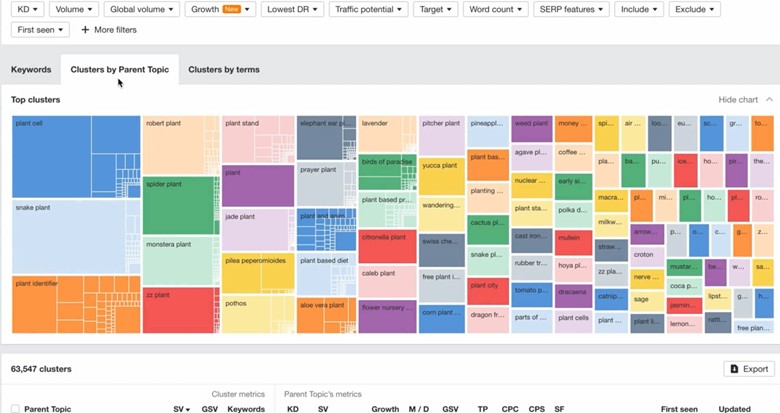
This view automatically consolidates massive keyword lists into clear topic clusters. On top of raw keyword lists, you get a visual map of clustered topics. Each box represents a keyword cluster, scaled by size to show how many related terms fall under it, helping you quickly identify priority topics versus long-tail niches.
In terms of keyword evaluation, while Moz has a Priority Score that ranks keywords using a composite opportunity metric, Ahrefs shows Traffic Potential, which reveals the broader traffic potential of a full topic rather than a single query. It also has a visual SERP overview, showing whether pages rotate over time or remain dominated by the same results.
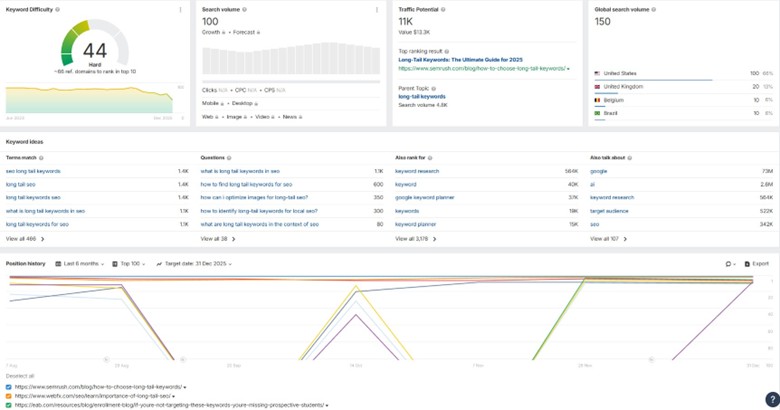
Overall, Ahrefs is the stronger choice for SEOs who have moved past surface-level metrics and need deeper visibility into backlink velocity, content gaps, and how individual pages accumulate traffic across hundreds of related keywords. By going deeper on analysis, Ahrefs helps teams execute more efficiently and reduce guesswork throughout the SEO workflow.
For smaller blogs and very small websites, an Ahrefs subscription might be overkill, but if you’re an SEO professional, agency, medium to large website, or multi-niche brand, Ahrefs’ highly advanced competitor backlink analysis and reporting tools can definitely come in handy.
3. SEMrush
Plans start at: $199/month ($165.17/month billed annually)
Free Trial: 7-day free trial
If you’ve been using multiple specialized tools to handle different SEO tasks and want to consolidate your SEO tech stack into a single, comprehensive platform, SEMrush is the answer.
Semrush is often called the “Swiss Army knife of SEO” because it’s so comprehensive and versatile, offering dozens of tools for keyword research, competitor analysis, backlink auditing, site audits, content optimization, PPC, and social media.
They have dozens of tools and features for their SEO dashboard alone.
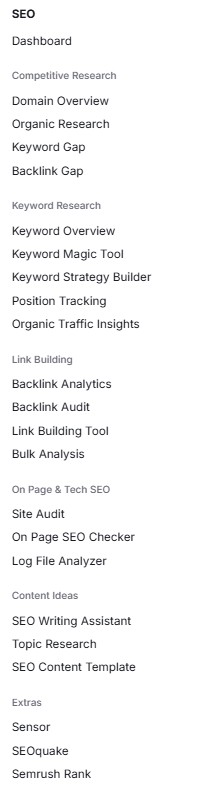
One common reason people switch to Semrush is competitive depth. Competitive analysis in Moz is largely organic-only, which leaves gaps for teams that want broader market context. Semrush fills that gap by combining SEO, PPC, and competitive intelligence in one place.
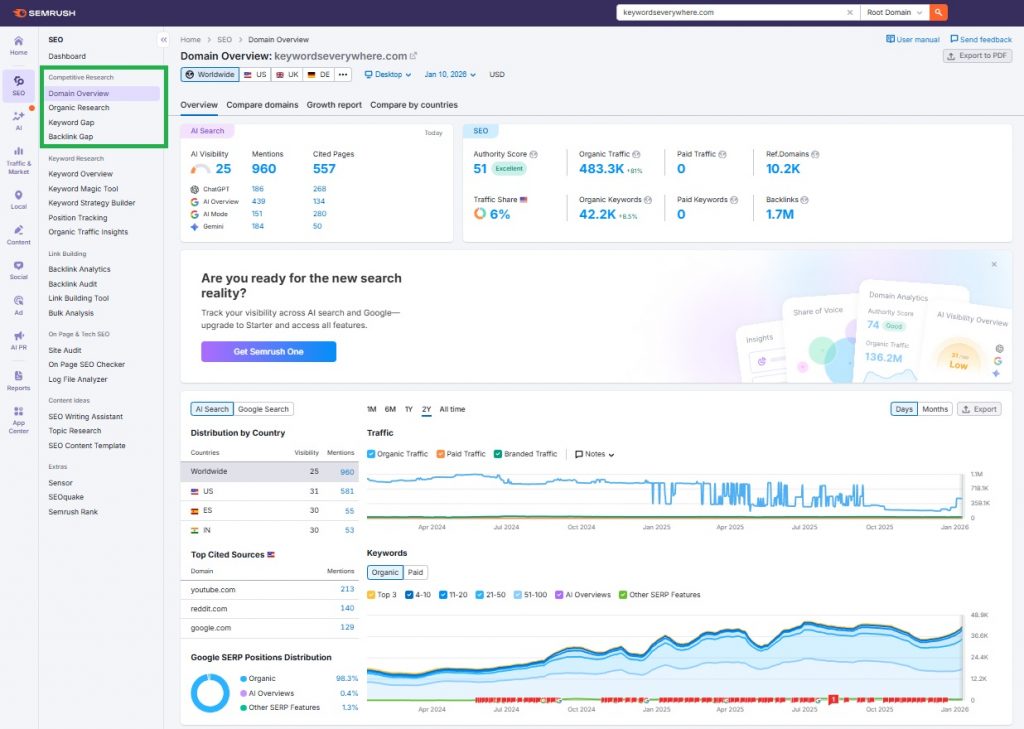
In terms of keyword research, Semrush’s Keyword Magic Tool pulls from a very large keyword database (billions of terms), so it tends to return more keyword ideas and deeper coverage. Moz, on the other hand, tends to return smaller, more curated keyword sets and emphasizes metrics like Priority Score to help users quickly decide what’s worth targeting.
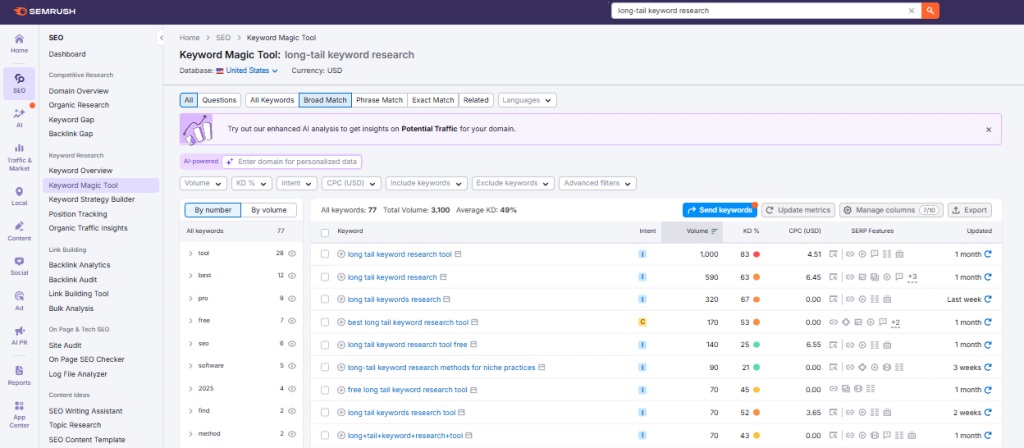
In practice, Semrush is better for teams that want to explore widely and build comprehensive content systems while Moz works well for users who prefer faster decisions with less data to sift through.
Operationally, SEMrush is simply built for scale. It supports higher crawl limits, more granular rank tracking across devices and locations, broader automated and white-label reporting, and deeper API access. With deeper historical data, large-scale SERP feature tracking, and intent-based topic organization, SEMrush gives teams a more connected view across SEO, PPC, and content. This makes it much easier to run large sites or multi-client, international campaigns, while Moz keeps things intentionally lean and SEO-focused.
Moz fits many SEO workflows as well, but it’s not always the best long-term fit once strategies mature. SEMrush definitely has a more complete feature-set, but the Starter plan also runs higher at $165, which is a bit steep for solo professionals or smaller sites that only need basic SEO.
And because Semrush is an all-in-one digital marketing platform, the learning curve is also steeper. However, if you’re a business doing SEO + content + ads + cross-channel marketing, SEMrush’s broad capabilities can definitely tie your entire strategy together.
4. SE Ranking
Plans start at: $65/month ($52/month billed annually)
Free Trial:14-day free trial (No credit card required)
SE Ranking has been catching on with more SEOs lately because it also offers all-in-one tooling without the heavy pricing, starting at just $52/month.
It offers lots of important SEO functionalities like keyword research, site audits, rank tracking, and backlink monitoring. If you have moderate SEO needs and have a limited budget, SE Ranking can help you cover what you need without overspending.
While Moz is well-known for its industry-standard Domain Authority (DA) metric and a deep backlink database, users often opt for SE Ranking because it provides a more robust and frequently updated suite of tools at a much more accessible price point for small to medium-sized businesses and agencies.
The primary distinguishing feature of SE Ranking is its highly capable and flexible Rank Tracker. SE Ranking automatically updates keyword positions on a daily basis across multiple search engines (including Google, Bing, Yahoo, and YouTube), providing real-time data on performance. Moz’s standard plans, in contrast, typically only update rankings weekly, which can be a significant drawback for fast-paced SEO management and reporting.
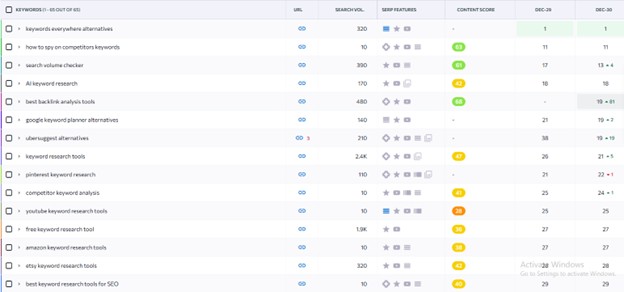
SE Ranking’s backlink data isn’t as deep as Ahrefs, and its feature set isn’t as broad as SEMrush, but it hits a practical sweet spot for budget-conscious teams and startups with straightforward SEO needs. Its cleaner, less cluttered interface also makes day-to-day SEO work feel more approachable, especially for users who don’t want to wrestle with overly complex dashboards.
5. Ubersuggest
Plans start at: $12/month (Lifetime Price: US$120)
Free Trial: 7-day free trial
Neil Patel’s Ubersuggest is another solid Moz contender. It started out as a simple keyword scraper but quickly evolved into an all-in-one SEO suite over the years. It now does keyword research, rank tracking, backlink reporting, and basic site audits.
A lot of SEOs love Ubersuggest because it looks and feels streamlined and easy to navigate, free of heavy dashboards and filters. Plus, the price point is very approachable, starting at $12 per month. You can even take advantage of their lifetime offer for just a $120 one-time payment.
Many users particularly highlight Ubersuggest’s keyword research as one of its strongest areas, especially for discovering long-tail keywords, related terms, and questions people actually search for. Moz’s keyword tools are still strong, but they’re better suited for more structured SEO planning rather than rapid content discovery.
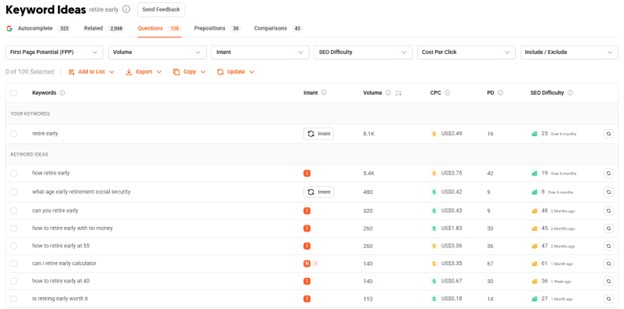
Another key difference is how each tool handles competitor insights. Ubersuggest’s Traffic Overview surfaces page-level traffic estimates and top-performing pages, making it easier to spot content opportunities and reverse-engineer what’s driving results.
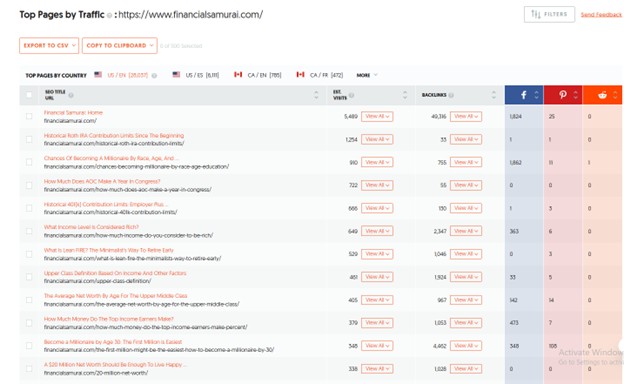
Moz relies more heavily on keyword and authority metrics, which are useful for planning but less direct for quick content execution. If you’re a beginner blogger, small business, or casual SEO needing something feature-rich, stable, and low-cost, Ubersuggest is definitely a practical and budget-friendly Moz alternative.
Final Thoughts
Whether you want something simpler and more budget-friendly or more enterprise-grade with robust capabilities, the quick list of Moz alternatives above helps you pick the right solution for your needs.
Overall, Moz is still a good and reliable SEO tool, maintaining a strong reputation for certain use cases. However, the SEO software market has just become more competitive and fast-moving than ever.
Bigger players have really pushed the envelope with more advanced features, and niche alternatives have also come to the surface, meeting the demands of those with limited or specific needs.
Despite the market shifting around it, Moz still has millions of loyal subscribers loving its intuitive interface and trusted toolset for foundational SEO and local SEO. It continues to be a steady, familiar tool for many SEO workflows.