
Let’s clear something up straight off the bat: Google doesn’t use LSI keywords, and it never has. The reason the term never really died down is because its underlying practice technically works. Let’s explore what LSI keywords actually are and how the idea behind them can still prove useful for your SEO strategy.
What are LSI keywords in SEO?
The technology of Latent Semantic Indexing (LSI) is based on a real information retrieval method patented in 1989 by researchers at Bell Labs, including Susan Dumais.
LSI keywords have come to be understood as words or phrases related to the target keyword. For example, if your primary keyword is “keyword research”, related terms might include “SEO”, “seed keywords”, “content creation”, or “search intent”.
Human beings find it effortless to associate words based on context. If someone mentions “coffee shop”, we can instinctively think up all the words that fit the context– “brew”, “latte”, “chill music”, even “afternoon chitchats”.
Computers, on the other hand, need “training” to understand word associations and meaning. This training is what Latent Semantic Indexing is all about. This concept does sound helpful, like a promising method that could help search engines move beyond keyword density.
Why do people think Google uses LSI keywords?
In its infancy, Google heavily relied on exact-match keywords. Thus, marketers had to obsess over a single keyword to the point of keyword stuffing in an effort to get good rankings. Fast forward today, Google has gone so much smarter. However, it was never indicated that they’re using LSI Keywords or adopting it as a ranking factor.
There’s no such thing as LSI keywords– anyone who’s telling you otherwise is mistaken, sorry.
— John Mueller
The closest thing Google launched which resembles LSI keywords is the Hummingbird update.
Released in 2013, it was considered a major overhaul of Google’s search algorithm, focusing on overall meaning and context instead of a rigid match of keywords. The Hummingbird update improved how Google understood intent, processed natural language like how humans do, and made sense of related concepts even without keyword matches.
When marketers realized that simply stuffing one keyword no longer worked, they sought out new terminology to stress the importance of using synonyms and related terms. The SEO community stumbled upon the concept of “LSI keywords”, which seemed to be a catchy and technical-sounding shorthand for the practice.
SEO influencers also hyped it up, attributing their success to the concept, and actual tools were even built around the term itself.
It’s fairly understandable why the term quickly became a hot topic and a buzzword. But then again, Google repeatedly denied the use of this technology.
If not LSI Keywords, then what?
Google does not use Latent Semantic Indexing because it’s an old technology, invented in the 1980s before the creation of the World Wide Web. It was only designed for smaller documents and static datasets and couldn’t possibly cover the entire web.
Google developed better and more scalable technology to understand queries and content contextually at scale. In particular, Google uses other sophisticated methods like:
1. Vector Embeddings
The outdated LSI technology is based on a sheer statistical approach. Relying too much on keyword co-occurrence and keyword density, it didn’t have the ability to truly grasp context and meaning.
Vector-based embeddings enable meaning-based retrieval instead of keyword-based retrieval. The approach is based on a mathematical technique that translates words and concepts into vectors or numerical representations that machines can understand. Words with similar meanings are then mapped in closer proximity in a multi-dimensional or vector space. Terms with different meanings are positioned farther apart. Proximity thus implies semantic similarity. When a user fires a query, Google then instantly calculates the distance between the query vector and all the stored webpage vectors in the database.
2. Knowledge Graph
Google introduced Knowledge Graph as early as May 2012. Its main function is to organize all unstructured data into a structured format, sorting “entities” (people, places, concepts, facts) and mapping the relationships between them.
For instance, it doesn’t just process “Barack Obama” and “Hawaii” as separate keywords, but it would know that Barack Obama was born in Hawaii. This relational database model brings order to disparate facts.
This organization and retrieval tool also avoids disambiguation. For instance, it can understand that “Mercury” might be a planet, a metal, or a deity—and choose the right one based on context.
Because of how fast, direct, and contextually relevant the resulting facts and answers are, the Knowledge Graph is powering lots of applications, including the Knowledge Panels, Voice Assistants, SERP Features, and the semantic Google Search itself.
3. Natural Language Processing (NLP) and Machine Learning Models
Vector embeddings are powered by machine learning models to learn the nuance of human context and language.
Google leverages the full power of modern NLP and AI to mimic human comprehension, helping it understand what users mean, not just the words they use. It builds upon the following AI systems, along with other features and signals:
● RankBrain
Google’s main purpose is to organize the world’s information and serve the best and most relevant results. However, it had always been a challenge how 15% of daily queries– that’s billions of queries per day– were novel and never-been-seen-before.
RankBrain solved this gigantic issue, deciphering anything novel, vague, and unclear. Even if users aren’t using the right vocabulary, RankBrain can predict what the user meant. Because of how it effectively nails search intent, it’s an important component of Google’s ranking system. It helps decide the best order for top search results.
Besides search intent, this machine learning model also looks at UX signals to find patterns that indicate relevance, including click-through rate (CTR) and dwell time. It helps interpret the whole search landscape to rank results in the most optimal order for users.
● BERT
In 2019, Google further enhanced semantic search with the introduction of BERT. Traditional NLP models could only process words sequentially (either left-to-right or right-to-left), which often ends up missing the full context of the sentence. BERT understands nuance bidirectionally, interpreting words that come before and after. Even prepositions and subtle connectors are accurately interpreted. BERT is not a replacement for RankBrain but an additional method in Google’s toolbox to further deliver the most helpful and relevant results.
● MUM
There are certain queries that require significant context and research across multiple languages, steps, and formats.
Take this query as an example:
“I climbed Kilimanjaro last October and now want to do Everest Base Camp next spring. What should I do differently to prepare?
It’s so complex and multi-layered that it demands a hyper-efficient system for comparing weather conditions, altitude, trail difficulty, gear and equipment, etc. MUM or Multitask Unified Model is created exactly for this function. It’s designed to synthesize information from various sources, trained across 75 languages, and meant to be multimodal, understanding various formats such as text, images, audio, and video. MUM is a thousand times more powerful than BERT, but it’s not meant to replace either RankBrain or BERT. Instead, it’s an added layer of intelligence to enhance the search process.
Though MUM is highly advanced, it’s also super resource-intensive, so Google doesn’t really use it for every single query. It only reserves it for highly complex searches that require deep, multi-step reasoning and cross-domain understanding.
● Neural Matching
Neural matching is another NLP system that allows Google to process and understand language at a deeper, more human-like level. It’s the system responsible for calculating the proximity of vectors using mathematical methods like cosine similarity. This helps Google serve the most relevant search results even if the query is expressed with alternate terms of vocabulary.
It’s mainly a sophisticated retrieval engine that reduces the time it takes for users to find the information they need, making the overall search process more intuitive and efficient.
The NLP and AI systems above complement each other within Google’s overall algorithm. They’re also largely built on the same transformer architecture that Google introduced in 2017. Google did not invent LSI technology, but it definitely became the driving force behind the biggest breakthroughs in semantic search. In fact, its Transformer neural network architecture became the foundation for almost all modern large language models (LLMs), including Google’s own BERT and GPT-3 and beyond.
Google has definitely come a long way in creating a more sophisticated and useful search engine that we now all enjoy.
Can LSI keywords still be helpful?
The quick answer is yes. LSI keywords’ benefits are real. While the term “LSI keywords” is incorrect, the underlying concept of using related vocabulary and context is central to how modern Google Search works. It’s then fair to consider LSI as an ancestor to modern search engine technology.
The more accurate term for LSI keywords is “semantic keywords”, supporting words and phrases that improve topical depth, semantic relevance, and intent alignment.
“Google does like synonyms and semantics, but they don’t call it Latent Semantic Indexing. For an SEO to use those terms can be misleading and confusing to clients who look up Latent Semantic Indexing and see something very different. There is no Wikipedia information on LSI Keywords. There is no information about how LSI Keywords might use LSI. There are no patents that explain how LSI Keywords work because they have never been patented.”
— Bill Slawski
It’s clear that Google always favors pages that satisfy search intent and relevance criteria. And although technically not “LSI keywords,” using relevant keyword phrases and variations helps search engines draw logical relationships and better understand the meaning and context of a page.
Besides other signals like backlinks, the presence of semantically related terms can help Google understand content at such a deep level. For instance, if you write an article about “link building”, other terms that commonly appear when you talk about the topic extensively include “guest posting”, “citations”, “directories”, “outreach”, or even “HARO”.
The deeper you explore a topic, the more terms and jargons surface, and that signals Google how fully developed your content is. Thus, if you only talk about a topic at a surface level, Google would also know because of the lack of any related and important terms that indicate breadth and depth. You can also dive into Google’s research paper and their ‘How Search Works’ overview to better understand how these signals work.
How to Identify and Use (LSI) Semantic Keywords
Whether you call them LSI keywords or not, adding related words and phrases can help improve your content’s relevance, boost your discoverability, and increase your search engine rankings.
And since you’re already producing content anyway, might as well do it right and take the time to optimize it the best way you can. Let’s talk about how you can find and use these semantic keywords that can make your content extra discoverable and effective.
How to find (LSI) semantic keywords
Before we talk about where you can find all these semantic keywords, let’s further cite some examples and distinguish them from the misattributed LSI keywords.
LSI vs Semantic Keywords
Since people always confuse LSI keywords with semantic keywords, you may assume they’re just one and the same.
Here are semantic and lsi keywords examples and how they differ.
| Aspect | LSI Keywords | Semantic Keywords |
| Scope | Specific word relationships | Broader conceptual relationships |
| Focus | Based on co-occurrence patterns | Focused on overall meaning and intent |
| Example | “Pizza” → “crust,” “sauce,” “cheese” | “Healthy eating” → “balanced meals,” “nutrition,” “wellness” |
If you take a closer look, LSI keywords are just citing basic, surface-level relationships like something fresh out of a thesaurus, e.g. cook→ fry, boil, roast, bake. They’re all about words and how frequently they appear together.
Semantic keywords, on the other hand, touch on concepts, variations, related subtopics, and even history. Full context is covered, leaving little to no room for ambiguity. For example, if the topic is about cooking, other words and phrases that are conceptually related can be interpreted such as famous chefs (Julia Child, Wolfgang Puck), history of culinary arts (Escoffier’s brigade system, the rise of Nouvelle Cuisine), recent events (Netflix food-culture documentaries, global Michelin star announcements), or even cultural influences (Italian regional cooking, Japanese kaiseki traditions).
Semantic keywords are more than co-occurrence patterns. They’re full-spectrum understanding and framework.
How to Find Semantic Keywords
Now, how do you find these semantic keywords to start optimizing your content the best way possible?
Even without a keyword research tool, you can find all these terms free of charge. Just check the following places on Google:
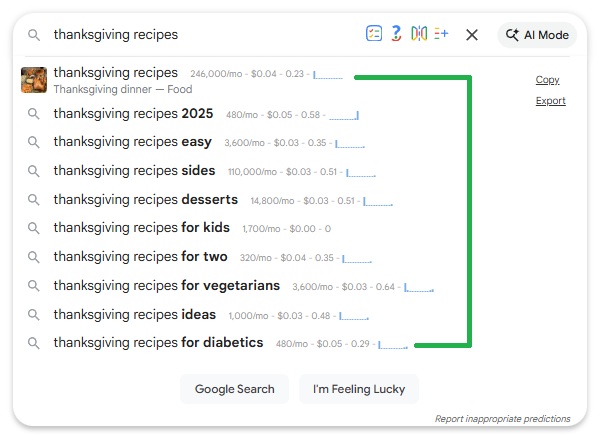
● Google Autocomplete
These autocomplete suggestions are based on actual, real-world searches, which would make your content extra helpful for more people and more relevant across variations of the query.
Whether you’re looking for more insights to develop your outline or finalize your keyword or even topic cluster, this can be your quick and easy brainstorming tool.
You can even validate your keywords on the go by installing our Keywords Everywhere browser extension to instantly view the search volume and other keyword-level data of the autosuggested terms.


Also Read: How to Use Keywords Everywhere (Step-by-Step Guide)
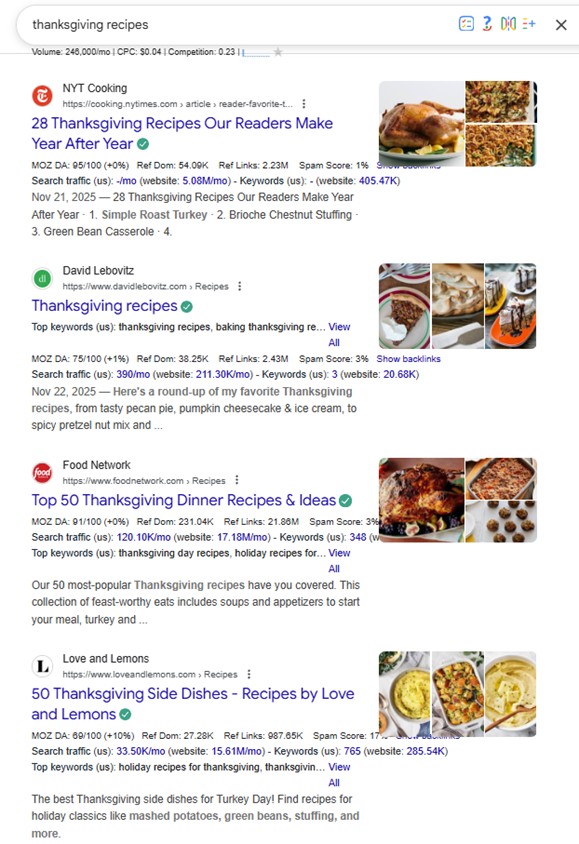
● Bolded Terms in Google Snippet/Meta Descriptions
Notice how Google automatically emboldens important terms in the SERPs. These terms highlight the concepts relevant to the user’s query and thus are a good source of related “LSI” entities and ideas.
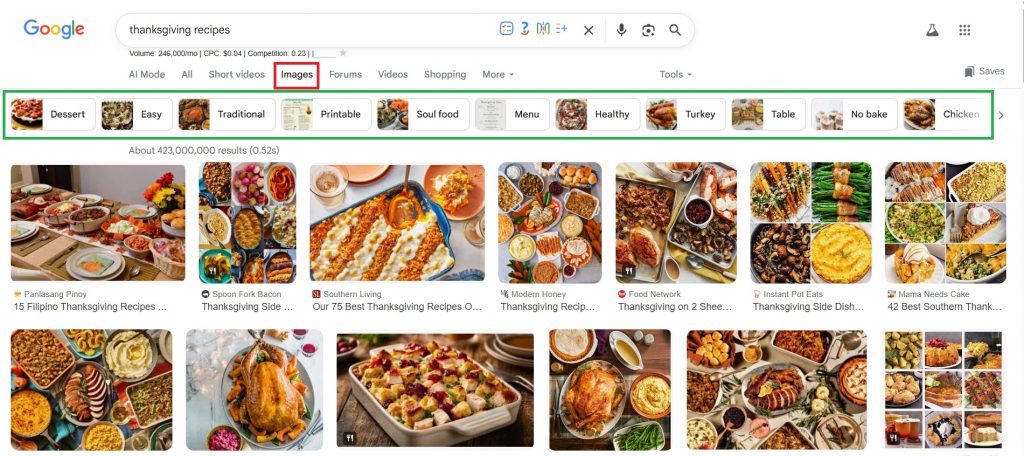
● Google Image Tags
Another easy way to find explicit textual context is Google’s images section, particularly the Image Tags. Google organized these search refinement chips to instantly reflect sub-intents for the query. This is another perfect place to grab relevant clusters of user intent.
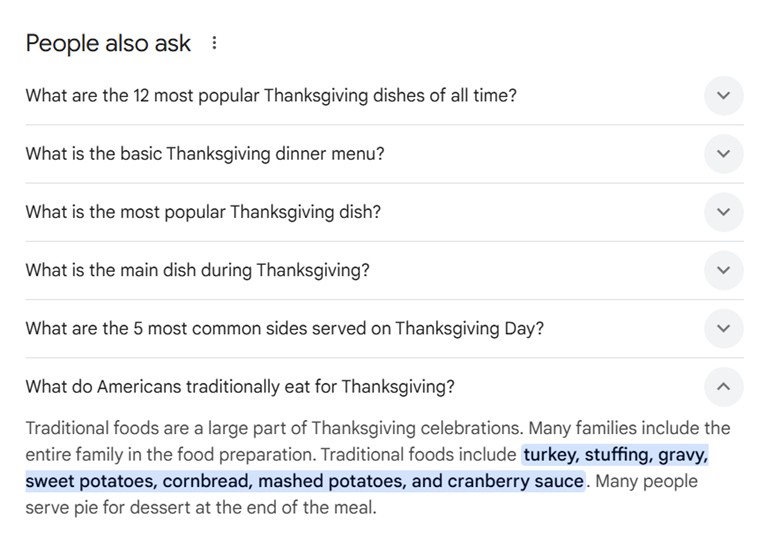
● “People Also Ask” questions
PAA questions are based on actual questions and sub-topics Google considers relevant to the query. You can find lots of tangential terms and questions you can include in your content to improve your topic coverage. Google also highlights important terms dynamically as shown below:
● “People Also Search for” Section
What makes this section extra valuable is that it’s predictive by design. It’s meant to anticipate and suggest related search queries that users typically explore next. Including these words and phrases in your content makes your topic development more comprehensive and semantically complete.
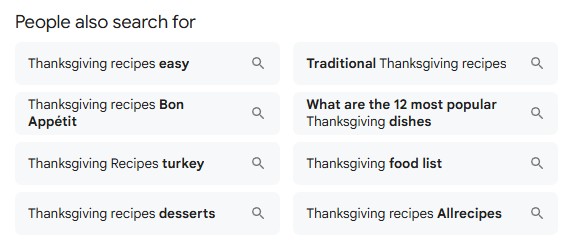
If you want instant access to a list of PAA keywords you can use, just download Keywords Everywhere browser extension to see this widget directly on Google as you search and browse.
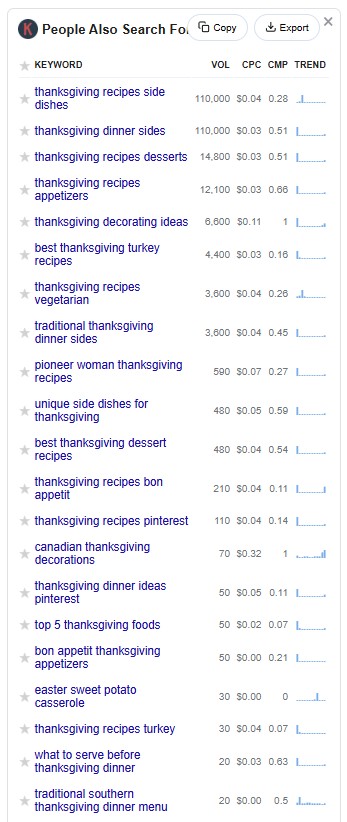
You can Copy or Export the list along with the search volume and other keyword metrics.
Technically, you can use any keyword research tool to find semantic keywords. There are even specialized LSI keyword generators meant to compile variations, synonyms, and subtopics. Just make sure to use them to enhance depth, and not to force keywords unnaturally.
How to use (LSI) semantic keywords
Now that you know where to intentionally look for these related search terms, let’s talk about how and where to insert them into your article.
First of all, you actually don’t have to be too hung up on finding “LSI” and semantic keywords. If you really know the subject matter, you’ll naturally be able to mention all the search terms that support the topic.
If you need to outsource help, make sure to hire or collaborate with experts in the niche. An expert would be able to:
- Ensure factually correct information
- Naturally talk about related entities and topics
- Use industry-relevant language
- Share related studies, updated statistics, and unique examples and insights
- Make your content look trustworthy in the eyes of both users and search engines
In short, having a specialist write your content will be way more valuable than spending hours looking for LSI keywords.
However, what semantic (LSI) keyword research does is help you or your writers cover related angles or subtopics you may have otherwise missed or not considered, helping you build more comprehensive, intent-satisfying content.
The goal then when using semantic keywords or so-called LSI keywords is to ensure the following:
● Create well-researched, in-depth content
If you cover the topic or satisfy the search intent better than anything that is out there, you’d surely have a shot at ranking higher in the SERPs.
● Don’t go overboard with the use of synonyms
Some folks oversimplify semantic terms and refer to them as synonyms, but they’re not. They may be conceptually adjacent, but they’re not interchangeable. While there’s no harm in using synonyms instead of using exact-match keywords each and every time, your focus shouldn’t be to ensure you’re using synonyms. Your focus should be 100% search intent matching and 100% helpful content.
● Use common sense
As you proofread or finalize your content, check if you’ve missed any obvious points. For example, if your article is about “thanksgiving recipes”, but it’s missing the words “turkey”, “stuffing”, or “Casserole”, you might want to implement the quick semantic keyword research tips above and add in all the key information that ought to be there.
● Focus on user experience
If you’ve taken the time to gather LSI or semantic keywords, just make sure you’re not haphazardly sprinkling them in your content. Just focus on making it a great reading experience while striving to make the context as deep and insightful as possible.
However, don’t get too deep to the point of straying too far from the topic either. Satisfying the search intent or main question/pain point should be your main focus from start to finish.
Final Thoughts
Again, Google doesn’t use latent semantic indexing in the true sense of the word, and we should technically be referring to them as “related keywords” or “semantic keywords”. But whatever label you use, the point is that Google now reads pages contextually. In fact, it’s scary how smart it has become.
Google’s super advanced algorithm can now read a page like a human would, categorizing terms and phrases based on actual context. Since search engine algorithms can differentiate between terms based on even the smallest details, taking the time to map keywords and semantic variations can go a long way.
Besides, finding and using LSI or semantic keywords definitely don’t hurt and don’t cost anything, as long as they’re fitting in naturally. When it comes down to it, your content doesn’t need LSI or semantic keywords per se. It just needs to be genuinely helpful and relevant.

