
What the metrics mean
Keywords Everywhere adds Moz's link metrics to the bottom of every Google search result, so you can judge how strong a site's backlink profile is without leaving the page.
Run any Google search and you will see a new line under each result, like the one below.
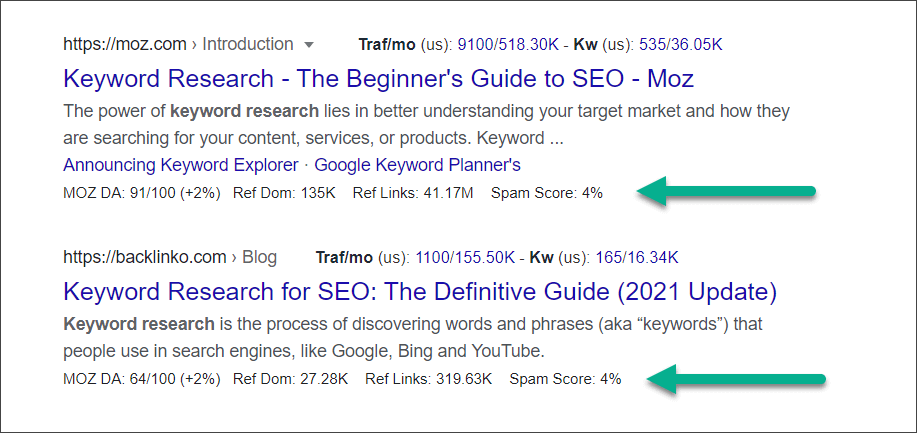
Here is what each metric tells you.
| Metric | What it tells you |
|---|---|
| Domain Authority (DA) | Moz's 0 to 100 prediction of how strongly the whole domain can rank. The number beside it is the change over the last 12 months, handy for spotting domains that have gained or lost links fast. |
| Referring Domains (Ref Dom) | How many separate websites link to the domain at least once. One site can send many links, so this is usually the more meaningful number. |
| Referring Links (Ref Links) | The total number of backlinks pointing to the domain, counting every link rather than every site. |
| Spam Score | Moz's estimate, shown as a percentage, of how risky the domain's link profile looks. A flag to investigate, not proof of spam. |
| Link Propensity | How likely the domain is to link out to other sites. A higher figure is useful when you are looking for sites to approach for backlinks. Shown in the hover popup. |
| Total Backlinks | The full backlink count for the domain. The SERP line shows a rounded figure; the popup shows the exact number. |
The popup and DA trend chart
Move your mouse over the metrics and a larger popup opens with the full set of numbers for that domain, plus a chart.
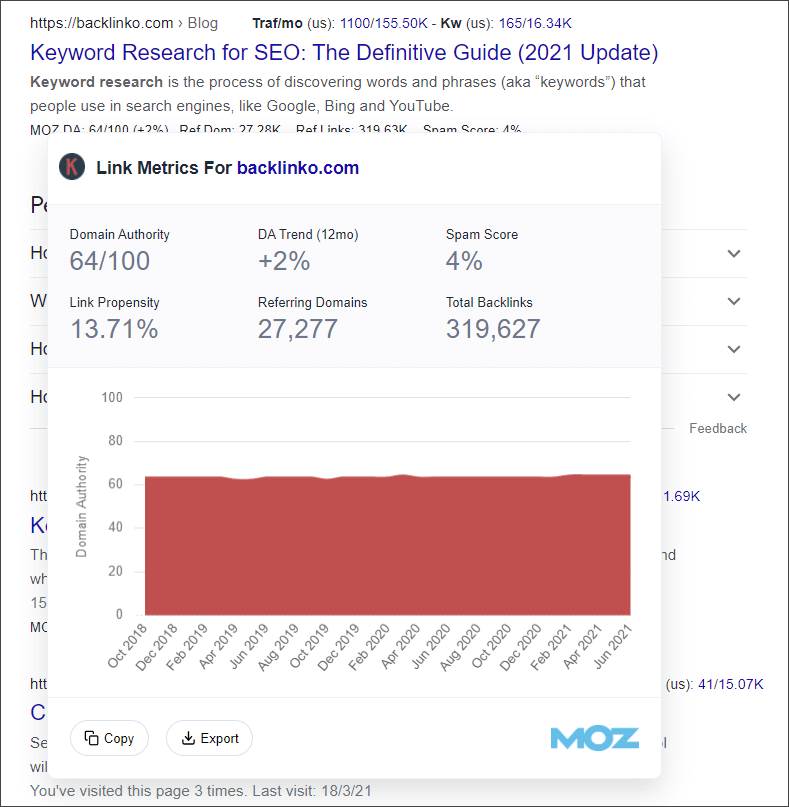
The chart is the DA trend chart. It plots the domain's Domain Authority over the last few years, so you can see at a glance whether its authority is climbing, flat or sliding, useful context that a single number cannot give you.
You can also Copy or Export the data straight from the popup.
See the backlinks behind the numbers
Next to the link metrics there is a Show Backlinks link.
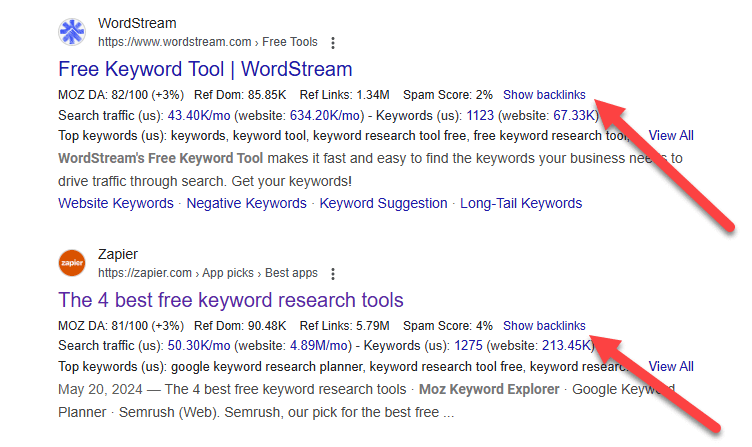
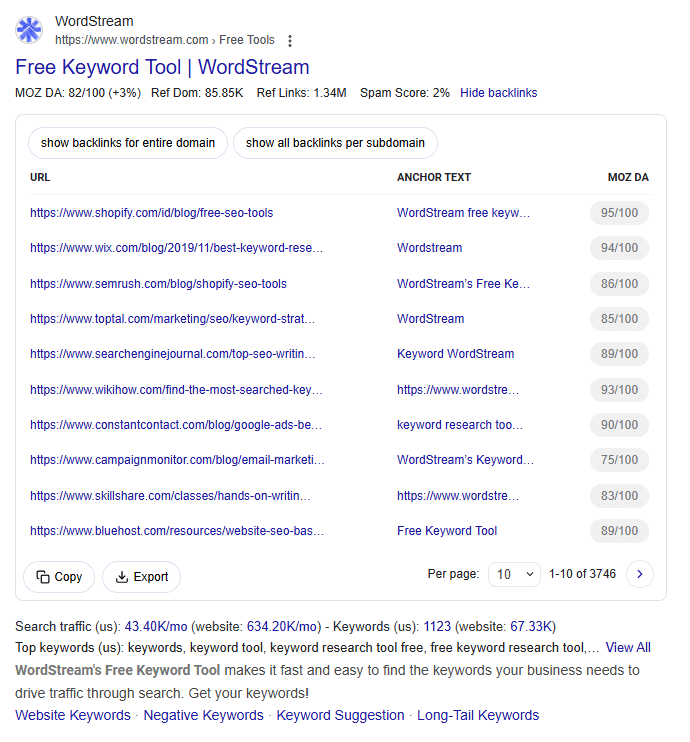
Click it to open a panel listing up to the top 10,000 backlinks for that URL, sorted by authority. For each one you see the source URL, the anchor text and the Domain Authority of the linking page.
By default the panel shows one backlink per source domain. Click show all backlinks per subdomain to see every link from each site, or show backlinks for entire domain to pull the links pointing at every page on the website, not just the one URL.
For a full workflow built around this data, see the free backlink checker.
Want to check a single site's Domain Authority without installing anything? Our free Domain Authority Checker looks up the Moz DA for any domain right in your browser.
How to read the numbers
The metrics are a quick way to judge how hard a result will be to outrank. A few things are worth keeping in mind so you read them correctly.
Domain Authority and Spam Score are Moz's predictions, not Google's. Google does not use Domain Authority to rank pages. Moz built it as a yardstick to estimate ranking strength, so treat it as a comparison tool, not a target to chase.
DA is logarithmic and relative. Pushing a score from 20 to 30 is far easier than from 70 to 80, and a number only means something next to the other results on the same search. Compare competitors on one SERP rather than aiming for an absolute figure.
Referring domains usually beats raw link count. One hundred links from one hundred different sites is worth far more than one hundred links from a single site, so weigh referring domains more heavily than total backlinks.
To turn these signals into a single difficulty number for a keyword, see how we combine Moz Domain Authority with on-page and off-page factors on the SEO Difficulty metrics page.
Why your link counts differ between tools
If Moz shows fewer links than Ahrefs, SEOprofiler or your own records, that is expected, not a fault.
Every link tool runs its own crawler and its own index, and none has crawled the entire web. So the counts never match exactly, and a link that appears in one tool can be missing from another. Moz also refreshes its index on a schedule, so brand-new links take time to show up.
Two things to know about what Keywords Everywhere shows. It lists up to the top 10,000 backlinks per URL, so very large profiles are capped, use Moz directly for the complete set. And it collapses to one backlink per source domain unless you click "show all backlinks per subdomain", which is why a domain with many links can look like a single result at first.
In short, Keywords Everywhere surfaces Moz's data as it is. It cannot show links that Moz has not indexed.